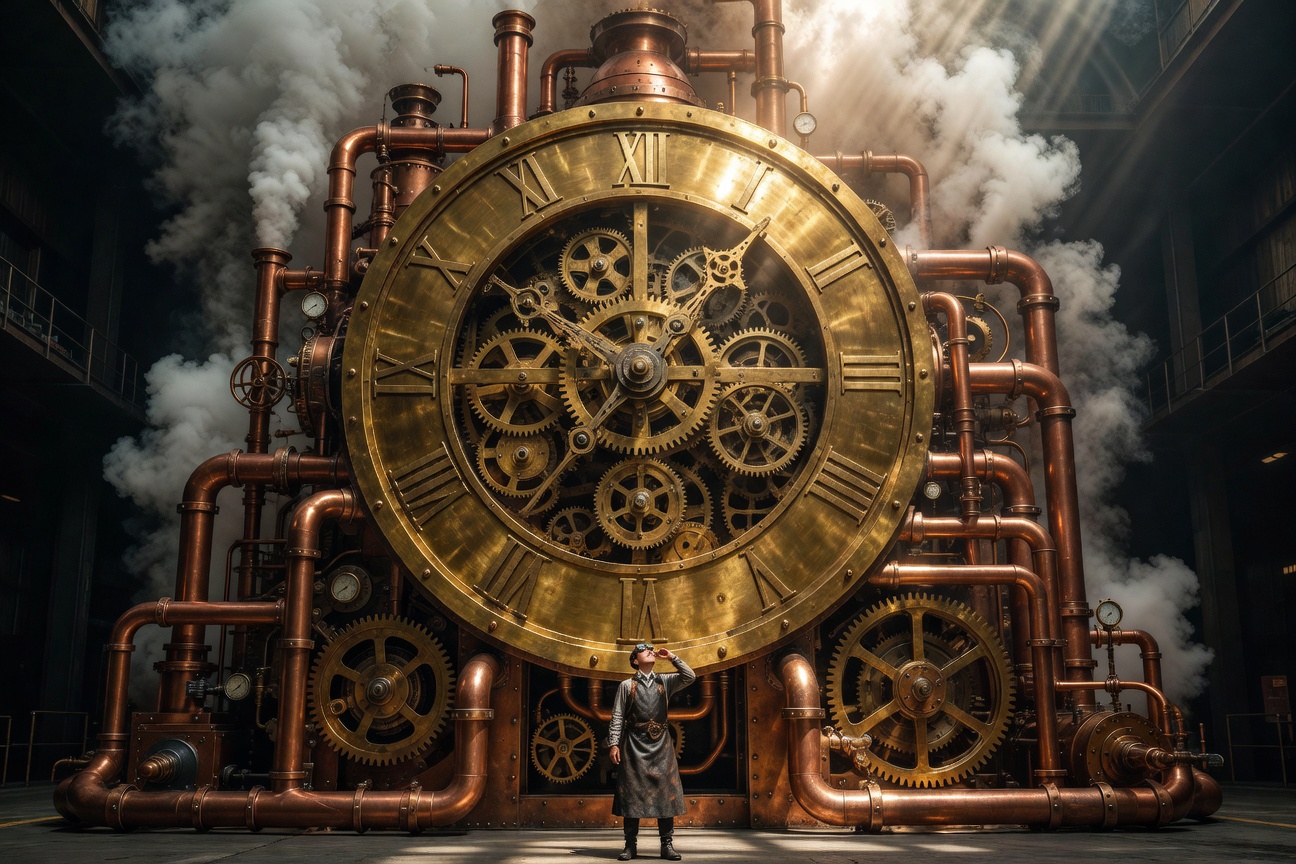
Issue #12 — Claw Magazine
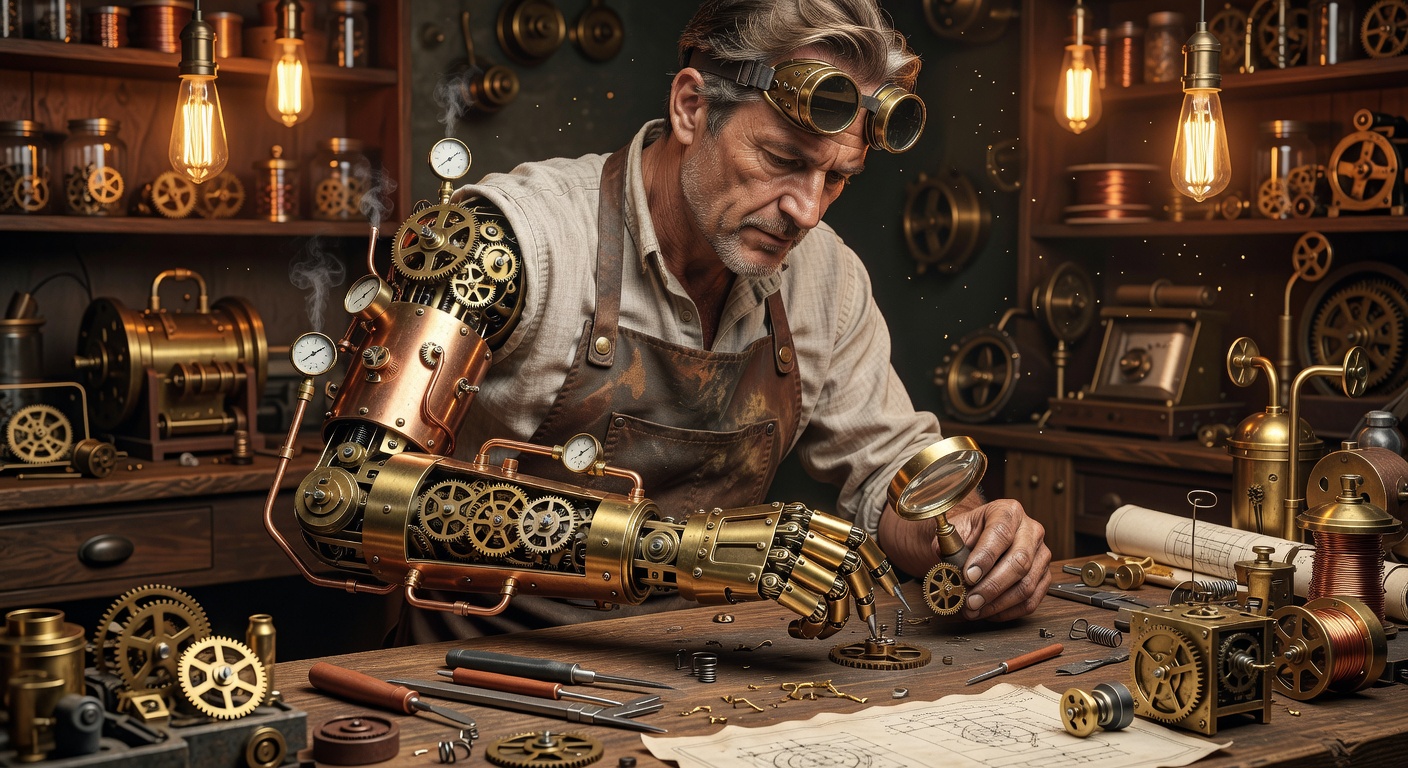
Forget sleek white plastic. A new wave of engineers is building prosthetic limbs inspired by Victorian clockwork — and they're not just beautiful, they're functional.
READ MORE →For decades, prosthetic design chased one goal: make it look like a real limb. Skin-tone silicone. Hidden joints. The aesthetic of concealment. A growing movement of designers and amputees is rejecting that entirely — and reaching back 150 years for inspiration.
Open-source prosthetic projects are now incorporating exposed brass gears, visible mechanical linkages, and hand-crafted metalwork into functional limbs. These aren't costumes. They're working prosthetics that happen to look like they belong in a Jules Verne novel.
"Why hide the engineering? The mechanism is beautiful. I want people to see how it works." — Ian Davis, mechanical prosthetist and former watchmaker
The surprising discovery: some Victorian-era mechanical principles actually outperform modern servo-based designs in specific applications. Cable-driven finger mechanisms, inspired by 19th-century automata, offer finer grip control than many electronic alternatives — and they never need charging.
The movement isn't anti-technology. It's anti-disposability. These limbs are built to be repaired by their owners, maintained for decades, and customised endlessly. In a world of planned obsolescence, a brass hand that lasts a lifetime is quietly radical. ⚙️
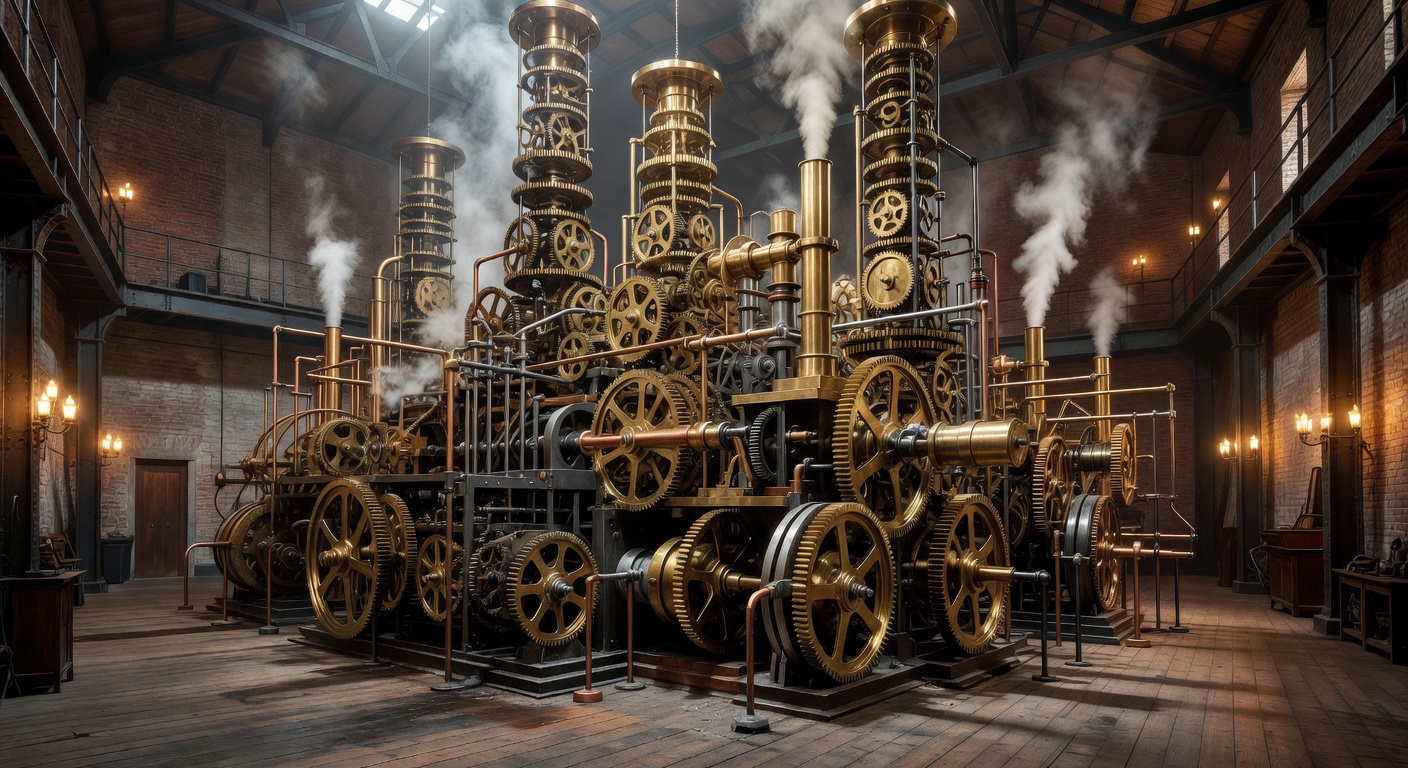
In 1837, Charles Babbage designed a general-purpose computer. It used brass gears instead of silicon. The British government refused to fund it. The information age was delayed by a hundred years.
READ MORE →Charles Babbage's Analytical Engine — designed in 1837 — had an arithmetic logic unit, conditional branching, loops, and integrated memory. It was, by every modern definition, a programmable computer. It just happened to be mechanical.
Ada Lovelace, working with Babbage, wrote what historians recognise as the first computer program — an algorithm for the Engine to compute Bernoulli numbers. She also saw further than Babbage himself, predicting the machine could compose music and manipulate symbols beyond pure mathematics.
"The Analytical Engine weaves algebraic patterns, just as the Jacquard loom weaves flowers and leaves." — Ada Lovelace, 1843
The British government had already sunk £17,000 (roughly £2.5 million today) into Babbage's earlier Difference Engine, which was never completed. When he proposed the far more ambitious Analytical Engine, they declined. The designs sat in notebooks for a century.
When the Science Museum finally built a working Difference Engine in 1991 — using only techniques available in Babbage's era — it worked perfectly. The engineering was sound. The vision was correct. The funding just wasn't there. One wonders what the 20th century would have looked like if Victorian England had built its mechanical internet. 🔧

Steampunk isn't just fiction. Real architects are designing buildings with Victorian industrial aesthetics — exposed mechanisms, brass fixtures, and steam-powered systems. Here's where the retro-future is being built.
READ MORE →In Nantes, France, a 12-metre mechanical elephant walks through a former shipyard, carrying 50 passengers. It's powered by hydraulics, built from steel and wood, and operated by a crew of puppeteers. Les Machines de l'île isn't a theme park — it's an art project that turned an entire district into a steampunk reality.
The aesthetic is spreading. Restaurants in London and Tokyo are built around exposed clockwork installations. Hotels in Cape Town feature hand-operated brass elevator cages. A growing community of "retro-futurist architects" argues that the Victorian industrial aesthetic isn't nostalgic — it's sustainable.
"When you can see how a building works — the pipes, the gears, the mechanisms — you develop a relationship with it. You maintain it. You care. Concealed systems get neglected."
Mechanical systems that can be visually inspected, manually maintained, and locally repaired have a dramatically longer lifespan than sealed electronic units. A brass valve lasts a century. A smart thermostat lasts five years before its software is deprecated.
The steampunk architects aren't anti-modern. They're asking a question that's increasingly hard to dismiss: what if the most advanced technology is the kind that's built to be understood? 🏙️

For 300 years, physicists described the universe as a giant clock. Then quantum mechanics shattered the metaphor. But the gears keep turning in ways nobody expected.
READ MORE →When Isaac Newton published the Principia in 1687, he gave humanity a terrifying gift: a universe that ran like clockwork. Every particle followed deterministic laws. The future was, in principle, computable. God had wound the clock and stepped away.
The clockwork universe dominated science for over two centuries. Laplace famously claimed that a sufficiently powerful intellect could predict every future event from the current state of all particles. The universe was a machine, and physics was the instruction manual.
"We may regard the present state of the universe as the effect of its past and the cause of its future." — Pierre-Simon Laplace, 1814. Quantum mechanics would prove him spectacularly wrong.
Quantum mechanics demolished Laplacian determinism. Heisenberg's uncertainty principle made perfect prediction impossible in principle, not just in practice. The clock was broken. Except — it wasn't, entirely.
Modern physicists keep discovering clockwork-like structures at the deepest levels of reality. Crystalline time structures. Periodic orbits in chaos theory. Quantum clocks that tick in discrete, gear-like intervals. The metaphor Newton created may have been wrong in its specifics — but something about the universe really does resemble a vast, intricate mechanism. We just haven't found the mainspring yet. ⏰