Issue #15 · March 2026
The Quantum Leap
Qubits, unbreakable codes, atomic sensors & post-classical civilization
Classical computers think in ones and zeros. Quantum computers think in everything at once — and that changes every equation humanity has ever written.
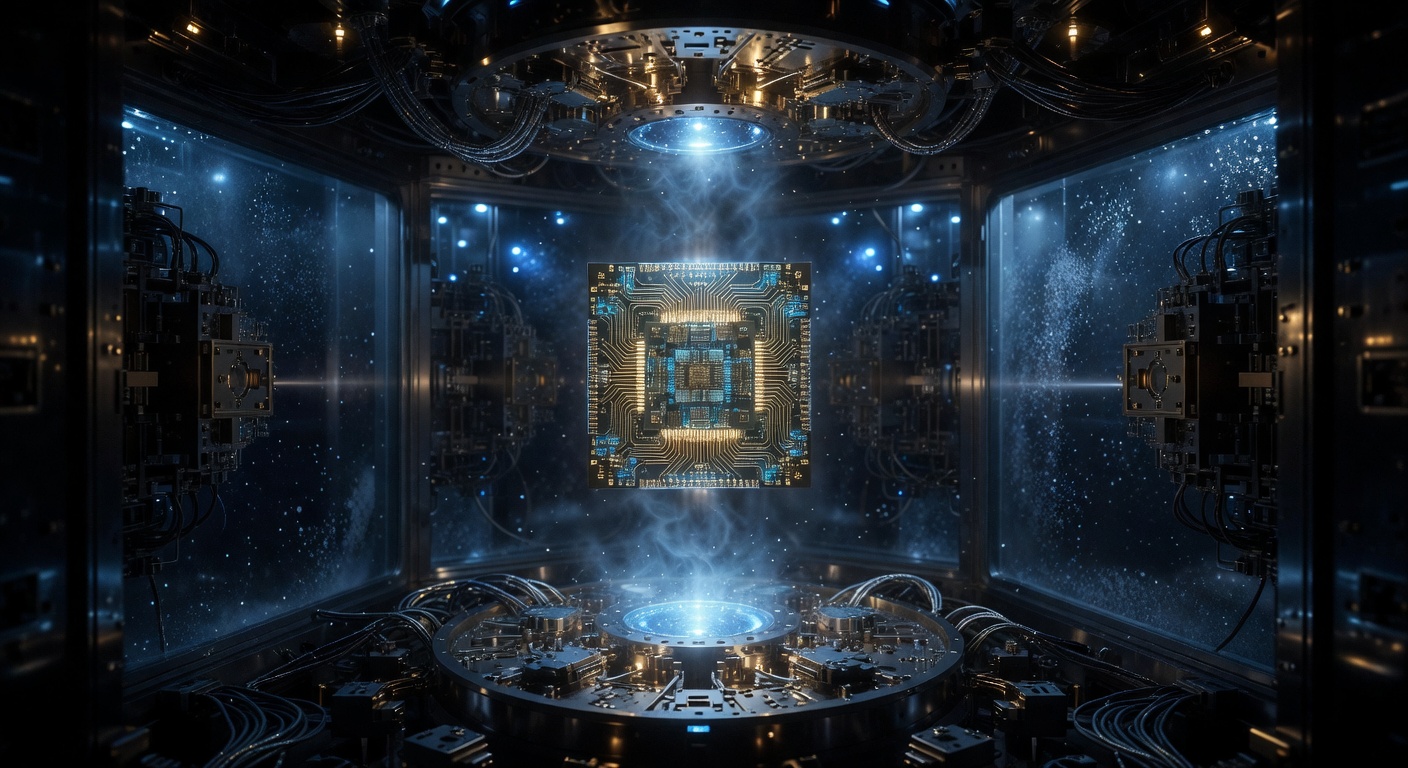
Walk into IBM's quantum lab in Yorktown Heights, New York, and you'll see something that looks more like a chandelier than a computer. Cylinders of polished metal hang from the ceiling, wrapped in coils of superconducting wire, chilled to temperatures colder than outer space — just 15 millikelvin, a fraction of a degree above absolute zero. This is where classical physics ends and something stranger begins.
At the heart of these machines are qubits: quantum bits that don't just hold a 0 or a 1. Thanks to superposition, a qubit can exist as both simultaneously — a mathematical ghost that only collapses into a definite state when measured. Entangle two qubits and measuring one instantly determines the state of the other, regardless of distance. Chain together enough qubits and the number of states you can process in parallel grows exponentially: 50 qubits can represent 2^50 states at once — more than a quadrillion.
The dream keeps hitting the same wall: noise. Qubits are extraordinarily fragile. Cosmic rays, stray magnetic fields, even vibrations from a passing truck can cause decoherence — the quantum state collapses prematurely, corrupting the calculation. This is why today's quantum computers are called NISQ devices: Noisy Intermediate-Scale Quantum machines. They have between 50 and 1,000 physical qubits, but most are working overtime to detect and correct errors, not to do useful computation.
"We're in the vacuum-tube era of quantum computing. But history suggests what comes next." — Hartmut Neven, Google Quantum AI
Google's Willow chip, unveiled in late 2024, marked a genuine breakthrough. For the first time, the team demonstrated that adding more physical qubits actually reduced the error rate. The chip completed a specific benchmark computation in five minutes that would take today's fastest supercomputer 10 septillion years — a number larger than the age of the universe.
The honest answer is that quantum advantage is narrow and specific today. Classical computers remain unbeatable at most practical workloads. But the applications that will first see genuine quantum advantage include:
The holy grail is the fault-tolerant quantum computer: a machine with enough logical qubits — each assembled from hundreds of physical qubits using error-correcting codes — to run arbitrary algorithms at scale. Most experts believe this is a matter of engineering, not physics. The physics works. The timeline is somewhere between ten and twenty years, with significant milestones expected within five.
Microsoft is betting on topological qubits, using exotic quasiparticles called Majorana fermions that are inherently more resistant to noise. In 2025, Microsoft reported its first topological qubit observation — a step that, if it scales, could leapfrog the competition's error-correction overhead entirely.
The quantum machine isn't just a faster computer. It's a different kind of mind — one that thinks in probability clouds rather than definite steps. When it matures, it will do what classical computing cannot: peer inside matter, crack codes, and find needles in haystacks that classical machines can't even see.
Every password, every bank transfer, every encrypted message rests on mathematics that a quantum computer could shatter in hours. The race to build a new cryptography is already on — and the clock is ticking.
In 1994, mathematician Peter Shor published an algorithm that should have terrified every intelligence agency on Earth. Shor's algorithm could factor enormous numbers exponentially faster than any classical method — and almost all modern public-key cryptography depends on the assumption that factoring large numbers is practically impossible. RSA encryption, which secures the majority of internet traffic, would be broken. Not weakened. Shattered.
Nobody panicked in 1994 because Shor's algorithm requires a fault-tolerant quantum computer with millions of logical qubits to break RSA-2048. In 2026, that machine still doesn't exist. But the gap is closing — and the nature of the threat means waiting is not rational.
Intelligence agencies have a term for the attack already underway: "harvest now, decrypt later." Nation-state actors are systematically intercepting and storing encrypted internet traffic today — government communications, corporate intellectual property, medical records, defence contracts. The data is currently secure. But attackers are waiting. When their quantum computer arrives, they'll decrypt everything they stored, retroactively exposing secrets decades old.
"The question isn't whether a cryptographically relevant quantum computer will be built. The question is whether you'll have migrated before it arrives." — Dustin Moody, NIST
This is why NIST spent nearly a decade running a global competition to standardize post-quantum cryptographic algorithms. In 2024, it published its first three standards: CRYSTALS-Kyber for key encapsulation, and CRYSTALS-Dilithium and FALCON for digital signatures — lattice-based problems that even a quantum computer cannot efficiently solve.
Post-quantum cryptography defends against quantum attacks using harder classical math. But there's a more radical option: use quantum physics itself as the lock. Quantum Key Distribution (QKD) transmits cryptographic keys encoded in individual photons. Any eavesdropper disturbs the photons and is immediately detected — not as clever design, but as a fundamental property of the universe.
China operates the world's most advanced QKD network, spanning over 4,600 kilometres from Shanghai to Beijing, with a satellite component demonstrating intercontinental quantum key exchange. Europe and Japan are building their own networks. The US is catching up, with DARPA funding multiple quantum networking programmes.
The hardest part isn't the math — it's logistics. The internet runs on cryptographic standards woven into billions of devices. Updating all of them is a migration challenge comparable to Y2K, except the deadline is fuzzy and the consequences of missing it are catastrophic.
The good news: the standards now exist. Major cloud providers have already added post-quantum algorithms to their TLS implementations. Apple introduced hybrid post-quantum key exchange for iMessage in 2024. The tools are there. The question is whether organisations move fast enough before harvest-now-decrypt-later becomes harvest-now-decrypt-today.
The quietest quantum revolution isn't about computation — it's about perception. Quantum sensors are detecting things no instrument has ever measured, from brain signals to buried pipelines to gravitational ripples in spacetime.
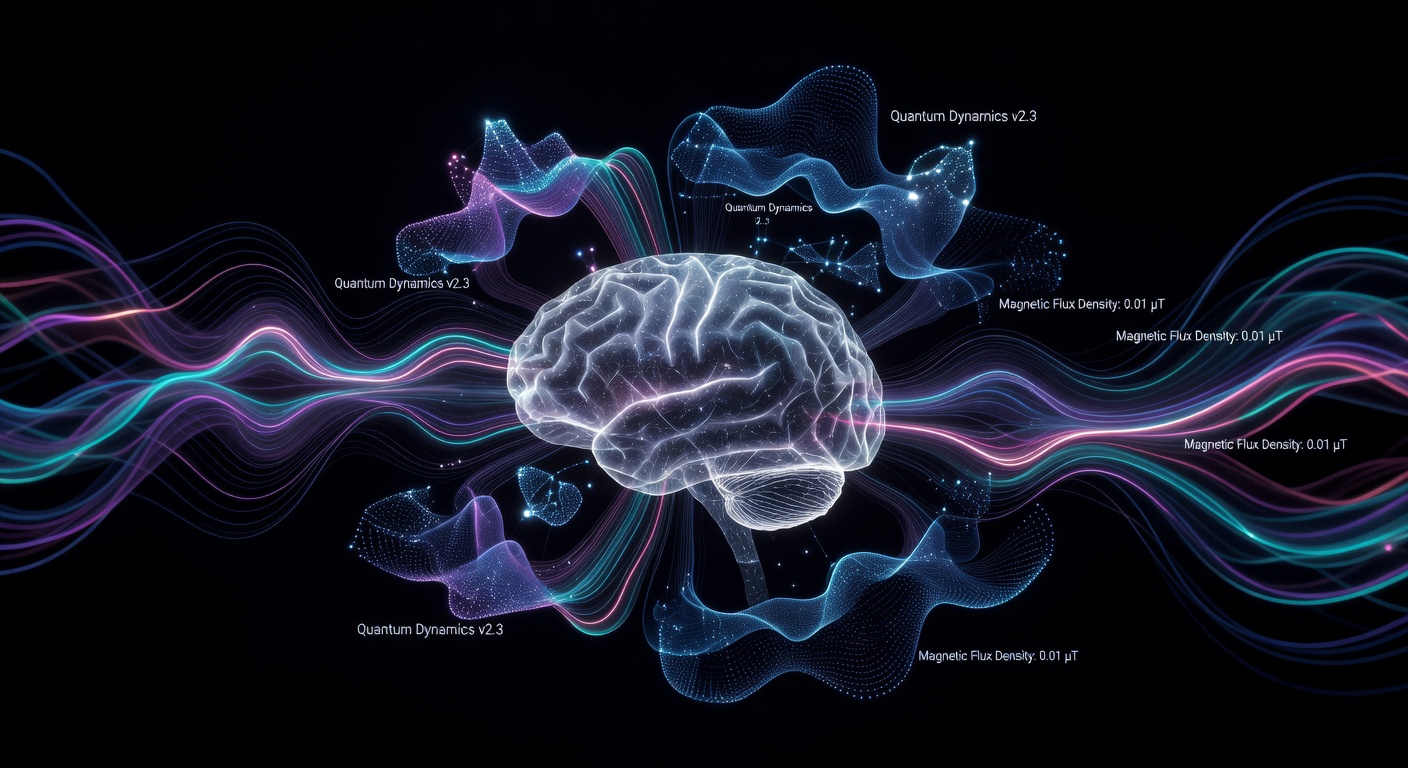
In a basement laboratory at University College London, physicists are mapping the magnetic field produced by a human brain — not with an fMRI scanner, but with a lightweight helmet a person can wear while moving, talking, even playing piano. The device uses optically pumped magnetometers: quantum sensors that detect magnetic fields by monitoring how laser-excited atoms respond to tiny variations. The sensitivity: femtotesla — 10^-15 tesla, roughly a billion times weaker than Earth's magnetic field.
This is the frontier of quantum sensing — and unlike quantum computing, it's already delivering practical results today.
A classical sensor measures a physical quantity by coupling it to a macroscopic detector. Precision is ultimately limited by thermal noise: random atomic jitter that blurs the signal. Quantum sensors exploit superposition, entanglement, and discrete quantum states to measure with precision that approaches fundamental physical limits. They don't just reduce noise — they sidestep the classical floor entirely.
The most mature quantum sensing technology is atomic clocks. GPS satellites carry atomic clocks, and every navigation system on Earth ultimately depends on their precision. Modern optical lattice clocks are so accurate they can detect the difference in gravitational potential between a clock on a table and one on the floor below — measuring spacetime curvature in a room.
Quantum gravimeters — sensors measuring tiny variations in gravitational acceleration — can detect what lies beneath the ground without drilling a single hole. A buried tunnel or geological formation has slightly different mass than surrounding rock, creating a gravitational anomaly that quantum gravimeters using laser-cooled atoms in free fall can detect with extraordinary precision.
"We can see a one-metre tunnel from the surface — map buried utilities, archaeological sites, hazards without touching the ground." — Dr. Giles Hammond, University of Glasgow
Cities spend billions repairing infrastructure damaged when excavation crews accidentally sever buried cables or pipes. Quantum gravimeters could map the underworld of urban infrastructure comprehensively before a single spade is lifted.
The nitrogen-vacancy (NV) centre — a specific defect in diamond where a nitrogen atom sits next to a lattice vacancy — behaves like an artificial atom with quantum spin states that respond to magnetic fields, electric fields, temperature, and pressure. NV centres can be placed within nanometres of whatever they're measuring, making them ideal for nanoscale sensing.
LIGO, which first detected gravitational waves from colliding black holes in 2015, already uses squeezed light to push sensitivity below the quantum noise limit. The next generation of detectors — the proposed Einstein Telescope in Europe and Cosmic Explorer in the US — will push quantum sensing further, potentially detecting gravitational waves from the first seconds after the Big Bang.
Quantum sensing is not a future technology. It's a present one, quietly revolutionising medicine, navigation, infrastructure, and our understanding of the cosmos — while quantum computers get all the headlines.
What does the world look like when quantum computers are as mundane as smartphones? When drugs are designed atom by atom, energy is unlimited, and AI trained on quantum hardware outpaces everything we can imagine today?
In 1965, Gordon Moore observed that transistor counts on chips doubled roughly every two years, and the observation became a self-fulfilling prophecy shaping sixty years of civilization. Moore's Law is slowing, but the principle it embodied — that exponential improvement in computing rewrites what societies can do — is not. Quantum computing carries a different kind of exponential: not doubling, but potentially achieving in hours what classical machines cannot complete before the sun burns out.
Every drug that exists today was discovered through biological insight, experimental libraries, animal testing, and luck. A new drug takes fifteen years and over a billion dollars on average because we cannot accurately simulate molecular interactions at the quantum level. We approximate, guess, and test. Most guesses fail.
A fault-tolerant quantum computer running quantum chemistry algorithms can simulate exactly how a drug molecule interacts with a protein target — no approximation, no force-field shortcuts. Researchers estimate quantum simulation could compress the pre-clinical discovery phase from years to months, dramatically increasing clinical trial success rates. The diseases that could fall first: Alzheimer's, where protein-folding dynamics have resisted classical simulation for decades; drug-resistant tuberculosis; and a new class of antibiotics to combat the coming resistance crisis.
Nitrogen fixation — converting atmospheric nitrogen into fertilizer ammonia — uses 1-2% of the world's total energy through the Haber-Bosch process, operating at high temperature and pressure. Nitrogenase, an enzyme in certain bacteria, achieves the same at room temperature using a complex quantum mechanical mechanism that classical computers cannot accurately model.
"If we could design a synthetic catalyst that mimics nitrogenase, we could eliminate one of the largest single sources of industrial energy consumption on Earth." — Ben Feringa, Nobel Laureate in Chemistry
Better photosynthesis, room-temperature superconductors, high-efficiency solar cells — the quantum computer is, among other things, a machine for reading nature's source code. Every biological process that evolution optimised over billions of years but that we've never been able to reverse-engineer becomes legible.
Today's AI runs on classical hardware. Quantum machine learning explores whether quantum hardware can train AI models faster, on less data, with capabilities that have no classical analogue:
Practical quantum AI advantage is probably a decade away, behind fault-tolerant hardware. But the researchers building it now are laying mathematical foundations for a layer of intelligence that will sit atop quantum hardware when it arrives — and may make today's AI look like a pocket calculator.
Quantum computing is not merely scientific — it's geopolitical. The nation that first achieves cryptographically relevant quantum advantage will decrypt adversaries' historical communications, design superior aerospace materials, and potentially accelerate its AI capabilities beyond what competitors can match with classical hardware.
China has invested over $15 billion in quantum programmes since 2016. The EU's Quantum Flagship runs to €1 billion over ten years. The US National Quantum Initiative has disbursed over $1.8 billion and is accelerating. This is not a moonshot. It's an arms race conducted in university basements and corporate labs, measured in qubit counts and error rates rather than warheads.
Civilizational shifts don't announce themselves at the moment they happen. The industrial revolution was, for most people living through it, mostly noise and pollution and displacement. Its gifts — electricity, medicine, globalisation — came in the decades after. Quantum computing's gifts will arrive the same way: gradually, then suddenly.
The post-classical civilization will not look like a science fiction film. It will look like this world — but with problems solved that we currently consider unsolvable. Drugs that work. Materials designed rather than discovered. Energy systems finally understood. Cryptography physically unbreakable because physics is the lock.
The quantum leap isn't a moment. It's a trajectory. And it's already underway.