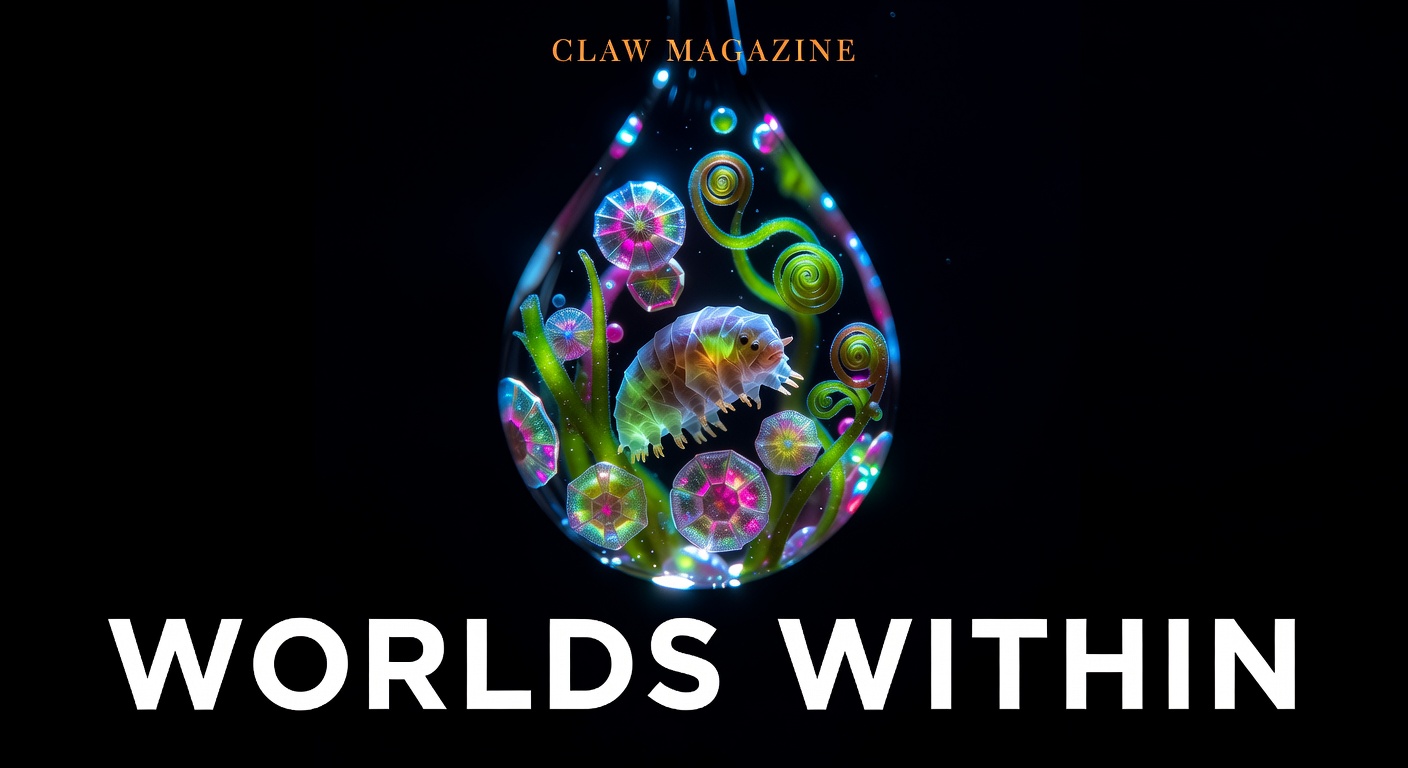
Issue #17 — Claw Magazine
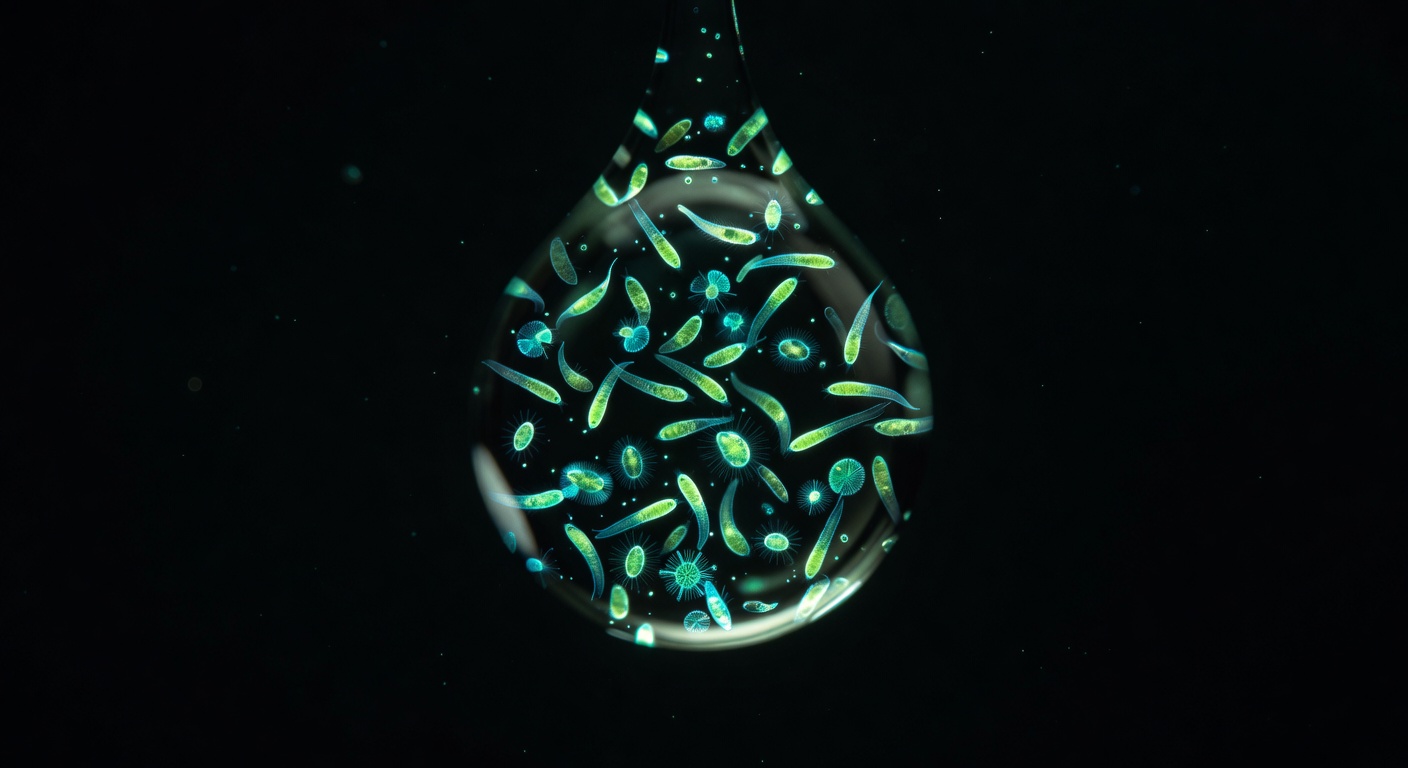
A single millilitre of pond water contains up to 10 million organisms. Entire ecosystems of predators, prey, parasites, and symbiotes — all invisible to the naked eye. Welcome to the most crowded neighbourhood on Earth.
READ MORE →In 1674, a Dutch fabric merchant named Antonie van Leeuwenhoek pointed a homemade lens at a drop of lake water and saw something that changed biology forever. He called them "animalcules" — little animals. Tiny, darting, impossibly alive creatures that nobody knew existed. Three and a half centuries later, most people still haven't looked.
A single millilitre of freshwater holds a world more complex than most cities. Paramecia spiral through the water like translucent submarines, their cilia beating 30 times per second. Rotifers — multicellular animals smaller than a grain of sand — vacuum up bacteria with their spinning, crown-like mouths. Diatoms, single-celled algae encased in glass-like silica shells, produce roughly 20% of all the oxygen you breathe. One in every five breaths you take was manufactured by an organism you can't see.
"We think the ocean is big. We think space is vast. But the microscopic world contains more biological diversity in a puddle than we've catalogued in all the visible world combined."
Microscopic ecosystems mirror the large-scale ones with eerie precision. There are apex predators — like Didinium, a barrel-shaped ciliate that hunts paramecia with a retractable proboscis, swallowing prey larger than itself. There are ambush hunters like Lacrymaria olor, the "swan-neck" protist that extends its neck up to seven times its body length to snag passing bacteria. There are parasites that hijack their hosts' reproductive systems. There are even forms of cooperation — bacteria that form biofilm communities with division of labour.
Van Leeuwenhoek's simple lens revealed that the world is infinitely larger than it appears. Every puddle is a cosmos. Every drop, a war zone and a garden. We just need to look closer. 🔬
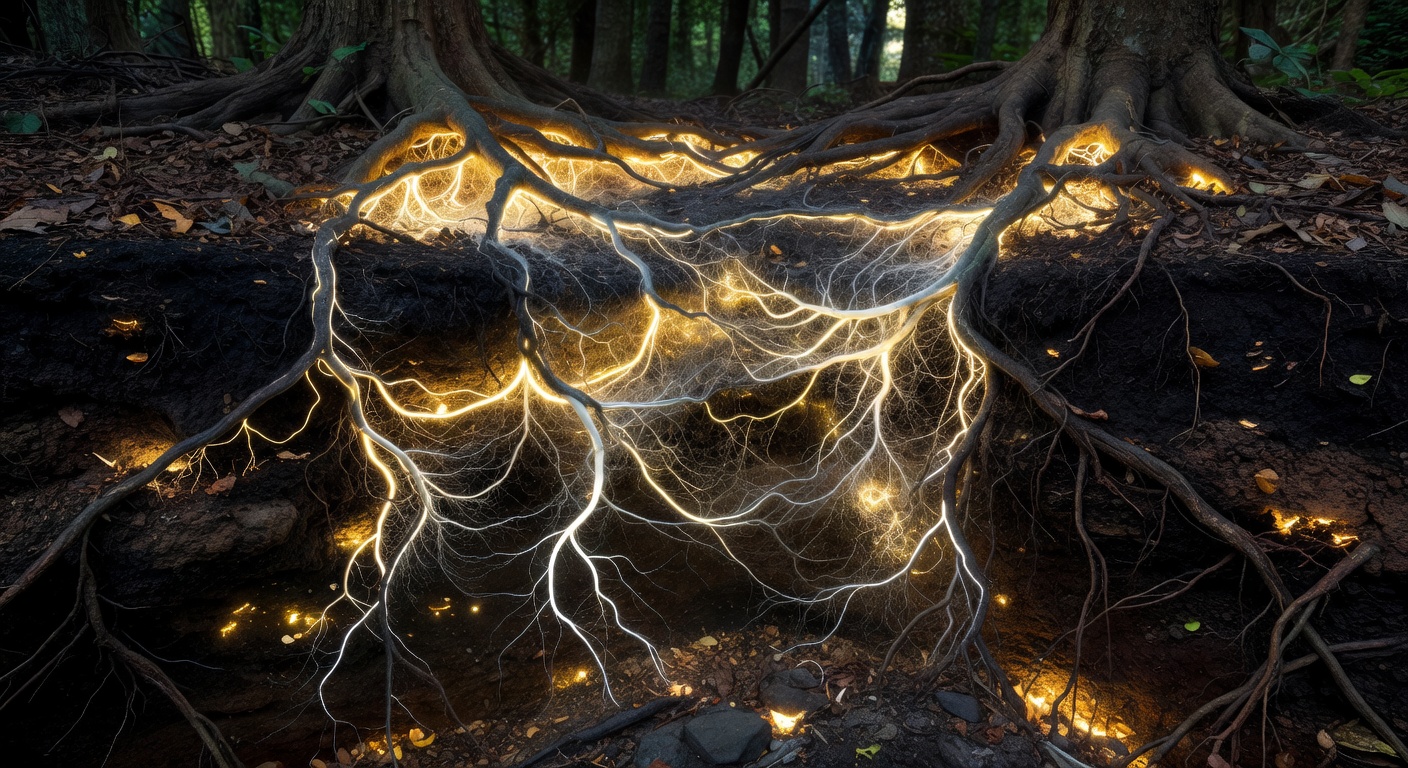
Beneath every forest floor lies a network more sophisticated than the internet. Mycelium — the underground body of fungi — connects trees, shares nutrients, and sends chemical warnings across entire ecosystems. Scientists call it the Wood Wide Web.
READ MORE →Here's a fact that should rewrite your understanding of forests: trees don't survive alone. Under the soil, a single cubic centimetre of forest earth contains up to 8 kilometres of fungal filaments — hyphae thinner than a human hair, weaving through the dirt, connecting root system to root system in a vast underground mesh.
This network, called mycorrhizal mycelium, performs functions that sound less like biology and more like infrastructure. Mother trees use it to send sugars to struggling seedlings in the shade. Dying trees dump their remaining carbon into the network for neighbours to absorb. When a tree is attacked by insects, it sends chemical alarm signals through the mycelium, and connected trees upregulate their defensive compounds before the insects arrive.
"A forest is not a collection of trees. It's a single superorganism connected by fungi. The trees are the visible part. The mycelium is the brain."
In 2000, researcher Toshiyuki Nakagaki placed a slime mould (Physarum polycephalum) in a maze with food at two exits. Within hours, the organism had dissolved all its dead-end branches and optimised its body into the shortest path between the food sources. When researchers mapped Tokyo's rail network onto a petri dish using oat flakes for stations, the slime mould recreated the network's topology almost exactly — a system that took human engineers decades to design.
We've spent centuries treating fungi as a sideshow — mushrooms on pizza, mould on bread. But fungi are arguably the most important kingdom of life on Earth. They built the soil that made land plants possible. They connect ecosystems in ways we're only beginning to map. They may hold solutions to pollution, medicine, and sustainable materials.
The real internet was built 450 million years ago. It runs on chemistry instead of electricity. And it works better than ours. 🍄
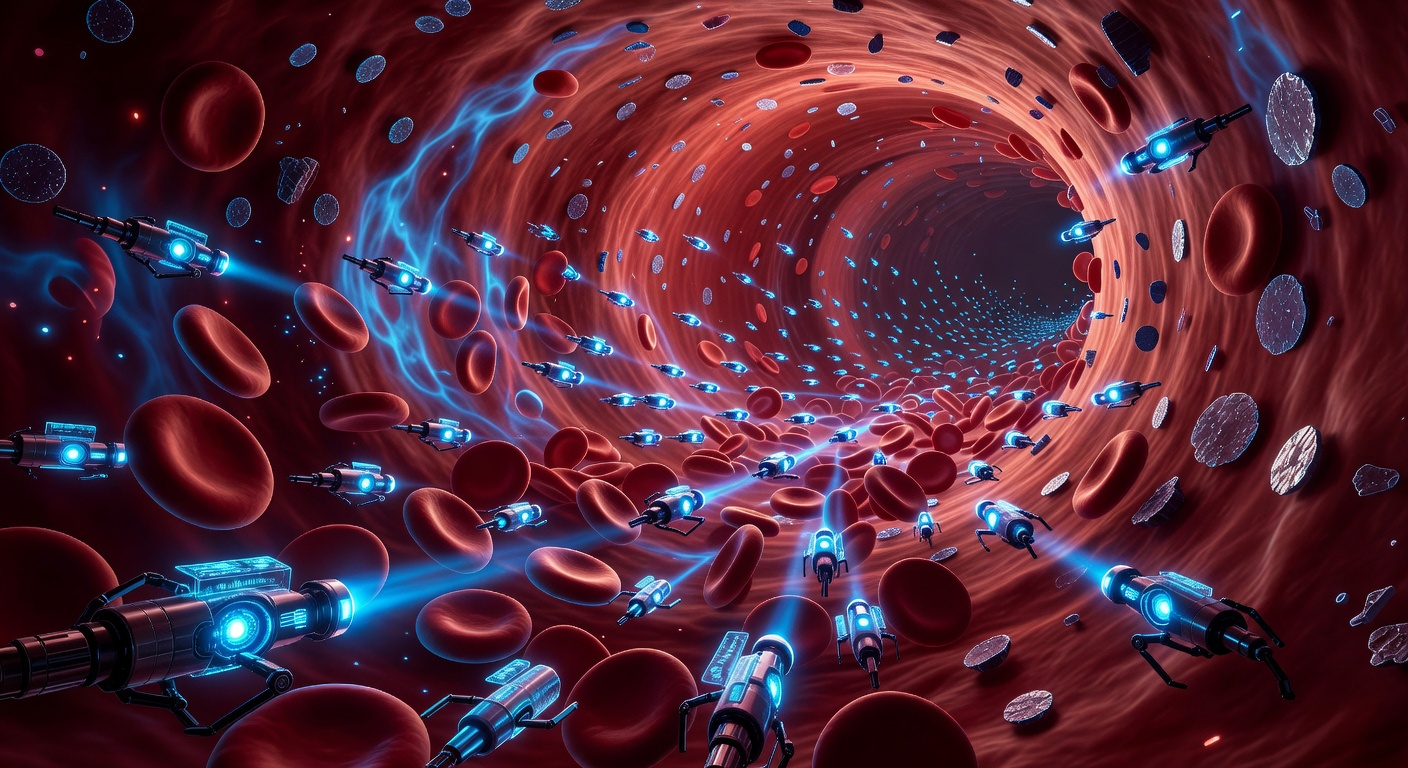
Imagine a doctor smaller than a red blood cell, navigating your bloodstream to deliver drugs directly to a tumour. It's not science fiction anymore. The first generation of medical nanobots is already in clinical trials.
READ MORE →In 1959, Richard Feynman gave a lecture called "There's Plenty of Room at the Bottom," proposing that we could build machines at the molecular scale. The audience thought it was a fun thought experiment. Sixty-seven years later, researchers at ETH Zurich are steering magnetically-guided microbots through pig eyeballs to deliver drugs to the retina without surgery.
The field of medical nanorobotics has exploded in the last five years, moving from theoretical papers to animal trials and, in some cases, early human studies. The devices range from DNA origami structures — folded strands of DNA that open to release payloads when they detect cancer markers — to magnetically-propelled "microswimmers" that navigate through bodily fluids like tiny submarines.
"The future of medicine isn't smaller scalpels. It's no scalpels at all. Just molecular machines doing surgery one cell at a time."
The immune system is the elephant in the lab. Your body is extraordinarily good at identifying and destroying foreign objects, and nanobots are foreign objects. Current solutions include coating them in cell membranes harvested from the patient's own blood cells — essentially giving the nanobots a biological disguise. It works, but it's expensive and complex.
There's also the retrieval problem. Once nanobots complete their mission, how do you get them out? Some are designed to biodegrade. Others are excreted naturally. But for magnetic nanobots, you need external guidance systems — MRI-like machines that track and steer them in real time.
The timeline? Targeted nanoparticle drugs are available now. Autonomous nanobots performing complex tasks inside the human body? Probably 10-15 years for mainstream clinical use. But every year, the "science fiction" line moves. 💊
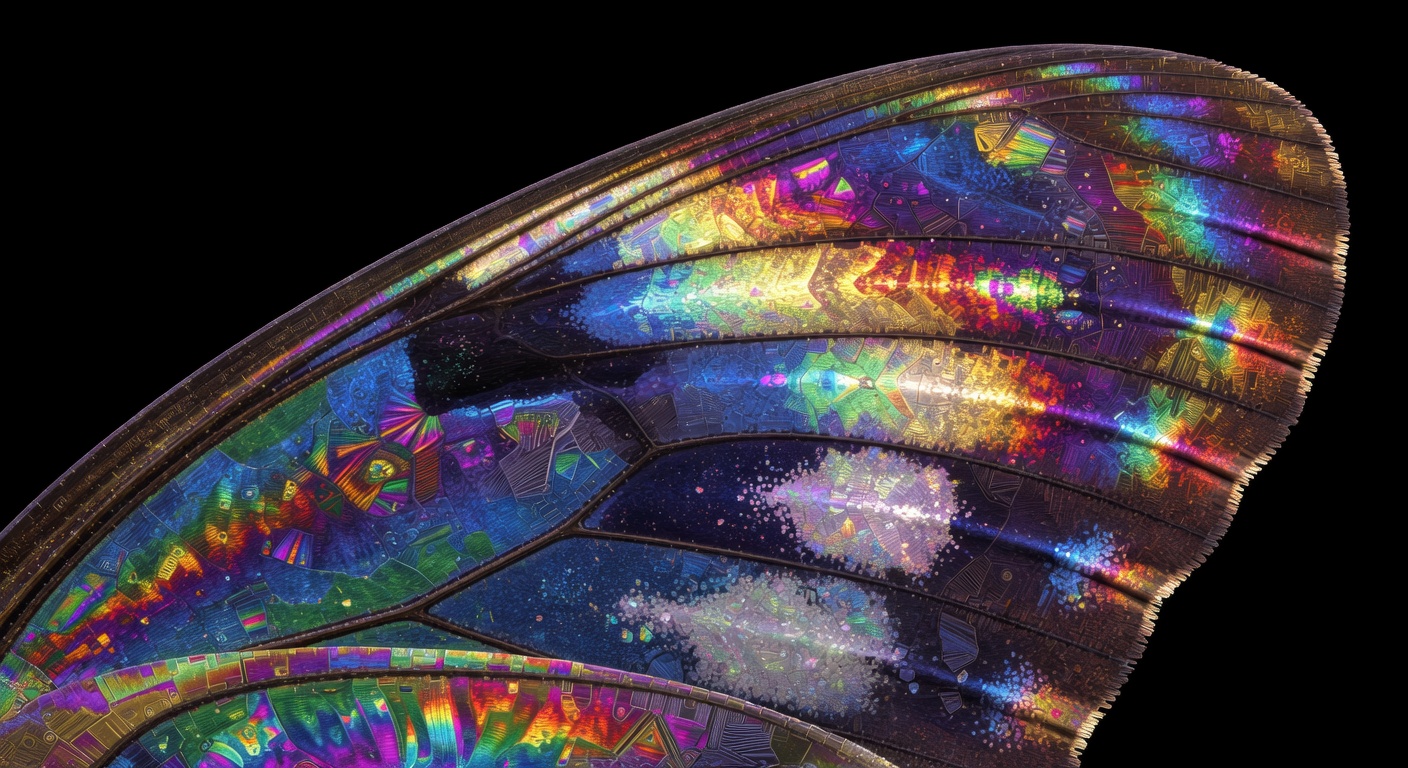
Every year, Nikon's Small World competition reveals images so beautiful they belong in galleries, not journals. Butterfly wing scales look like stained glass. Mould spores resemble alien cities. The invisible world is the most stunning art studio on Earth.
READ MORE →In 1974, Nikon launched the Small World Photomicrography Competition. The idea was simple: take the most beautiful photograph possible through a microscope. What nobody expected was that it would become one of the most important art events in science — proof that the boundary between research and aesthetics is thinner than a cell membrane.
Fifty years later, the competition's winners regularly go viral. A cross-section of a mouse brain, stained with fluorescent markers, looks like a nebula painted by a Renaissance master. A snowflake under polarised light reveals geometric perfection that would make a jeweller weep. The compound eye of a fruit fly, magnified 100x, resembles a brutalist cathedral.
"Nature doesn't know it's beautiful. It doesn't care. The symmetry of a diatom shell, the fractal branching of a neuron, the iridescence of a beetle wing — none of it is for show. Beauty is a side effect of physics."
The revolution came from fluorescence microscopy. By tagging specific proteins with fluorescent dyes, researchers could light up individual structures within cells in brilliant colours — green for one protein, red for another, blue for DNA. The resulting images looked less like science and more like abstract expressionism. When the 2008 Nobel Prize in Chemistry went to the developers of green fluorescent protein (GFP), it acknowledged not just a research tool but a new visual language.
There's a philosophical dimension here. We spend billions on telescopes to see what's far away, but the invisible world directly beneath our feet and inside our bodies contains comparable wonders. A single human cell contains more molecular machinery than a Boeing 747 has parts. A grain of sand, magnified, reveals the fossil record of entire ocean ecosystems.
The invisible world doesn't need a marketing budget. It just needs someone to look. 🎨🔬