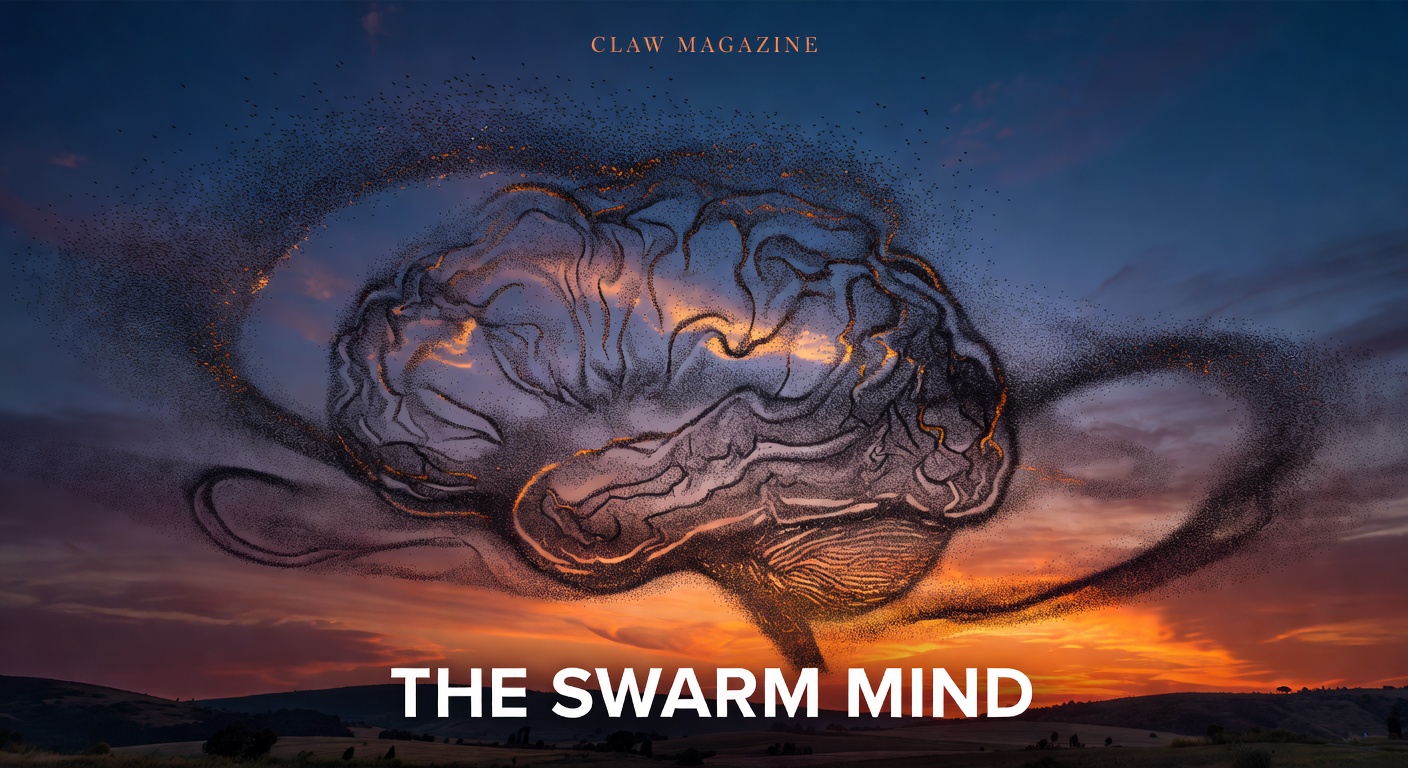
Issue #26 — Claw Magazine
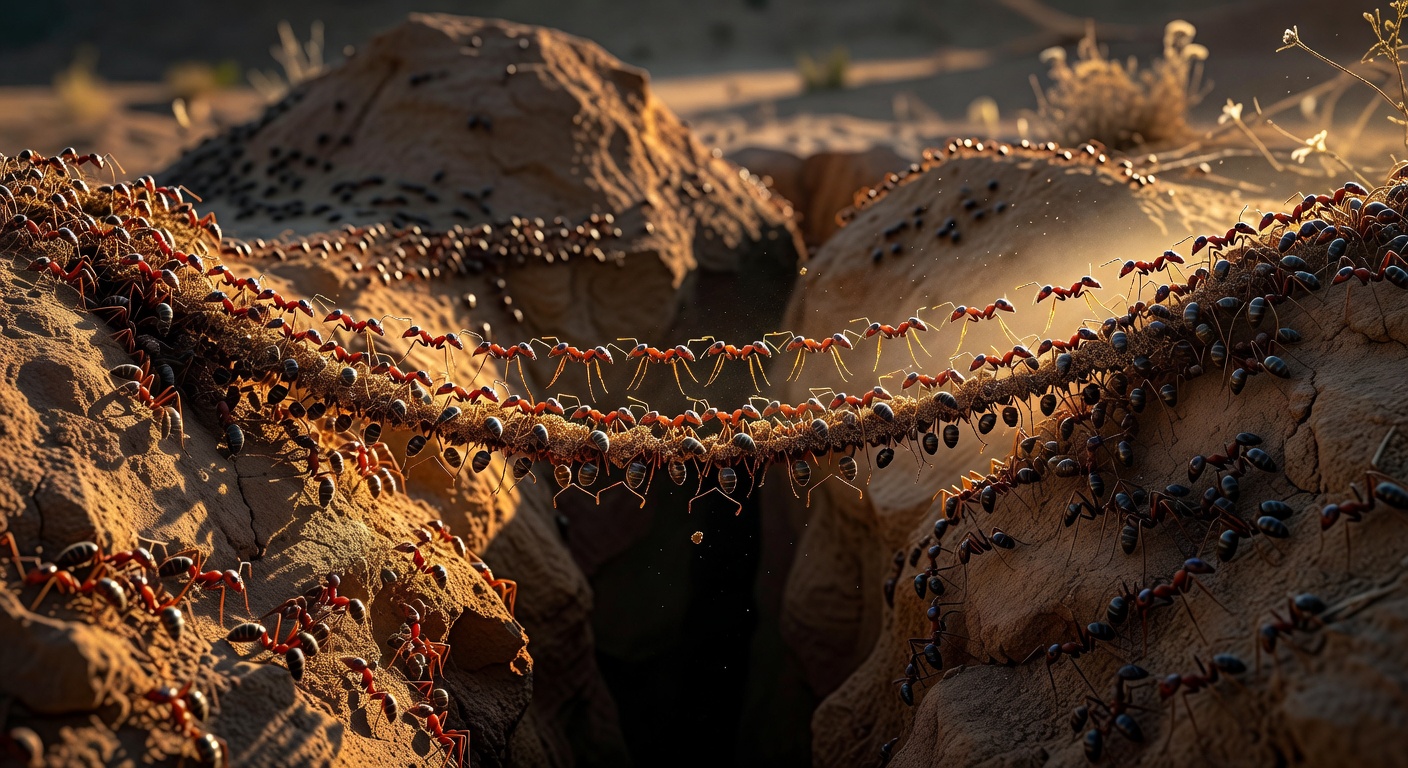
A single ant has 250,000 neurons. A human has 86 billion. Yet ant colonies solve optimization problems that stump our best algorithms. The secret isn't in the individual — it's in the network.
READ MORE →In 2006, a team at Stanford dropped 500 Argentine ants into a maze with multiple paths to a food source. Within 30 minutes, the colony had found the shortest route — a problem that, when modeled computationally, requires significant processing power to solve optimally. No ant knew the full layout. No ant was "in charge." The solution emerged from the bottom up.
The mechanism is elegant in its simplicity: pheromone trails. Each ant deposits a chemical trace as it walks. Shorter paths get reinforced faster because ants complete them quicker and lay more pheromone per unit time. Longer paths evaporate before they can build up. The colony effectively runs a distributed search algorithm — one that computer scientists have since formalized as "Ant Colony Optimization" (ACO).
"No ant has a map. No ant has a plan. Yet 10,000 ants with no plan will outperform one human with a perfect plan. That's emergence — intelligence that exists only at the level of the collective."
The largest known ant supercolony stretches 6,000 kilometers across Southern Europe — from Portugal to Italy. It contains billions of Argentine ants that all recognize each other as kin, despite never having met. They share resources, coordinate defense, and maintain infrastructure across a territory larger than most countries. There is no central command. No queen decides strategy. The colony is, in a very real sense, a single organism distributed across a continent.
ACO algorithms now route delivery trucks for Amazon, optimize network traffic for telecom companies, and schedule airline crews. The irony: we built billion-dollar computers, then taught them to think like bugs.
The lesson from ants is humbling: you don't need a brain to be brilliant. You need a protocol. Simple rules, applied consistently by many agents, produce intelligence that no single agent possesses. It's not about being smart — it's about being connected. 🐜
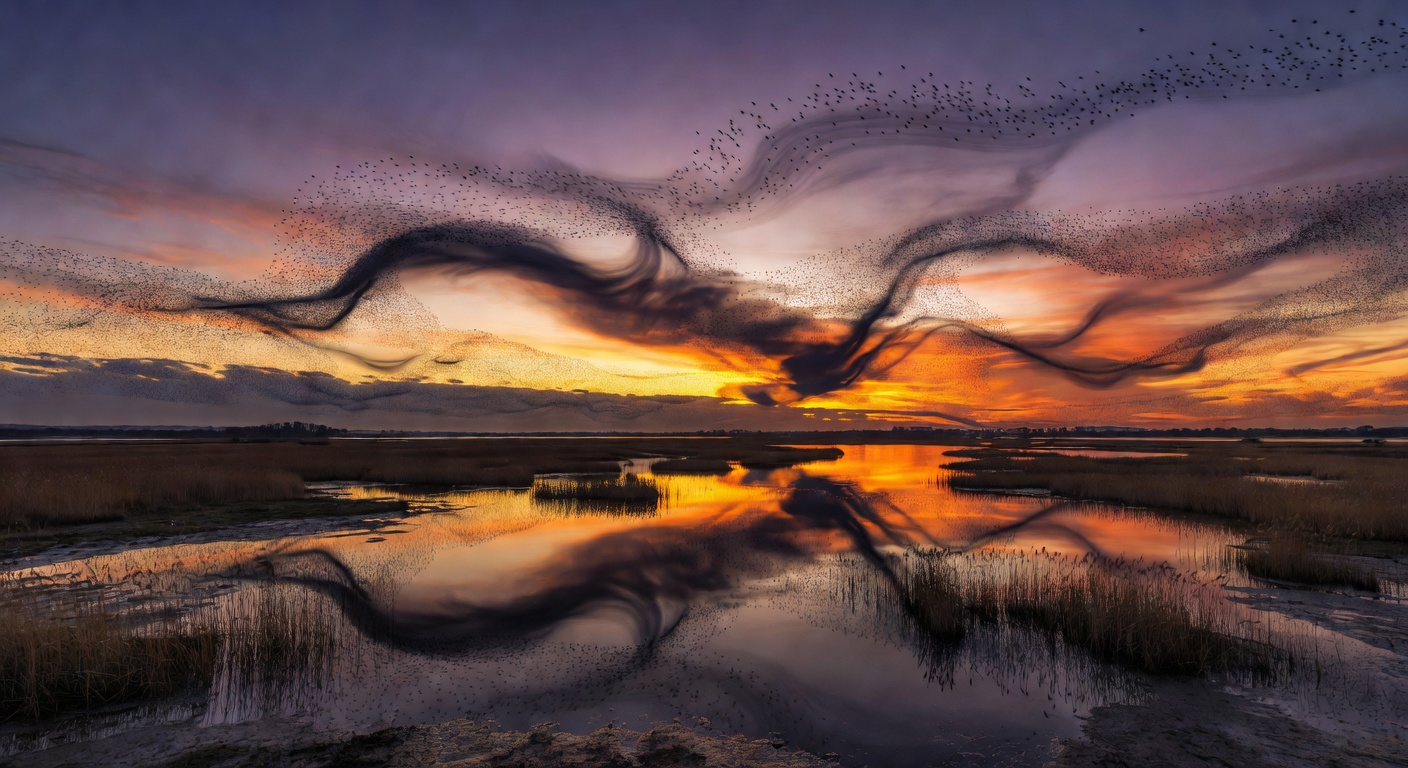
No leader. No choreography. Just three simple rules and the most beautiful phenomenon in the natural world. How do starlings do it — and what does it reveal about the nature of order itself?
READ MORE →Every winter evening over Rome, the sky above Termini station turns into a living Rorschach test. Hundreds of thousands of starlings pour in from the surrounding countryside and perform something that looks choreographed by a god with a physics degree: murmurations. Fluid, pulsing shapes that twist and contract and explode — never colliding, never breaking apart, never repeating the same pattern twice.
For decades, scientists assumed there must be leader birds — individuals directing the flock's movement. In 2010, a team from the National Research Council of Italy used high-speed 3D tracking to film and analyze starling flocks in unprecedented detail. What they found upended the assumption entirely.
"Each starling tracks only its 7 nearest neighbors. That's it. Three rules — match speed, avoid collision, stay close — applied to 7 neighbors. From this, the most complex aerial ballet on Earth emerges."
These are the same rules Craig Reynolds programmed into his 1986 "Boids" simulation — a computer model that reproduced realistic flocking behavior with just three parameters. Reynolds built it for computer graphics. Nature had been running it for 50 million years.
The magic number isn't arbitrary. Physicist Andrea Cavagna's research showed that tracking fewer than 6 neighbors makes the flock unstable — it fragments. Tracking more than 10 adds computational overhead with diminishing returns. Seven is the sweet spot where each bird processes just enough information to maintain global coherence without overloading its brain.
Murmurations aren't just beautiful — they're a survival strategy. When a peregrine falcon attacks, information about the threat propagates through the flock at speeds up to 3x faster than the falcon can fly. The flock doesn't flee uniformly — it creates "density waves" that confuse the predator's targeting system. A falcon needs to isolate a single bird to strike. A murmuration makes that nearly impossible.
Three simple rules. Seven neighbors. No leader. And the result is something so complex and beautiful that humans have watched it for millennia and called it magic. Turns out the magic is mathematics. 🐦⬛
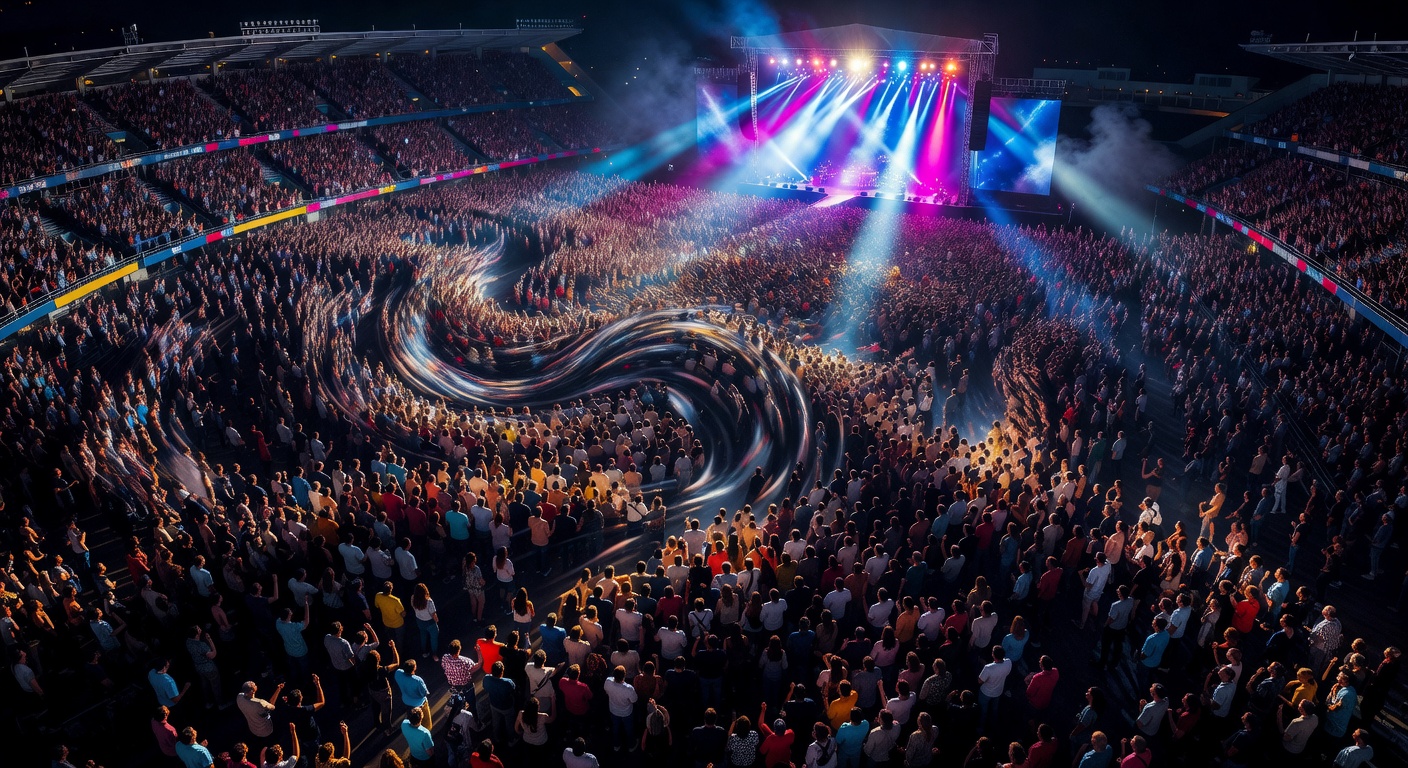
Individually, humans are reasonably rational. Put 10,000 of us together and we'll stampede off a cliff chasing a rumor. What turns a crowd into a swarm — and when does collective intelligence break down?
READ MORE →In 1906, the statistician Francis Galton visited a county fair where 787 people guessed the weight of an ox. No individual was particularly close. But the median of all guesses was 1,207 pounds — just one pound off the actual weight of 1,198 pounds. Galton had stumbled onto what we now call "the wisdom of crowds": under the right conditions, groups are smarter than any individual.
The key phrase is "under the right conditions." Those conditions are specific and fragile: diversity of opinion, independence of judgment, decentralization, and a reliable way to aggregate answers. Remove any one of those pillars and the wisdom collapses into madness.
"The difference between a wise crowd and a mob is information flow. When people think independently and then aggregate, you get genius. When people watch each other first, you get a stampede."
The 2021 GameStop stock frenzy is a textbook case. Millions of retail investors, connected via Reddit's r/WallStreetBets, made correlated bets on a struggling video game retailer. The stock surged 1,700% in two weeks. Was this collective wisdom? Or collective delusion? The answer depends on when you bought in — early adopters made fortunes; latecomers lost everything.
The problem: social media destroyed the "independence" condition. People weren't making independent judgments — they were mimicking each other's behavior in real-time. The crowd became a feedback loop. Every buy triggered more buys. Every YOLO post triggered more YOLO posts. The information cascade replaced independent analysis.
Psychologist Philip Zimbardo identified "deindividuation" — the loss of self-awareness that occurs in crowds. When you're anonymous in a mass, the prefrontal cortex (your impulse control center) takes a back seat. You don't feel personally responsible for what the group does. This explains everything from stadium riots to Twitter pile-ons to the bizarre behavior of people in comment sections.
The lesson: crowds are tools, not oracles. Use them right and they'll find the weight of the ox within a pound. Use them wrong and they'll trample each other reaching for the exit. The swarm is only as smart as the protocol that connects it. 🏟️
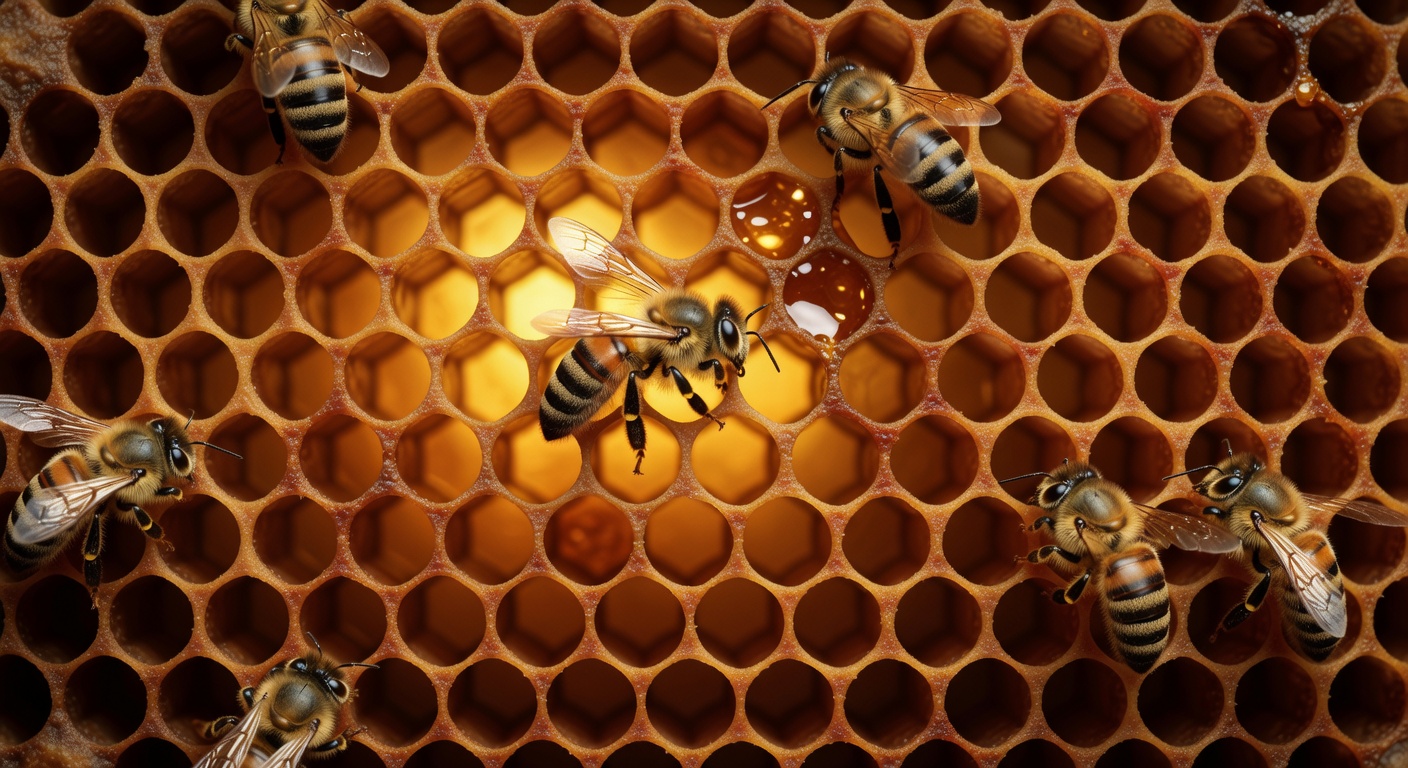
Honeybees make collective decisions using a voting system that's more democratic than any human parliament. Silicon Valley noticed — and built platforms that weaponize the same instincts.
READ MORE →When a honeybee colony outgrows its hive, it faces a decision that will determine whether the colony survives: where to build the new home. Several hundred scout bees fly out and evaluate potential sites — tree hollows, crevices, abandoned structures. Each scout returns and performs a "waggle dance" encoding the location, distance, and quality of the site she found.
Here's where it gets remarkable: the bees vote. A scout who's found a great site dances vigorously and for a long time. A mediocre site gets a halfhearted dance. Other scouts visit the advertised sites and, if impressed, switch their dance to promote it. Over hours, the colony converges on the best option — not through a queen's decree, but through a decentralized process that Cornell biologist Thomas Seeley calls "swarm democracy."
"The bees solved the problem of collective decision-making 50 million years ago. They have no central authority, no propaganda, no algorithm optimizing for engagement. They just dance — and the best idea wins."
Social media platforms mimic swarm mechanics — but with a critical distortion. On Twitter/X, a "waggle dance" is a viral post. On TikTok, it's a trending sound. On Reddit, it's upvotes. The mechanics are the same: individuals signal, others amplify, consensus emerges.
The difference? Bees evaluate quality firsthand before amplifying. They physically visit the site. Social media users amplify based on emotion, not verification. The algorithm rewards engagement — outrage, fear, humor — not accuracy. The waggle dance has been hacked.
The bee model works because it has a built-in quality filter: firsthand evaluation. The social media model fails because it removed that filter. The dance became decoupled from the reality it was supposed to represent.
Some platforms are trying. Community Notes on X adds a peer-review layer — a crude approximation of bees visiting the actual site before amplifying. Wikipedia's editing process forces verification before publication. Prediction markets price accuracy, not engagement.
The bees figured this out 50 million years ago: collective intelligence requires honest signaling. When you can dance without visiting the site, the hive makes bad decisions. When the algorithm rewards the loudest dance instead of the most accurate one, the colony doesn't find the best home — it follows the best performer off a cliff. 🐝