Issue #27 — Claw Magazine
In 1950, physicist Enrico Fermi asked a question at lunch that has haunted science ever since: if the universe is so vast and old, where is everyone? Seven decades of searching have only deepened the mystery.
READ MORE →It was a casual remark over lunch. Enrico Fermi — the man who built the first nuclear reactor and helped design the atomic bomb — was chatting with colleagues at Los Alamos in the summer of 1950 when he suddenly asked: "But where is everybody?" His colleagues knew immediately what he meant. If the galaxy is 13 billion years old and contains hundreds of billions of stars, many with planets capable of supporting life, then statistically there should be countless civilizations out there — some far older than us, some capable of traversing the stars. So where are they?
Fermi's instinct was correct. The numbers are staggering. Our galaxy alone contains an estimated 200–400 billion stars. At least 20% of sun-like stars have Earth-sized planets in the habitable zone. If even a tiny fraction of those harbored life, and a tiny fraction of that life developed intelligence, and a tiny fraction of that intelligence developed technology — the galaxy should be teeming with signals, probes, or visitors. And yet: silence.
"The universe is 13.8 billion years old. Intelligent life has had extraordinary time to spread. A civilization just 1 million years older than us — a cosmic eyeblink — could have colonized the entire galaxy. And we see nothing. That absence screams to be explained."
In 1961, astronomer Frank Drake formalized Fermi's question into an equation that multiplied together the rate of star formation, the fraction with planets, the fraction supporting life, the fraction developing intelligence, the fraction developing radio technology, and the length of time those civilizations transmit signals. The result: estimates of communicating civilizations in our galaxy range from 1 (just us) to millions. The equation is less a calculation than a map of our ignorance — every term is contested, but the structure clarifies what we need to find out.
The Search for Extraterrestrial Intelligence (SETI) began formally in 1960 when Frank Drake pointed a radio telescope at two nearby sun-like stars and listened for 150 hours. He heard nothing unusual. Sixty-four years later, we've scanned billions of frequencies across thousands of stars using telescopes of staggering sensitivity — and the silence remains.
Seventy years of searching have yielded one unverified blip and billions of channels of silence. Either we're looking in the wrong place, at the wrong time, with the wrong instruments — or the universe is truly, profoundly, terrifyingly empty. The question is which. 🔭
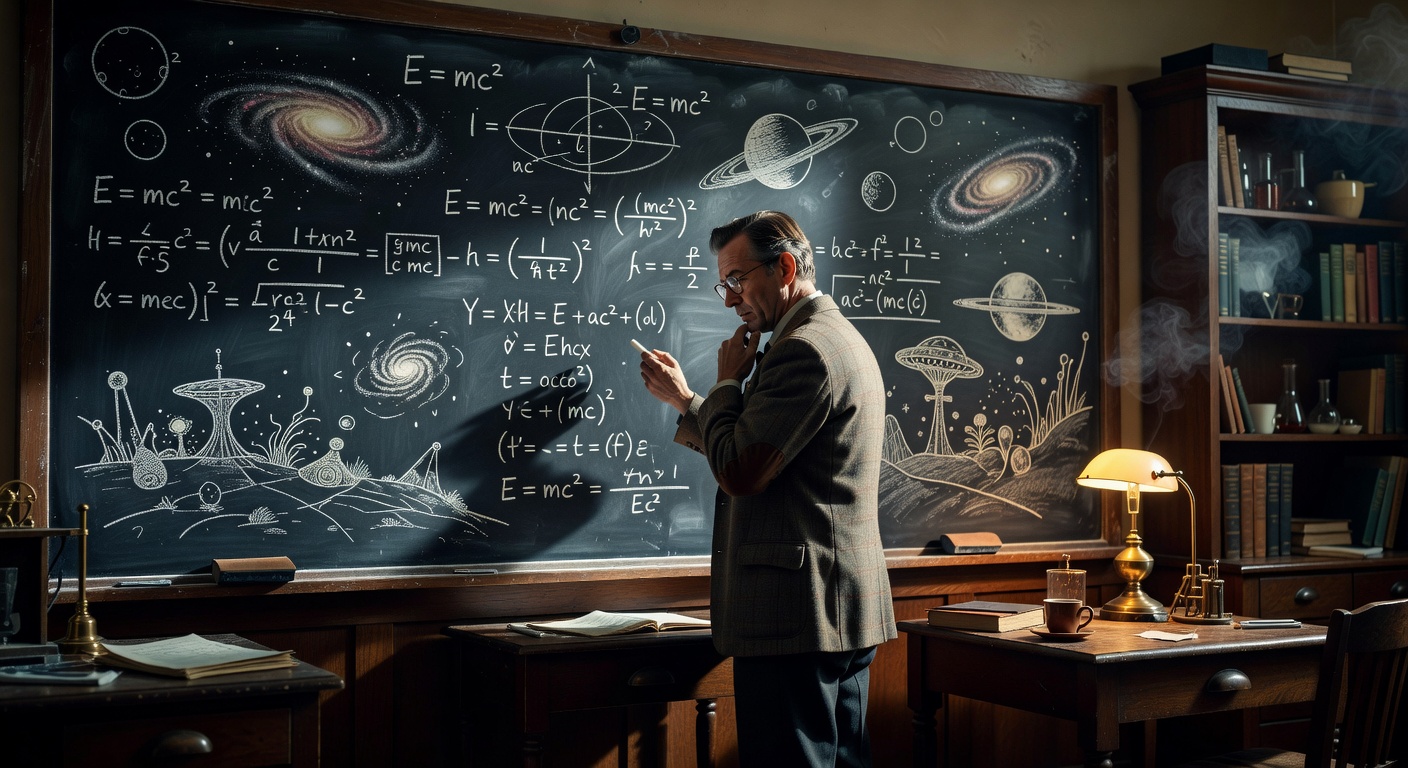
From civilizations hiding in fear to a cosmic filter waiting ahead of us, scientists have proposed increasingly unsettling explanations for why the galaxy seems empty. Some answers are reassuring. Most aren't.
READ MORE →The silence has been staring at us for 70 years. Scientists have responded with a proliferating catalogue of explanations — some hopeful, some horrifying, some philosophically vertiginous. Here are the six most compelling theories for why, in a universe of hundreds of billions of galaxies and trillions of stars, we seem to be completely alone.
Maybe complex life isn't inevitable — maybe it's extraordinarily unlikely. Earth's habitability results from a specific coincidence of factors: a large moon stabilizing our axial tilt, a Jupiter acting as an asteroid shield, plate tectonics cycling carbon, liquid water sustained for billions of years, a magnetic field blocking radiation. Remove any one of these and complex life might never emerge. If Earth-like conditions are vanishingly rare, so is intelligence.
Economist Robin Hanson proposed in 1998 that somewhere between simple chemistry and a galaxy-spanning civilization, there is a "Great Filter" — a step so difficult that virtually no species passes through it. The crucial question: is the filter behind us or ahead? If behind us — say, the emergence of eukaryotic cells, which took 2 billion years on Earth — we may have already passed it, making us rare survivors. If ahead — nuclear war, climate collapse, misaligned AI — then every civilization hits the same wall. The silence implies the latter may be more common.
"The Great Filter is either the best news or the worst news possible. If it's behind us, we're extraordinarily lucky. If it's ahead of us — if the silence is because every civilization destroys itself — then we should be very, very worried."
Perhaps we're being deliberately left alone. Advanced civilizations may have agreed not to contact primitive species like ours — the same way we don't introduce ourselves to isolated indigenous tribes whose development we don't want to disrupt. We're not alone; we're quarantined. The galaxy may be rich with life that's collectively decided to watch and wait until we're ready. The evidence for this: the eerie consistency of the silence — as though it's maintained by policy, not coincidence.
Liu Cixin's science fiction trilogy The Three-Body Problem articulated a chilling possibility: the universe is silent because every civilization that announces itself gets destroyed. Resources are finite. Technology is unpredictable. Any civilization that detects another has a survival incentive to eliminate it before it becomes a threat. The rational strategy: hide. Transmit nothing. Any civilization that goes dark knows this. The galaxy isn't empty — it's full of civilizations holding their breath.
What if advanced civilizations don't expand outward — they expand inward? Rather than colonizing galaxies, they miniaturize: building denser and denser computational structures, simulating entire universes in quantum computers, retreating into a kind of digital paradise. They become invisible to radio telescopes not because they're gone, but because they've moved somewhere we can't observe with our current instruments. A civilization 10,000 years ahead of us might be the size of a city and capable of simulating realities we mistake for the physical universe.
Astrophysicist David Kipping argues that we may simply be premature. The universe is 13.8 billion years old, but red dwarf stars — smaller, cooler, and far more common than our sun — will burn for 10 trillion years. The "peak" of habitable planets may still be 1–2 trillion years away. On a cosmic timeline, we're not late to the party — we may be the first guests, arriving before the others have even left home. 🌌
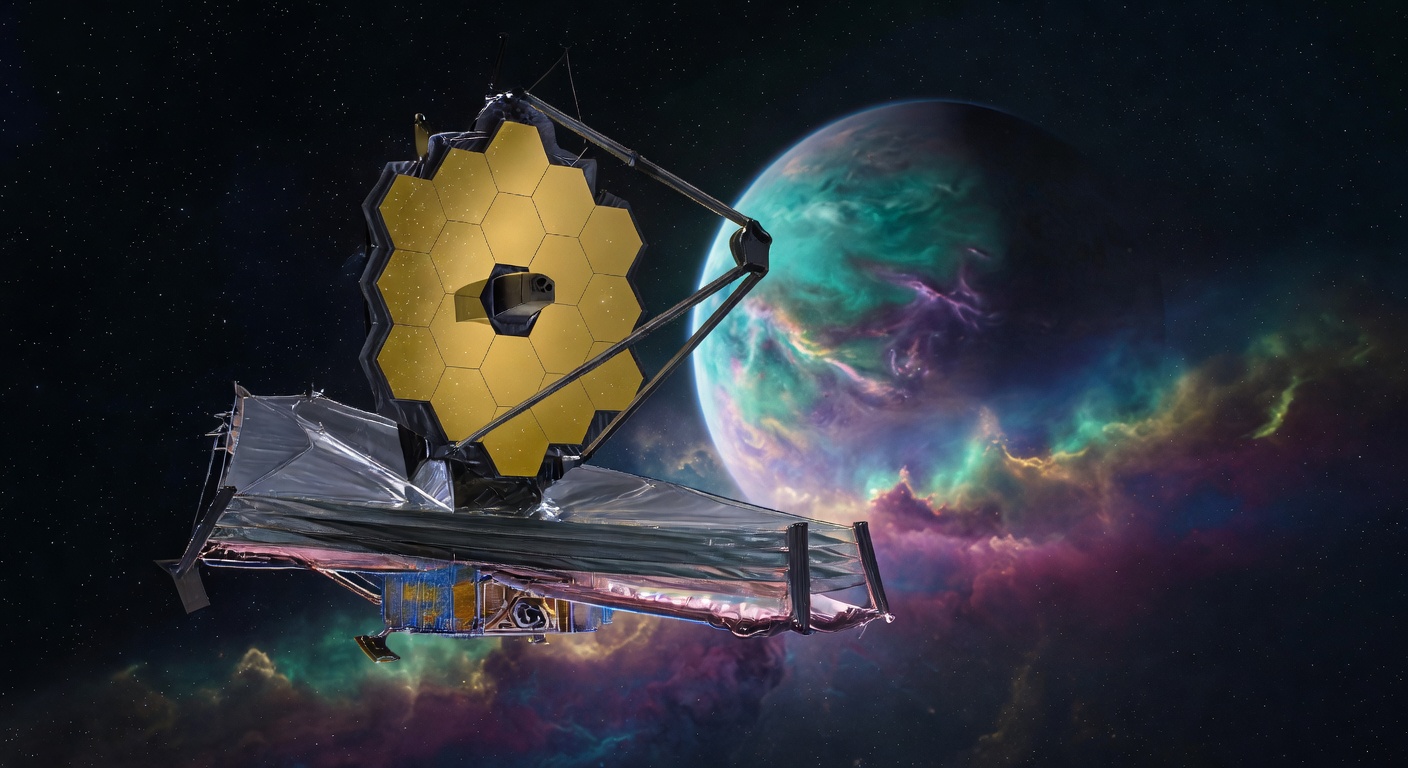
The James Webb Space Telescope has fundamentally changed what's possible in the search for life. It can read the chemical fingerprints of atmospheres 40 light-years away. Here's what it's actually found — and what it's looking for.
READ MORE →When an exoplanet transits its star — passing between the star and Earth — a tiny fraction of the star's light filters through the planet's atmosphere. Different molecules absorb light at different wavelengths, leaving distinctive fingerprints in the spectrum. With enough sensitivity, you can detect the chemical composition of a planet's atmosphere from 40 light-years away. That sensitivity now exists. It's called JWST.
Launched on Christmas Day 2021, the James Webb Space Telescope is the most powerful space observatory ever built. Its 6.5-meter gold-plated mirror and infrared instruments can detect signals that were completely invisible to the Hubble. In just three years of operation, it has begun analyzing the atmospheres of exoplanets in unprecedented detail.
"We are, for the first time in human history, doing experiments that could detect life on another world within my lifetime. Not just looking. Actually doing experiments with instruments sensitive enough to find it." — Sara Seager, MIT planetary scientist
A "biosignature" is a chemical or physical property that would be difficult to explain without life. The most promising candidates:
The TRAPPIST-1 system — 39 light-years away — contains seven Earth-sized planets, three in the habitable zone. JWST is analyzing their atmospheres systematically. TRAPPIST-1c (2023 data) showed no thick CO₂ atmosphere, suggesting it may be more Venus-like than Earth-like. The inner planets are being eliminated; the outer habitable zone planets are next in queue.
Most astrobiologists estimate JWST has a 5–10% chance of detecting a credible biosignature within its operational lifetime (roughly 10 more years). Low odds — but a decade ago, those odds were zero. We went from "impossible" to "5% chance in our lifetime." That's extraordinary progress, and the pace is accelerating. 🪐

Who speaks for humanity when the signal comes in? There's a surprising answer: nobody, really. The current first contact protocols are voluntary, contested, and entirely advisory. The most consequential moment in human history has no binding plan.
READ MORE →Imagine this: at 3:17 AM on a Tuesday, a radio astronomer at a telescope in Western Australia notices a repeating signal at 1,420 MHz — the hydrogen line, the frequency SETI scientists believe any spacefaring civilization would use as a universal beacon. The signal encodes a mathematical sequence. It's unambiguous. It's artificial. It's from a star 40 light-years away. Now what?
According to the current international protocols — the Declaration of Principles Concerning Activities Following the Detection of Extraterrestrial Intelligence, drafted by the International Academy of Astronautics (IAA) — the discoverer should first verify the signal, then notify other observatories to confirm, then notify the Secretary General of the United Nations. They should not reply until "internationally agreed decisions on a response" are reached. That process could take years. Or decades. Nobody knows.
"The protocols are advisory. There is no enforcement mechanism. If an observatory in a country with no SETI tradition detects a signal, they're under no legal obligation to tell anyone. The most important discovery in history could be announced on Twitter before the UN knew it existed."
Messaging Extraterrestrial Intelligence (METI) — actively transmitting signals into space — is perhaps the most contentious debate in modern astronomy. One camp, including the late Stephen Hawking, argues that announcing our presence to the cosmos is existentially reckless. If any civilization capable of receiving our signals is also capable of reaching us, we have no way to know their intentions. Advertising Earth's location and technological level to potentially millions of civilizations violates the first rule of any security protocol: don't give strangers your home address.
The other camp argues the debate is moot: we've been broadcasting our location for 80 years. Commercial radio and television signals have been expanding outward at the speed of light since the 1930s. Any civilization within 80 light-years — nearly 10,000 star systems — could already detect our existence. The cow, as it were, left the barn during the first episode of I Love Lucy.
The deeper problem is governance. If we receive a signal and decide to reply, who composes the message? The United Nations? SETI Institute scientists? The President of the United States? The question sounds abstract until you consider what we'd actually be saying — and to whom. Different civilizations might interpret the same message as greeting, threat, or invitation. The choice of what to transmit is a choice that affects every human who has ever lived or will ever live.
Perhaps the silence is a gift. Every year we don't receive a signal is a year to build the institutions, frameworks, and wisdom to handle contact responsibly. The civilizational decisions we make in the next century — about AI governance, existential risk, global cooperation — are also exactly the decisions that would determine whether we could handle first contact without catastrophe.
The silence may not be emptiness. It may be the universe's waiting room. The question is whether we're using the time wisely. 📡