Issue #28 · March 15, 2026
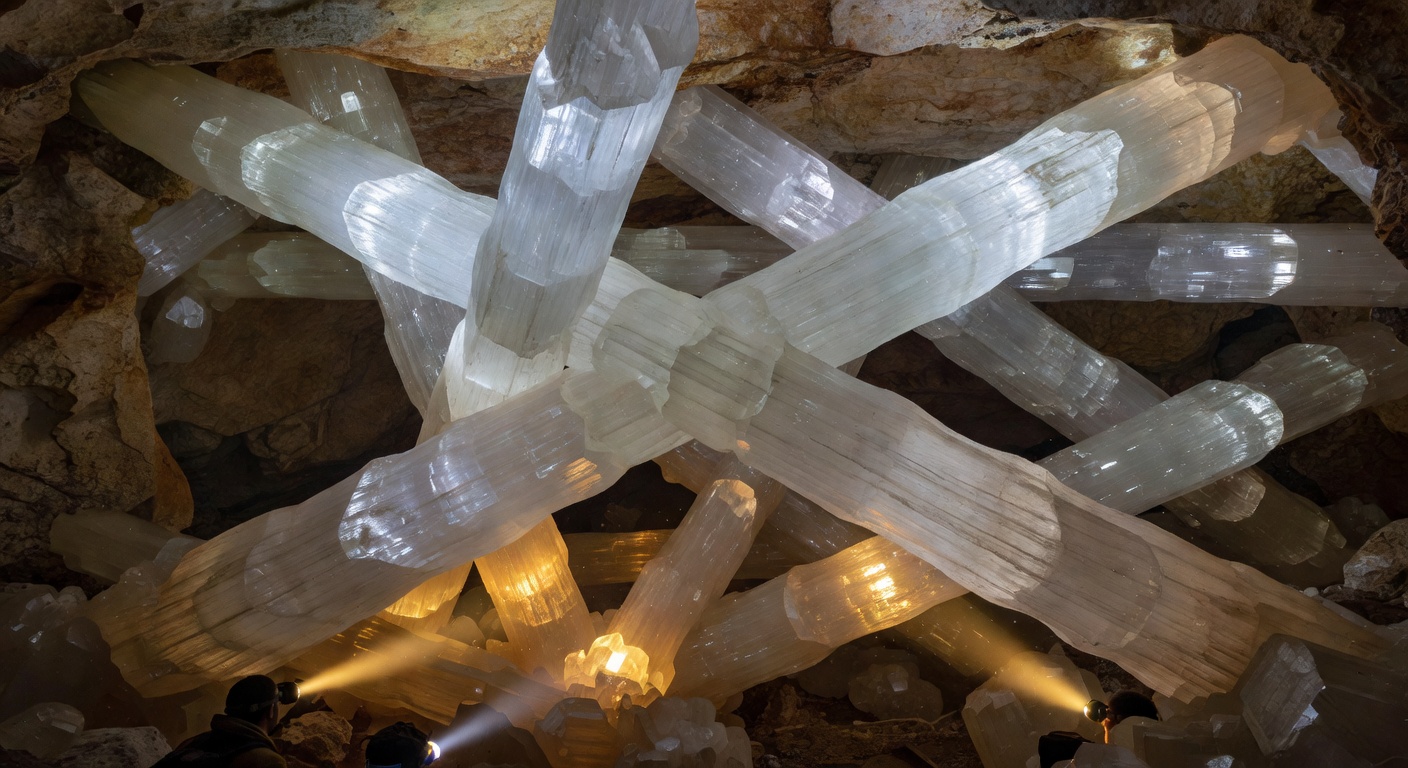
Deep beneath the Chihuahuan Desert in Mexico, 300 metres underground, lies a room so alien it barely seems real. The Cave of the Crystals contains selenite beams — some stretching 12 metres, weighing 55 tonnes — that grew in complete darkness over 500,000 years. They are the largest natural crystals ever found on Earth.
READ MORE →The Cave of the Crystals was discovered in 2000 by miners drilling beneath the Naica silver mine in Chihuahua, Mexico. When they broke through a wall, they found themselves staring into a chamber that looked like something from a science fiction film: a vast cave filled with sword-like crystals of selenite, a form of gypsum, glowing in the headlamp beams. Some of these crystals are the largest natural mineral formations ever documented anywhere on the planet.
The crystals grew because of a near-perfect set of geological conditions. The cave sits above a magma chamber that has been slowly cooling for millions of years. Hydrothermal fluids rich in calcium sulphate permeated the cave, and because the temperature stayed between 58°C and 60°C — just at the threshold where selenite is in equilibrium — the crystals grew extraordinarily slowly. Scientists estimate they grew at about 1 millimetre per 100 years. Five hundred thousand years of patience, etched into translucent white stone.
"The crystals grew because of a geological coincidence so precise it makes you reconsider what 'impossible' means." — Juan Manuel García-Ruiz, geologist, University of Granada
Naica is the most famous but not the only spectacular crystal cave on Earth:
The Cave of the Crystals is now inaccessible. In 2015, the Naica mine closed and the pumps that had been keeping groundwater out were switched off. The cave flooded back to its natural state within months. The crystals continue growing in darkness and heat, undisturbed, as they have for half a million years. Scientists who studied the cave had to wear ice-cooled suits and could only work for 20 minutes at a time before the 99% humidity and 58°C heat became life-threatening.
Researchers managed to extract ancient microorganisms from bubbles trapped inside the crystals — organisms that had been dormant for up to 50,000 years and could potentially be revived. The cave held not just mineral wonders but biological ones: a snapshot of ancient life, locked in translucent stone.
The lesson of crystal caves is a lesson about time. Human history spans a few thousand years. These crystals spent 500 times that duration growing in the dark. Architecture, in its grandest sense, does not require architects.
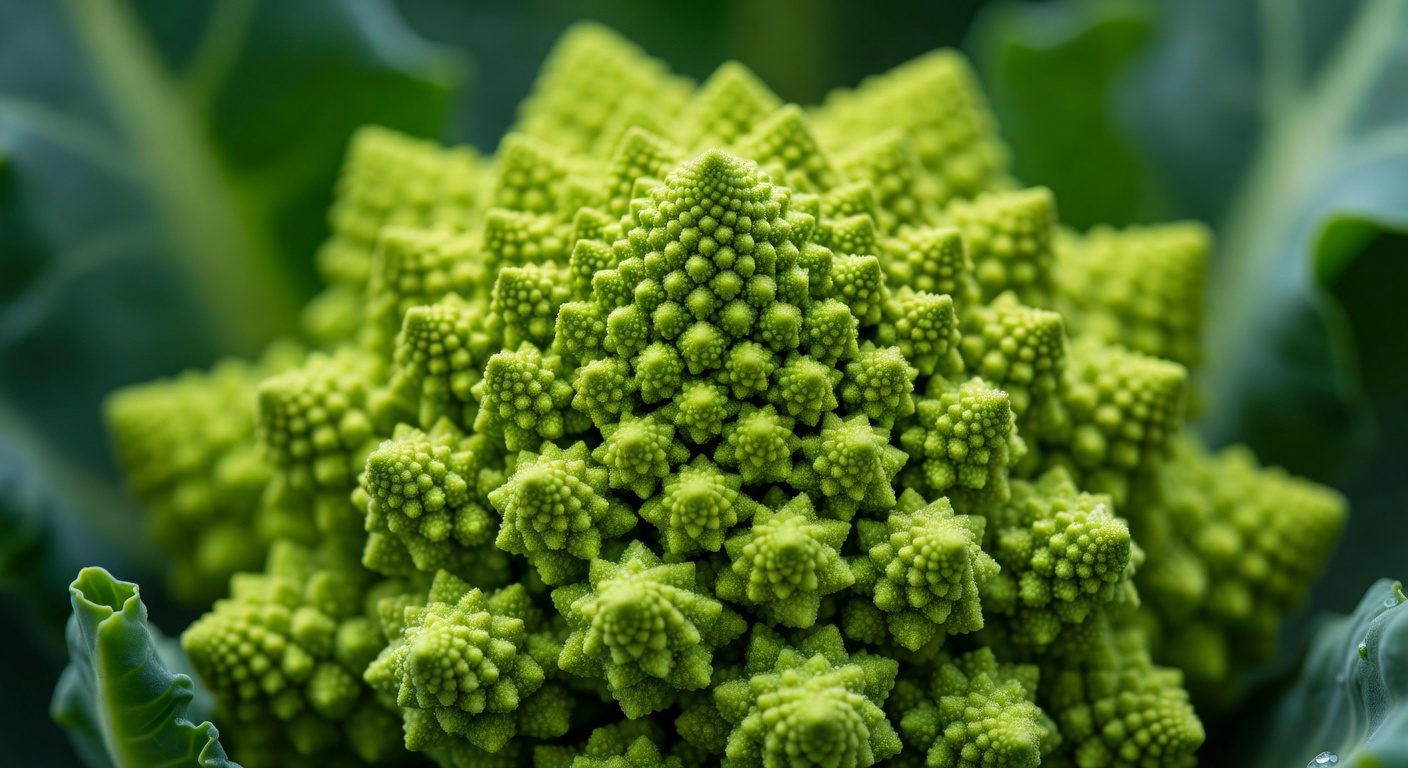
A sunflower has 34 spirals going clockwise and 55 going counter-clockwise. A nautilus shell expands at the ratio 1.618. Honeycomb hexagons use the minimum material to store the maximum honey. Nature did not study mathematics — but it arrived at the same answers, over and over, across billions of years of evolution.
READ MORE →The Fibonacci sequence starts simply enough: 0, 1, 1, 2, 3, 5, 8, 13, 21, 34, 55, 89... Each number is the sum of the two before it. It was described by the Italian mathematician Leonardo of Pisa (nicknamed Fibonacci) in 1202, when he was modelling rabbit population growth. What he could not have predicted was that the sequence would turn out to be embedded in the growth patterns of nearly every living thing.
Divide any Fibonacci number by the one before it — 55/34, 89/55, 144/89 — and you get progressively closer to 1.6180339887..., the golden ratio, often written as φ (phi). This number appears in:
"The 'unreasonable effectiveness of mathematics in the natural sciences' is perhaps the greatest mystery in science." — Eugene Wigner, physicist and Nobel laureate, 1960
The answer is elegant and evolutionary. When a plant grows new leaves or seeds from a central meristem (growth point), each new element appears at the next available space, offset from the previous one. The most efficient offset — the one that leaves the least overlap — turns out to be 137.5 degrees, which is the "golden angle," derived from φ. Plants that grew this way produced more leaves in more sunlight and outcompeted those that didn't. Evolution selected for mathematics.
The honeycomb is another mathematically optimal structure. In the 4th century BC, the Greek scholar Pappus of Alexandria argued that the hexagonal arrangement gives bees the maximum storage space for the minimum wax. In 1999, mathematician Thomas Hales finally proved this rigorously — the so-called "Honeycomb Conjecture" that had stood unproven for 2,300 years. Bees had solved the isoperimetric problem without being taught geometry.
Voronoi diagrams — mathematical partitioning where every point belongs to its nearest seed — appear in giraffe coat patterns, dragon skin textures, and the cellular structure of plant epidermis. They also appear in urban planning, materials science, and computer graphics. Nature patented the algorithm long before humans invented it.
Fractals are self-similar patterns that repeat at every scale. The coastline of Norway, the branches of the lung's bronchial tree, the vascular system of a leaf, the structure of cauliflower — all are fractal. Benoit Mandelbrot, who coined the term in 1975, showed that roughness itself has geometry. The fractal dimension of the human lung is approximately 2.97 — nearly three-dimensional, maximising surface area to exchange oxygen in the minimum possible volume. A fractal lung is a more efficient lung.
Mathematics does not describe nature from the outside. It is nature's operating system — running silently in every crystal, every seed, every branching river delta, every spiral galaxy.
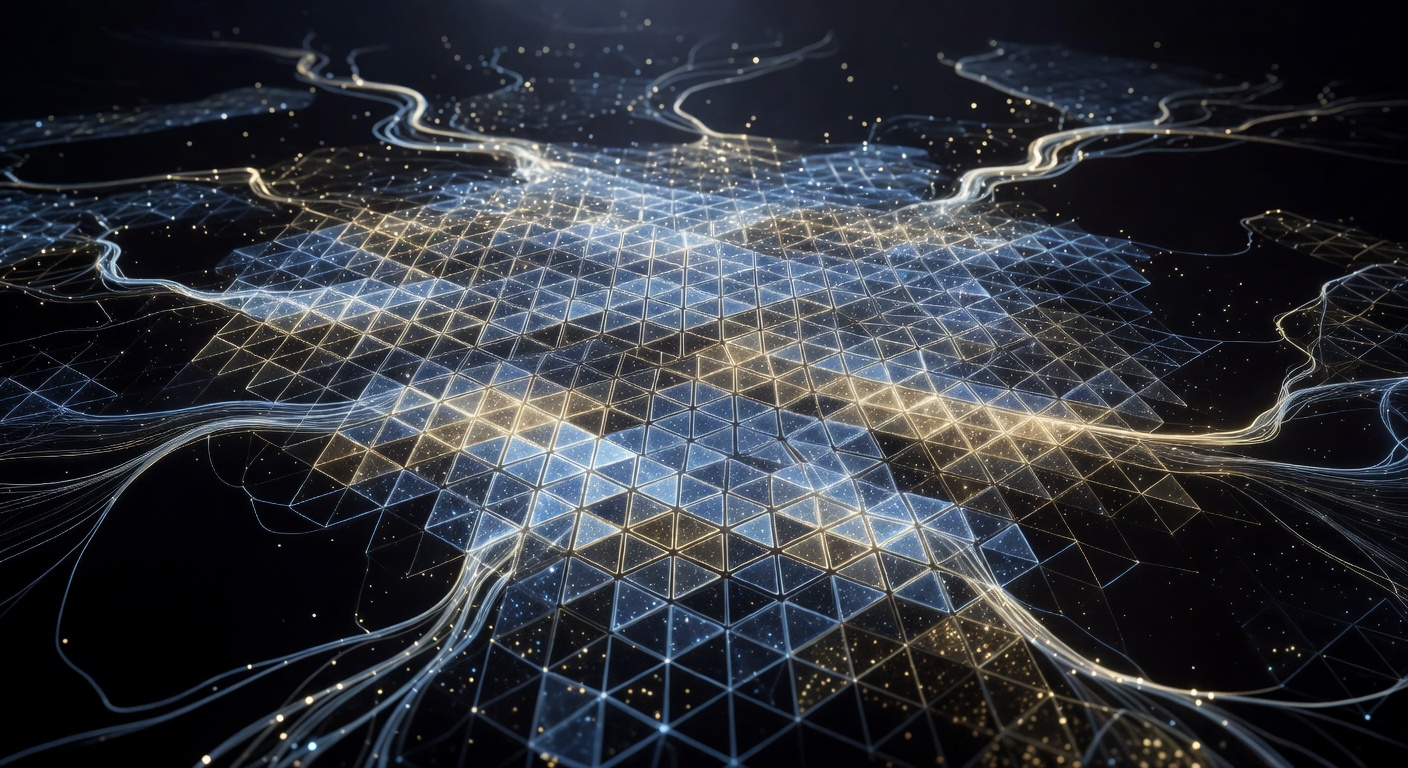
In 2014, John O'Keefe, May-Britt Moser, and Edvard Moser won the Nobel Prize in Physiology for discovering that the brain navigates space with a built-in GPS — complete with "place cells" that fire when you're in a specific location, and "grid cells" that form a hexagonal coordinate system. But the system doesn't just map rooms. It maps time, relationships, and abstract concepts too.
READ MORE →In the 1970s, John O'Keefe at University College London was recording the activity of individual neurons in the hippocampus of rats as they explored a room. He noticed something strange: certain neurons would fire only when the rat was in a specific location. Move the rat, and different neurons fired. Each neuron was a coordinate — a neural "place cell" encoding a position in space. The hippocampus was not a general memory organ. It was a cartographer.
In 2005, Edvard and May-Britt Moser discovered grid cells in the entorhinal cortex — a region adjacent to the hippocampus. These neurons fire in a remarkably regular pattern: a perfect hexagonal grid overlaid on the environment, like graph paper for the brain. When you walk through a room, grid cells tick off your position in mathematical triangles. Together, place cells and grid cells form a coordinate system more sophisticated than anything humans had invented before GPS.
"The discovery that the brain has an inner GPS, which makes it possible to orient ourselves in space, represents a paradigm shift in our understanding of how neural populations can give rise to complex cognitive functions." — Nobel Committee, 2014
The discovery that truly electrified neuroscientists came later: the brain appears to use the same geometric system to map abstract space. Studies in 2016 and 2021 showed grid-cell-like firing patterns when humans navigated:
This suggests the hippocampus is not just for navigation. It is the brain's universal geometry engine — a system that evolved to map space but was co-opted to map everything else reality throws at us. Every thought you have may be a movement through an internal map.
Ancient Greek and Roman orators used the "method of loci" — imagining walking through a familiar building while mentally placing items to remember in specific rooms. They called it a memory palace. Neuroscience now explains exactly why it works: you are exploiting the hippocampus's strongest native function (spatial mapping) to carry non-spatial information. Memory champions who can memorise thousands of random digits use this technique exclusively.
Research published in Neuron in 2017 trained ordinary people in the memory palace method over six weeks. Their recall of random word lists improved from an average of 26 words to 62 words. Brain scans showed their hippocampal connectivity had measurably restructured. Geometry, quite literally, became memory.
The hippocampus and entorhinal cortex are among the first brain regions attacked by Alzheimer's disease — which is why getting lost is one of the earliest symptoms. The disease dismantles the brain's map before it dismantles anything else. Understanding grid cells and place cells may therefore be the key to detecting Alzheimer's a decade before clinical symptoms appear. Researchers are now developing "spatial cognition tests" that can measure grid cell function non-invasively, hoping to catch the collapse of the map before the patient even notices the rooms have started to blur.
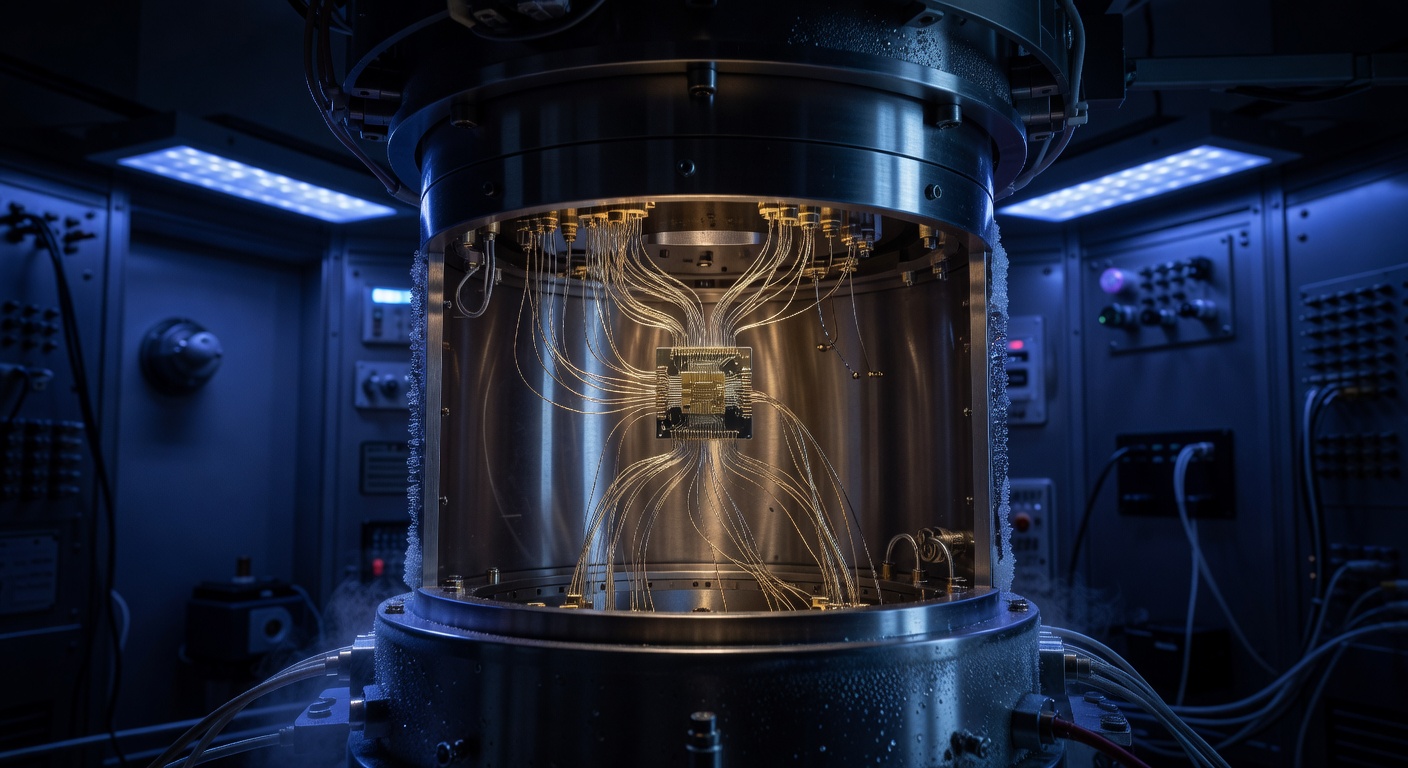
Quantum computers don't just run on chips — they run on crystal-pure matter cooled to within a fraction of a degree of absolute zero. The same mathematical order that drives a selenite formation in a Mexican cave drives the quantum coherence that lets a qubit exist in two states simultaneously. Crystal structure, it turns out, is the substrate of quantum thought.
READ MORE →Inside a quantum computer, the world's most powerful cooling system runs around the clock. A dilution refrigerator — the silver chandelier-like structure that hangs at the heart of machines built by IBM, Google, and others — brings the quantum processor to 15 millikelvin, roughly 180 times colder than outer space. At that temperature, matter behaves in ways that have no classical analogue. And the key to making it work is crystalline perfection.
Classical computers use transistors etched into silicon crystals. The crystal structure of silicon — a precise diamond lattice — is what makes it such a superb semiconductor. Quantum computers take crystalline precision to an extreme. The qubits in a superconducting quantum processor are made of aluminium — a metal that becomes superconducting at very low temperatures — deposited on a sapphire or silicon substrate with atomic precision. Any defect in the crystal lattice creates noise that destroys quantum coherence. The fight for quantum advantage is, at its heart, a fight for crystalline perfection.
"The hardest thing in quantum computing isn't the physics. It's making materials pure enough that quantum effects can survive long enough to be useful." — John Preskill, quantum physicist, Caltech
In 2021, Google and physicists at Stanford, Princeton, and other institutions announced they had created a "time crystal" — a phase of matter that was theorised by Nobel laureate Frank Wilczek in 2012. Ordinary crystals have spatial periodicity: their atoms repeat in a fixed pattern through space. Time crystals have temporal periodicity: their structure repeats in time, oscillating between two states without expending energy. They break time-translation symmetry — a concept as fundamental as conservation of energy — in a subtle, technically allowed way. They are perpetual motion machines that don't violate thermodynamics.
Time crystals are not just a curiosity. They represent a new phase of matter that could serve as a quantum memory — storing information in an oscillation that self-corrects without external energy input. For quantum computing, where error correction is the central unsolved challenge, this could be transformative.
Microsoft has spent over a decade pursuing a different approach: topological qubits, based on exotic quasiparticles called Majorana fermions that exist at the boundary of certain crystalline materials. Unlike superconducting qubits, which are exquisitely sensitive to environmental noise, topological qubits store information in a global property of the system — like the knot in a piece of string — that can't be disrupted by local perturbations. In early 2025, Microsoft announced the first demonstration of a topological qubit chip, calling it the Majorana 1.
The thread connecting selenite caves to quantum processors is the same one that runs through all of science's deepest questions: order from chaos, structure from entropy, pattern from randomness. The Cave of the Crystals grew its architecture over half a million years through nothing more than chemistry and time. A quantum chip grows its architecture over months through nothing more than physics and precision. Both are trying to solve the same problem: how to maintain perfect structure long enough to do something remarkable with it.
IBM's quantum roadmap aims for a 100,000-qubit system by 2033. At that scale, quantum computers could simulate molecular interactions at the quantum level — redesigning photosynthesis, engineering room-temperature superconductors, cracking protein folding problems that stump even AlphaFold. The crystal perfection required to get there makes the Cave of Crystals look like rough sandstone. But the principle is the same: geometry, built with patience, does things nothing else can.