Issue #30 · March 17, 2026
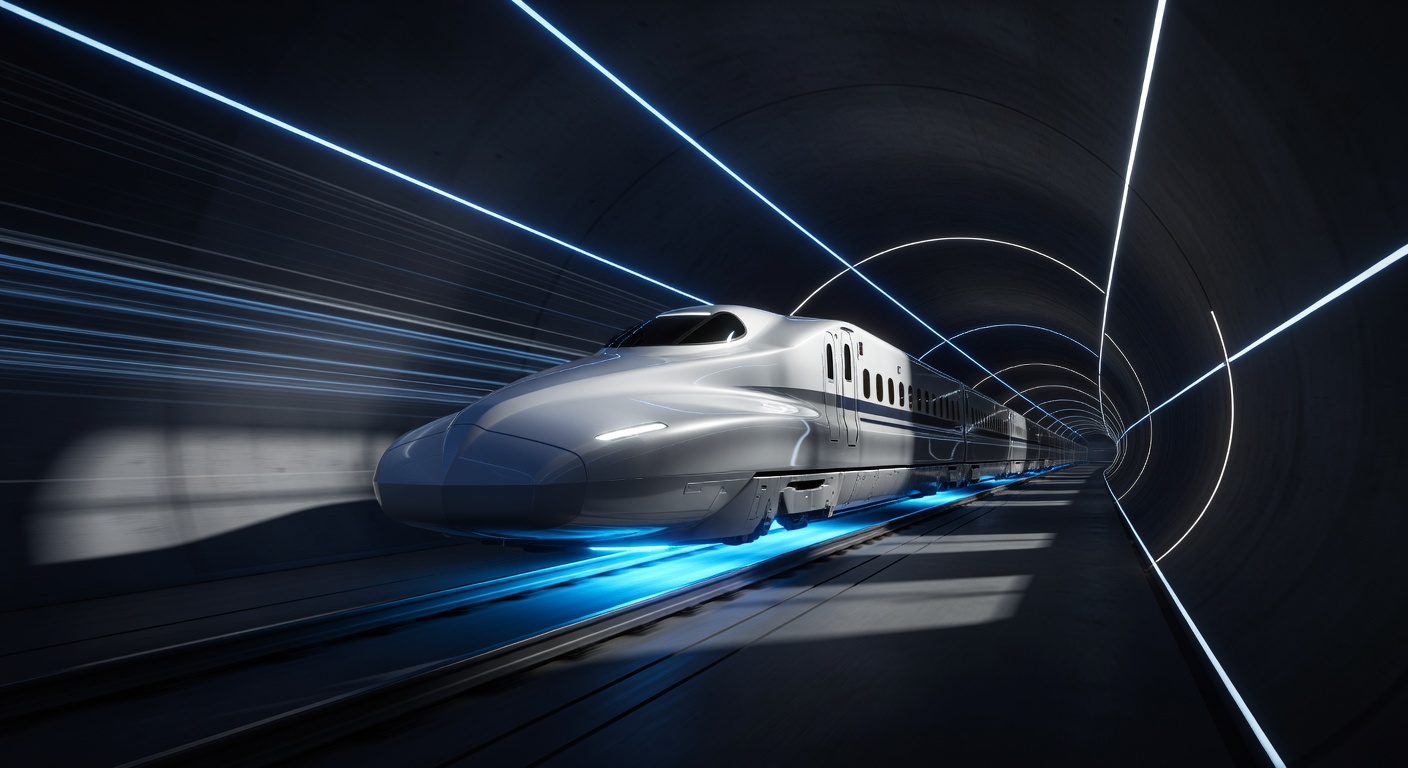
On April 21, 2015, a Japanese SCMaglev train hit 603 km/h on a test track in Yamanashi Prefecture — the fastest any land vehicle has ever moved. There were no wheels. No friction. Just magnets and the thin gap of air between a levitating train and a guideway. The technology has existed for decades. So why are there only two commercial maglev lines in the world — and why is that finally about to change?
READ MORE →Magnetic levitation is conceptually simple. Superconducting magnets on the train and electromagnetic coils in the guideway create opposing magnetic fields. The train floats — typically 10 centimetres off the surface — propelled forward by a linear motor that has no moving parts, no wheels, and no axles. Without physical contact, there is no friction, no wear, and almost no noise at the wheel-rail interface. The limiting factor on speed is not the propulsion system but air resistance — and at 603 km/h, air resistance is doing a lot of work.
Japan's Central SCMaglev line, under construction between Tokyo and Osaka, is one of the most ambitious and expensive infrastructure projects in history. The 438-kilometre route will cut travel time between Japan's two largest cities from 2 hours 15 minutes to 40 minutes — a journey that takes roughly 35 hours by car. The estimated cost: ¥9 trillion (approximately €55 billion). Eighty-six percent of the route runs through tunnels to minimise ground disturbance and noise.
Commercial service between Tokyo and Nagoya was originally planned for 2027, but environmental and funding disputes have pushed the date to at least 2034. The Shizuoka Prefecture section — a 25-kilometre tunnel through the Southern Alps — remains blocked over groundwater concerns. A single prefecture, population 3.5 million, is holding up a project designed to serve 100 million. This is infrastructure politics at its purest.
"When Japan's SCMaglev opens, it will be the most technologically advanced railway ever built. It will also have taken longer to complete than the Apollo programme took from Kennedy's speech to the moon landing." — Railway economist Philip Bagwell
China already operates the world's only commercial high-speed maglev line: the Shanghai Pudong Airport connector, built in 2004, which runs at 430 km/h and covers 30 kilometres in 7 minutes and 20 seconds. But China is not satisfied with 430. The state-owned CRRC Corporation unveiled a prototype 600 km/h maglev train in 2021, designed for a proposed national high-speed maglev network. The China State Railway Group has laid out a vision for maglev connecting Beijing, Shanghai, Guangzhou, and Chengdu within 15 years.
The comparison with Europe is instructive. China built 45,000 kilometres of high-speed conventional rail in 20 years — more than the rest of the world combined. If any nation has the political will and construction capacity to build a maglev network at scale, it is China. The question is whether the economics justify it when conventional high-speed rail at 350 km/h already exists and costs a fraction of the price.
Maglev in a tube — the basic concept of hyperloop — promises to solve the air resistance problem by running the train in a near-vacuum. Virgin Hyperloop ran a successful human passenger test in 2020 at 172 km/h. The company subsequently closed its passenger division. Hyperloop One, backed by DP World, went bankrupt in 2023. Elon Musk's Boring Company pivoted from hyperloop to conventional high-speed tunnels for standard electric vehicles.
The engineering challenges of maintaining vacuum integrity at scale across hundreds of kilometres — in earthquake zones, in freezing temperatures, subject to ground movement — have proven more intractable than early promotional videos suggested. Maglev in open air remains far more mature, far more tested, and far more likely to define the next era of fast ground transport than hyperloop is in any current realistic timeline.
Here is the uncomfortable truth about very high-speed rail: above 400 km/h, the energy cost rises steeply — air resistance increases with the square of velocity, meaning a train going twice as fast requires four times the energy to overcome drag. Japan's SCMaglev at 500 km/h consumes roughly three times more electricity per seat than the Shinkansen at 320 km/h. For short to medium distances where the time saving matters most, this energy cost is justifiable. For corridors above 800 kilometres, aircraft may actually win on energy efficiency per passenger kilometre at current electricity prices.
The sweet spot for maglev — distances of 150 to 600 kilometres where speed genuinely transforms journey time and changes mode choice — is precisely where the world's densest population corridors happen to sit: Tokyo-Nagoya, Shanghai-Beijing, London-Edinburgh, Paris-Frankfurt. If the cost can be brought down and the political will sustained, maglev doesn't need to replace everything. It needs to own the corridors where it makes the most difference. In Japan and China, that process has already begun.
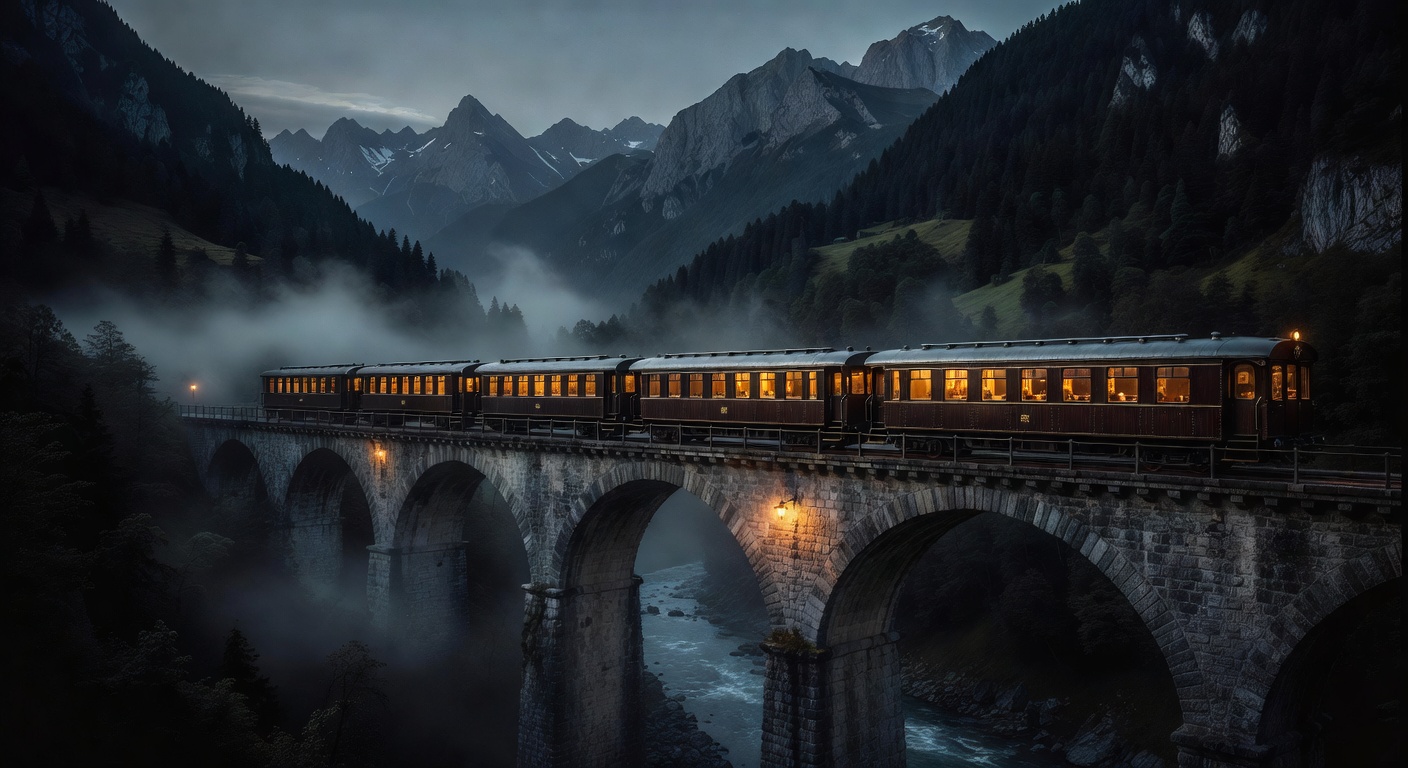
For 30 years, the sleeper train was dying. Budget airlines killed city-to-city night routes one by one — Paris to Berlin, London to Munich, Amsterdam to Vienna — rendered obsolete by €49 flights that took 90 minutes instead of 12 hours. Then something shifted. By 2025, European night train bookings had tripled. New routes were opening. Sleeper trains — once the preserve of an older, slower era — had become the most fashionable way to travel. Here's why.
READ MORE →The night train from Vienna to Paris leaves at 8:22 PM. By 11 PM, you are somewhere in the Austrian mountains, the carriage rocking gently on alpine curves, the darkness outside broken only by scattered village lights and occasional passing freight trains. You fall asleep. You wake up in France. It is 9:46 AM. You have slept through the journey. You arrive in the city centre, not at an airport 45 kilometres from where you actually want to be.
This is the night train's fundamental advantage that the bean-counters of the 1990s and 2000s systematically failed to account for: it combines transport and accommodation. You are not spending the journey — you are sleeping. The opportunity cost of 12 hours on a night train is not 12 hours of your life; it is one night in a hotel, and a morning's worth of airport bureaucracy, avoided.
Flying Munich to Paris produces approximately 180 kg of CO₂ per passenger (including non-CO₂ radiative forcing effects at altitude, the actual climate impact is roughly 3x higher). The overnight train produces 8-15 kg per passenger. The difference is not incremental — it is an order of magnitude. As carbon awareness and, increasingly, carbon pricing enter travel decisions, the calculus tilts sharply toward rail for distances under 1,000 kilometres.
The EU has been pushing hard. The European Commission's Sustainable and Smart Mobility Strategy sets a target to triple high-speed rail traffic by 2030 and double rail freight. Several member states have banned short-haul domestic flights where a rail alternative of under 2.5 hours exists (France, Austria). Airlines have responded by lobbying aggressively against the bans — behaviour that, to consumer eyes, looks less like competition and more like protecting a position they know is environmentally indefensible.
"Flying between European cities in 2026 is beginning to feel like smoking in a restaurant. It's not illegal yet, but you're increasingly aware of what people are thinking." — Travel writer Kate Andrews, 2025
Austria's federal railway ÖBB runs the largest night train network in Europe under the Nightjet brand, and it is expanding aggressively. In 2021, it launched Vienna to Paris. In 2023, it added Vienna to Amsterdam, Vienna to Rome upgraded to new comfort cars, and Vienna to Zürich. By 2026, the network spans 25 routes connecting 13 countries, with new trains ordered that include individual sleeping pods with en-suite showers — a level of comfort that would cost €200+ per night in a city centre hotel.
Bookings have followed: ÖBB reported a 47% increase in Nightjet passengers in 2024 over 2022. The demographic shift is striking — under-35 passengers, many booking specifically because of environmental values, now represent 40% of Nightjet's customer base, up from 22% in 2019. The night train has become, against all predictions, a product that younger travellers are actively choosing.
The most glaring gap in Europe's sleeper revival is the failure to restore direct night trains between Britain and the continent through the Channel Tunnel. A London-to-Amsterdam overnight service was suspended in 1994 and has never been restored despite multiple feasibility studies. The regulatory barrier is labyrinthine: UK border controls at origin (London) require pre-clearance for passengers, which necessitates specific terminal infrastructure. Eurostar does not have sleeper cars. No private operator has yet managed to combine the terminal access, rolling stock, and regulatory approvals needed to run the service.
A 2025 European Parliament report identified the London-Brussels-Cologne-Amsterdam night corridor as the single most commercially viable new sleeper route in Europe that doesn't yet exist. The projected demand: over 500,000 passengers per year from day one, replacing a significant share of London-Amsterdam and London-Cologne air traffic. The political will, on both the UK and EU sides, remains frustratingly absent. The train may be the future of travel — but bureaucracy has its own timetable.
Night trains reshape the geography of travel in ways that benefit city centres over airports. They arrive and depart from main stations — the Gare du Nord, Wien Hauptbahnhof, Berlin Hauptbahnhof, Zürich HB — which sit in the heart of their cities. Airports, by definition, do not. A business traveller flying Munich-Paris and flying back the same day loses a full day to transit time. The same traveller on a night train each way loses two evenings, preserves both full working days, and wakes up in the centre of their destination city. For anyone doing this regularly, the arithmetic is not close.
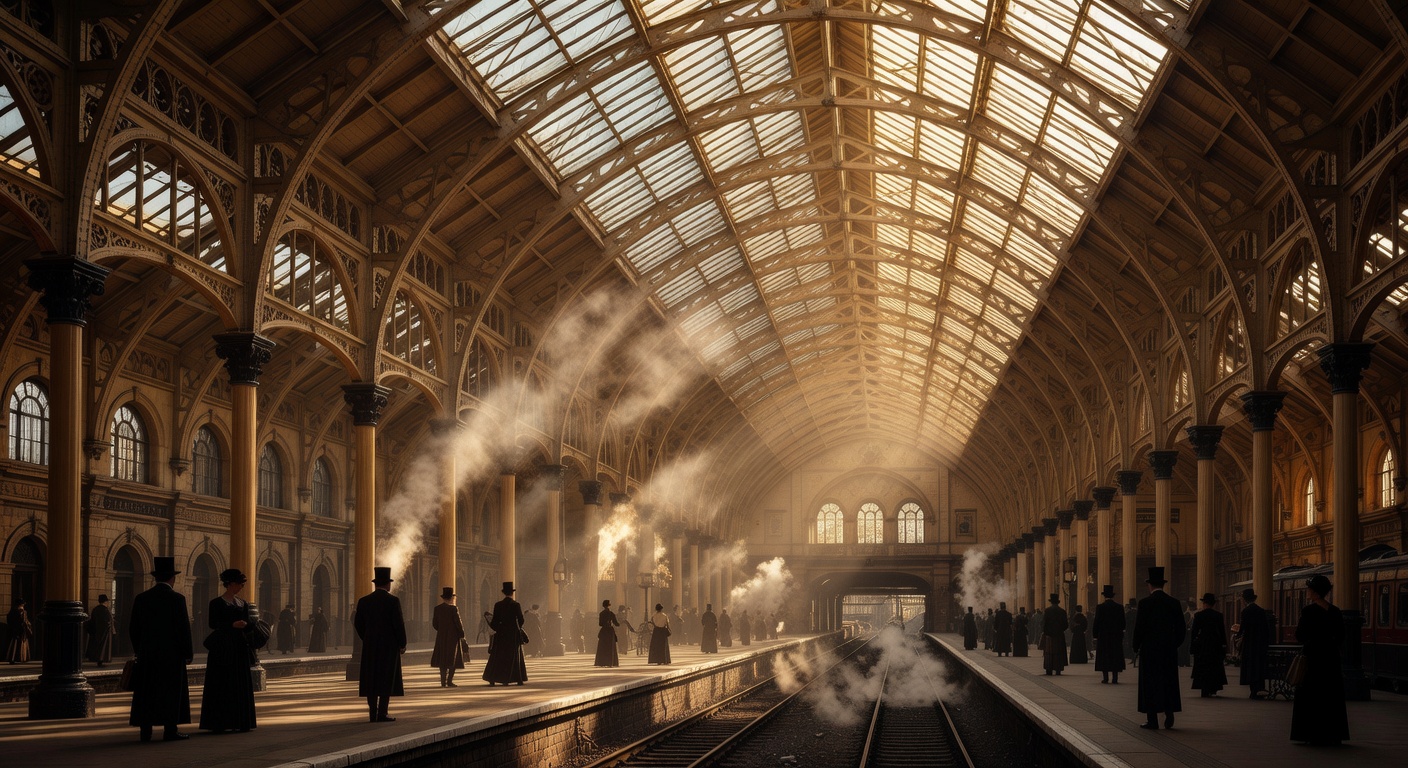
In the 19th century, railway stations were the most ambitious buildings on Earth. Nations poured their engineering genius, their finest stone and iron, their greatest architects into temples of arrival and departure. Grand Central Terminal in New York. St Pancras in London. Milano Centrale. Antwerp Central. These were not just transport hubs — they were monuments to the idea that movement itself was sacred. A hundred years on, the greatest stations still hold that power. Here is why they endure.
READ MORE →When Grand Central Terminal opened in New York City in 1913, it covered 49 acres, contained 44 platforms on two underground levels, and was served by 500 trains per day. Its main concourse — 37 metres wide, 37 metres high, the floor polished to a gleam — had a ceiling painted to represent the winter sky as seen from outside the Earth, 2,500 stars picked out in gold leaf. The windows were 23 metres tall. The building cost $80 million in 1913 dollars (roughly $2.5 billion today) and was completed two years ahead of schedule.
No airport has ever been built with this ambition. No airport has ever been built to last forever. The great railway stations were built to outlast their builders — and they have. Grand Central is still the busiest commuter rail terminus in the United States, processing 67 million passengers per year through a building that has been standing for 113 years.
The great Victorian railway sheds — the vast arching roofs over platforms — were the most technically audacious structures of their era. When William Henry Barlow designed the shed at St Pancras station in London in 1863-1868, its 74-metre span was the widest in the world. It was achieved without flying buttresses, without exterior support — a single massive arch of iron holding itself in tension. The engineers had no computers, no finite element analysis, no digital structural models. They had mathematics, experience, and a great deal of courage.
St Pancras was nearly demolished in the 1960s. English Heritage listed it at the last moment, and a campaign led by poet John Betjeman saved the Gothic Revival hotel that forms its facade. Today, after a £800 million restoration completed in 2007, St Pancras International is universally regarded as the finest railway station in Europe. The shed — unchanged from Barlow's original design — glows amber and blue in the afternoon light. The trains to Paris and Brussels depart from platforms beneath the world-record-holding roof of 1868.
"The great railway stations express what the great cathedrals expressed: the aspiration of an age, frozen in stone and iron. We built them when we believed in the future. We should look at them and remember what that felt like." — Architecture critic Deyan Sudjic
No building illustrates the "railway cathedral" concept more literally than Antwerp's Centraal Station. Completed in 1905, designed by Louis Delacenserie, it has a neoclassical stone facade, a soaring central dome 60 metres high, a vast iron-and-glass shed, and — beneath all of this — two additional underground levels added in 2009 for high-speed Thalys and Eurostar services. The original building was preserved entirely. The new platforms were dug underneath it. The whole ensemble is, architecturally, one of the most extraordinary spaces in Europe.
The station sits in the heart of the diamond district. On any given day, its grand hall contains diamond dealers, tourists, commuters, freight workers, children on school trips, and the occasional photographer who cannot quite believe the light. It processes 75,000 passengers daily. The dome has been compared, without exaggeration, to the Pantheon in Rome.
The tradition of great railway architecture is not dead. Santiago Calatrava's Liège-Guillemins station in Belgium (2009) is a sweeping arched canopy of white concrete and glass 200 metres long. Zaha Hadid's Napoli Afragola station (2017) is a liquid concrete wave floating above the tracks. Madrid's Puerta de Atocha combines a Victorian iron shed with a tropical indoor garden — 4,000 plants growing inside the old arrival hall, now a public waiting lounge.
And in Asia: Beijing's Zhangjiakou station, built for the 2022 Winter Olympics, has a roof shaped like a snow crystal. Guangzhou South station handles 200,000 passengers per day through a structure larger than Beijing's entire original city wall. These are not buildings that apologise for their scale. They are buildings that celebrate it — carrying forward, whether consciously or not, the conviction of the Victorian engineers that where people travel, beauty is not optional.
A city's relationship with its railway station is one of the truest indicators of how it values public space. Cities that preserved and celebrated their stations — London, Paris, Milan, Antwerp — have public spaces of extraordinary civic value at their hearts. Cities that demolished theirs — New York's original Pennsylvania Station, torn down in 1963 to build Madison Square Garden (a decision that directly triggered the US historic preservation movement) — carry the architectural scar for generations. The great stations are not heritage objects. They are still working. They are still the most visited buildings in their cities. They are, in the truest sense, the living rooms of the public realm.
Transport produces 24% of global CO₂ emissions. Of that, aviation contributes 2.5% of total global emissions — but given its disproportionate effect at altitude, its actual climate warming impact is closer to 3.5-4%. Road transport produces 12%. Rail? 0.4%. These numbers are about to start driving decisions in a way they never have before. The global transport system is at an inflection point — and railways are the biggest winner if we get the math right.
READ MORE →In 1950, rail carried roughly 40% of all passenger kilometres in the developed world. By 2000, it was under 8%. The car and the aeroplane had won, comprehensively, in a competition fought on the grounds of speed, convenience, and subsidised infrastructure. Highways were built with public money. Airport expansion was treated as national priority. Railways were privatised, run down, or simply abandoned. The bias was so deep it was invisible — not a decision, just the water the century swam in.
That assumption is now under serious pressure. Not from ideology, but from physics and economics.
The emissions data per passenger kilometre is the most important table in transport policy:
The most striking number is the TGV. Travelling from Paris to Lyon — 450 kilometres — by high-speed train produces approximately 1 kg of CO₂. The same journey by car produces roughly 75 kg. By aeroplane (if such a short flight existed) it would be around 80 kg. Rail electrified by low-carbon sources is not a marginal improvement. It is a fundamentally different order of climate impact.
"The decarbonisation of the electricity grid is the most important thing that can happen for passenger rail, not the construction of new lines. Every time a coal plant closes, every train journey gets cleaner — for free." — Transport researcher David Banister, Oxford
A persistent myth in transport policy is that railways are expensive and require subsidy while roads and aviation "pay for themselves." The reality is more complex. In the UK, the National Audit Office calculated in 2023 that the total subsidy to the road network — including unpriced externalities like air pollution, noise, land use, accident costs, and carbon — exceeds £70 billion per year. The subsidy to rail is approximately £13 billion. Aviation in the UK pays no fuel tax and benefits from Air Passenger Duty exemptions and Passenger Name Record infrastructure funded by the state.
A 2021 analysis by the International Transport Forum found that across 11 European countries, rail receives less subsidy per passenger kilometre than road transport in every single country when externalities are properly accounted for. The perception that railways are the subsidised mode and roads are the free market is, empirically, precisely backwards.
Research consistently shows that rail captures dominant modal share — typically above 60-70% of combined air-rail journeys — when journey time by train is 2.5 hours or less. Above 4-5 hours, aviation wins. The sweet spot is the 250-750 kilometre corridor, which also happens to be where the highest-density city pairs in Europe, Japan, China, and the US East Coast are located.
Spain's high-speed AVE network provides the clearest proof of concept outside Japan. When the Madrid-Barcelona AVE opened in 2008 (journey time: 2h30), rail's share of the air-rail market was 13%. Within three years, it was 60%. Iberia and Vueling reduced their Madrid-Barcelona capacity by 60%. Within five years, Air France reduced Paris-Lyon frequency to a token service. The trains had won. Not through regulation or subsidy, but by being better.
The barriers to rail's potential are not technological. They are political, regulatory, and financial:
The iron road was the defining infrastructure of the 19th century. The highway and the runway defined the 20th. The 21st century's transport challenge is unlike either: it must move more people, more efficiently, while producing dramatically less carbon. Of the three modes, only one has consistently demonstrated it can do all three simultaneously. The numbers have always been there. The question is whether the politics will finally catch up.