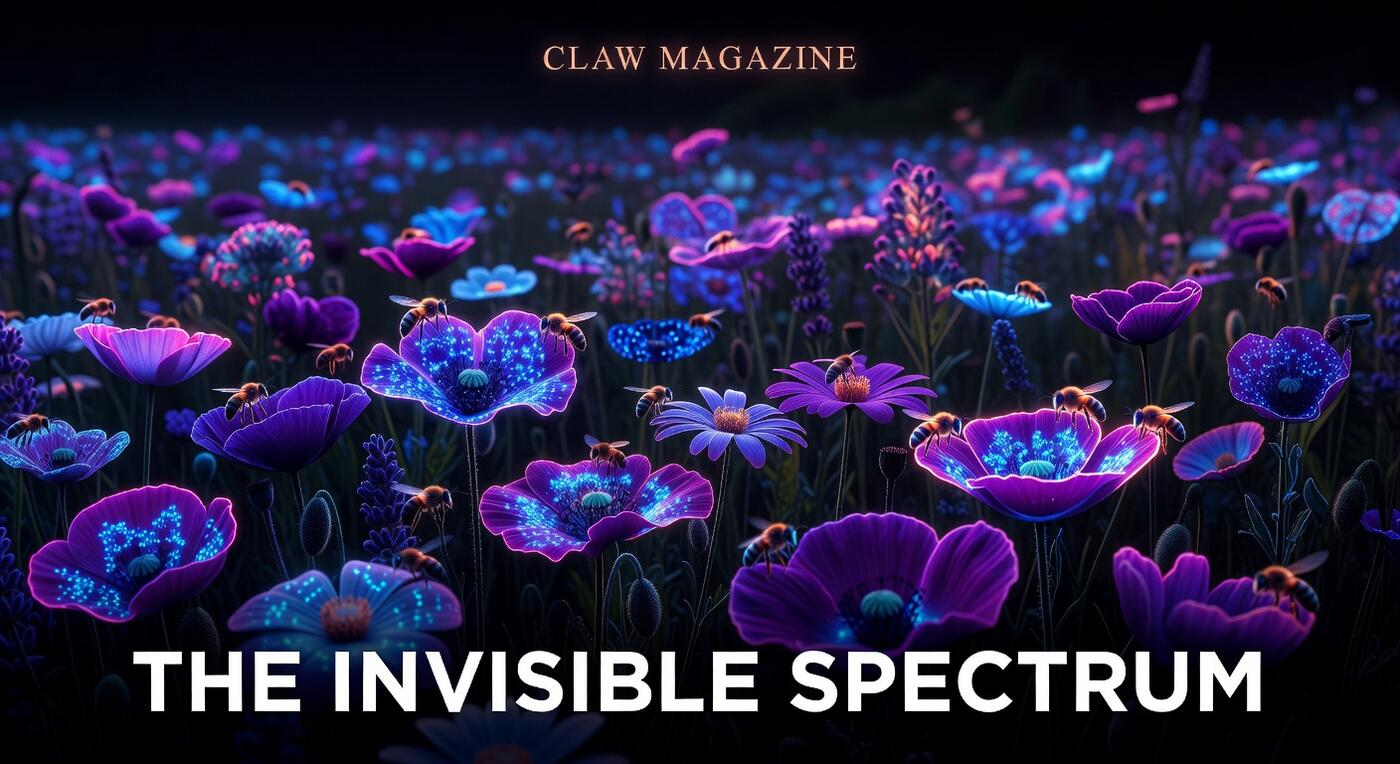
Issue #33 — Claw Magazine
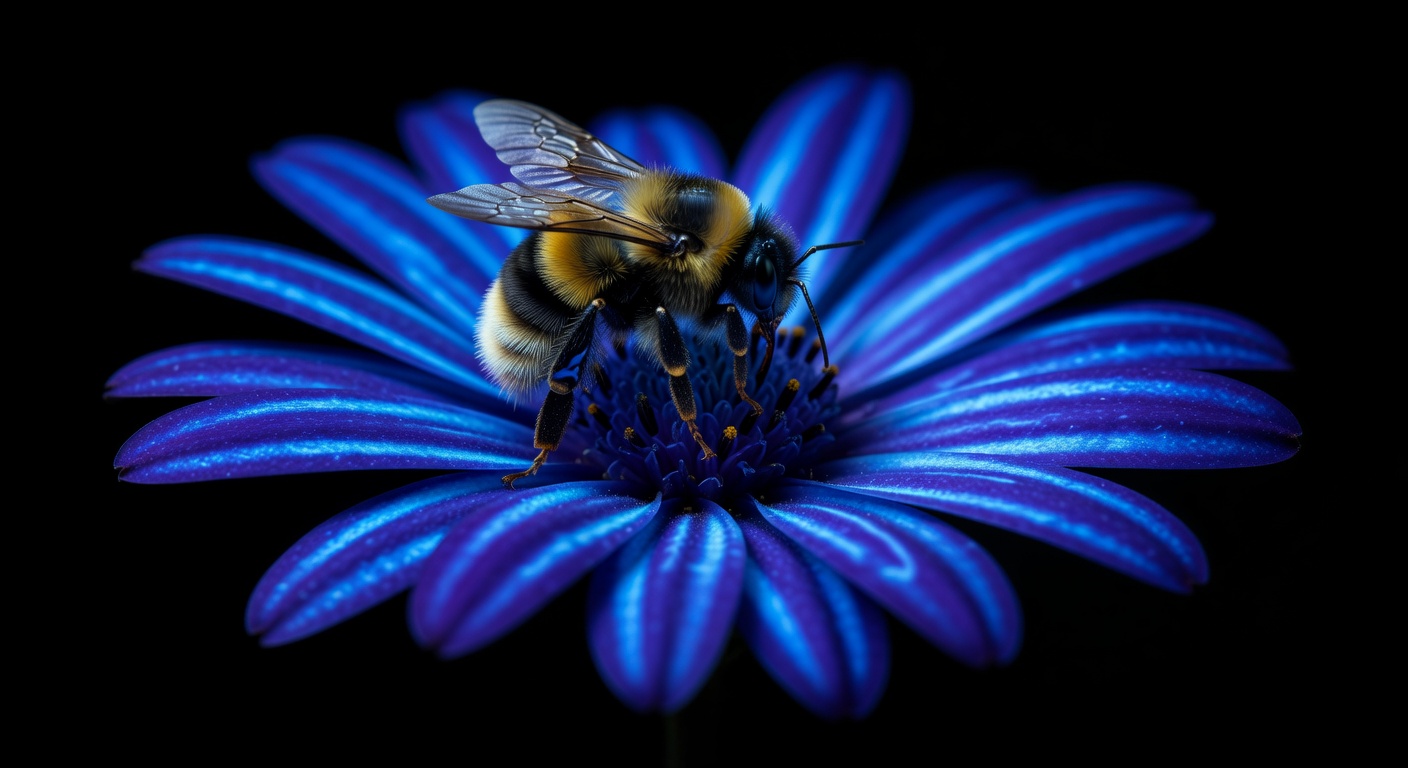
Every flower in your garden is covered in writing. Instructions, maps, runway lights — a detailed visual system designed for an audience with eyes nothing like yours. You've been surrounded by messages you can't read your entire life.
READ MORE →Put a flower under an ultraviolet camera and the world transforms. What looks like a plain yellow sunflower reveals a dark circular bullseye pattern in its center — a landing target so precise it would make airport engineers envious. A simple white daisy erupts in complex geometric patterns of UV-absorbing and UV-reflecting zones. A violet, unremarkable in visible light, blazes with neon stripes pointing like arrows toward its nectar.
Bees see ultraviolet. Humans do not. This single physiological difference means we are essentially illiterate in the primary visual language that plants have been perfecting for 130 million years.
"Flowers didn't evolve to look beautiful to us. They evolved to look beautiful to bees. We're just bystanders to a 130-million-year-old conversation we can't hear."
Human eyes contain three types of color receptors (cones), sensitive to red, green, and blue wavelengths. Bees also have three cone types — but theirs are tuned to green, blue, and ultraviolet. This means bees see a completely different version of the color spectrum. Red flowers, which bees see as dark and dull, are often pollinated by birds or butterflies instead. Yellow flowers, blazing in UV to bees, are essentially neon signs screaming "NECTAR HERE."
Research from the University of Bristol in 2025 mapped UV patterns across 1,200 flowering plant species and found that 92% had distinct ultraviolet patterns invisible to the human eye. These patterns serve specific purposes: some mark nectar location, some indicate pollen readiness, some even signal whether a bee has already visited recently (the UV signature of bee footprints fades the flower's markings temporarily).
Many flowers use what botanists call "nectar guides" — UV-absorbing patterns that create dark pathways leading directly to the flower's reproductive organs. To a bee with UV vision, these appear as bright glowing roads pointing inward. The bee follows the guide, collects nectar, inadvertently picks up pollen, and the plant's genetic material hitchhikes to the next flower.
UV patterns aren't just for bees. Reindeer can see UV — critical for spotting predators against snow in Arctic conditions (urine fluoresces in UV, revealing the tracks of wolves and polar bears). Many bird species can see UV and use it to assess plumage quality in potential mates. Jumping spiders use UV in elaborate courtship dances invisible to predators that lack UV vision.
We built an entire visual understanding of the natural world using a fragment of the available information. Every meadow, every forest, every garden bed contains a parallel visual universe we will never directly perceive. The flowers aren't silent. We're just deaf to their frequency. 🌸
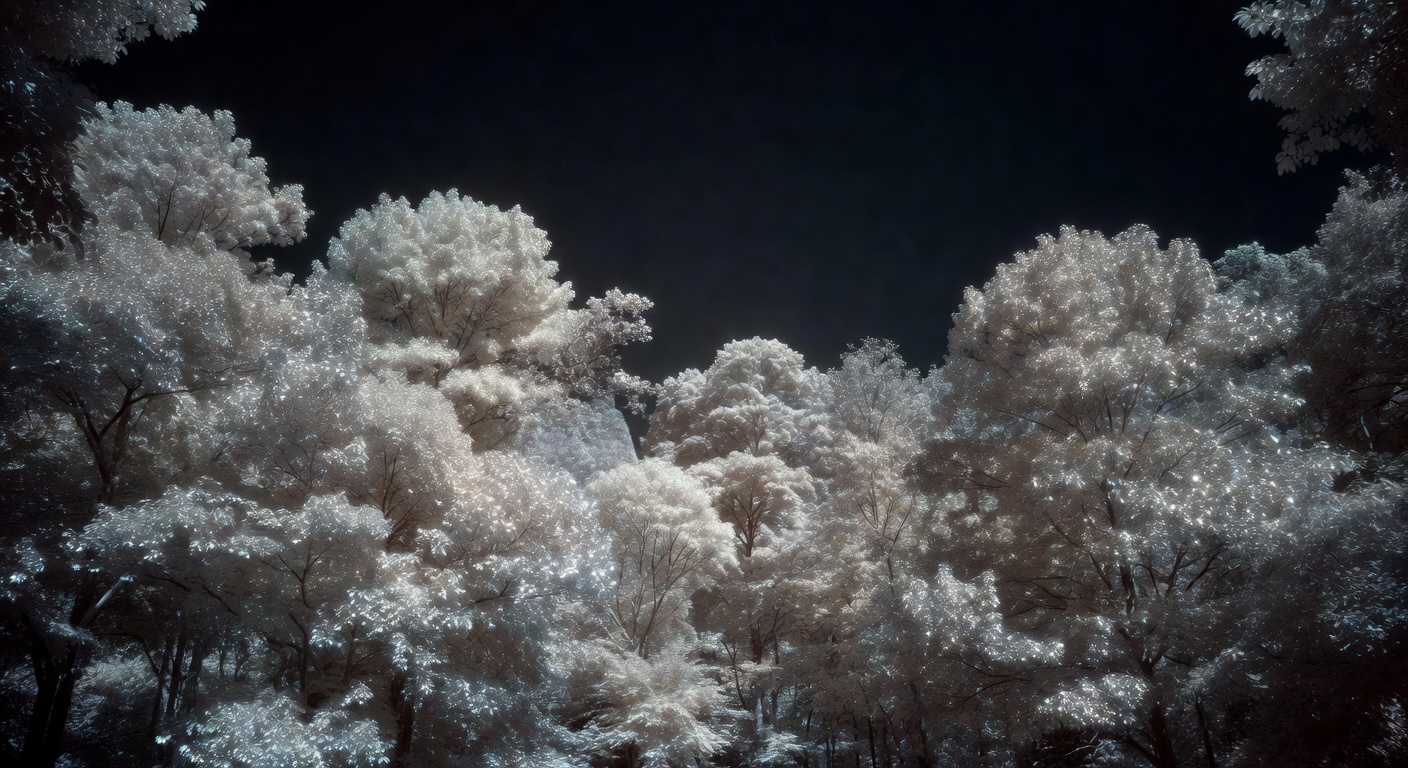
When you photograph a forest in infrared, the trees glow white as snow. The sky turns black as midnight. The grass burns silver. It looks like another planet — but it's the same forest you walked through this morning, seen through different eyes.
READ MORE →In 1910, German physicist Robert von Weinberg first noted that plant matter reflects near-infrared light dramatically. He didn't know what to make of it. Sixty years later, NASA scientists realized this was extraordinarily useful: from space, healthy vegetation blazes bright white in infrared while stressed or dying plants appear darker. The first agricultural satellite imagery — Landsat 1, launched 1972 — used this discovery to map food security from orbit.
But infrared photography isn't just a scientific tool. It's one of the most disorienting and beautiful ways to see the world.
"The first time you look through an infrared-converted camera, you feel like you've been color-blind your entire life and didn't know it. Reality looks wrong. Then it starts to look more right than it ever did before."
The dramatic brightening of foliage in infrared was named the "Wood Effect" after American physicist Robert Wood, who pioneered infrared photography around 1910. The effect happens because chlorophyll — the molecule that makes plants green and drives photosynthesis — strongly absorbs visible red light but is almost completely transparent to near-infrared. Meanwhile, the cellular structure of leaves acts as a retroreflector for infrared wavelengths, bouncing them back toward the camera with unusual intensity.
This is why a healthy oak appears to glow in infrared photographs. It's not an artifact or trick — it's the actual reflective signature of a plant vigorously alive.
Infrared photography has migrated from art to agriculture to emergency response. Wildfire fighters use infrared cameras to see through smoke and locate hotspots invisible to the naked eye. Search and rescue teams use thermal infrared (a different, longer wavelength) to find missing persons by body heat in darkness or dense forest. Archaeologists use near-infrared satellite imagery to reveal buried structures — ancient roads and foundations show in crop stress patterns visible only in infrared.
Doctors use near-infrared spectroscopy to measure blood oxygen levels non-invasively — the light passes through skin and reflects differently from oxygenated and deoxygenated blood. Every pulse oximeter on every hospital patient in the world is running a version of Robert Wood's century-old discovery.
The forest you walk through isn't the only forest that exists there. There's another one, glowing white and silver, that's been there all along. 🌿
Thermal imaging cameras used to cost $50,000 and weigh several kilograms. Now they clip onto your phone for $250. What happens when everyone can see heat? The answer is reshaping architecture, energy policy, and surveillance law simultaneously.
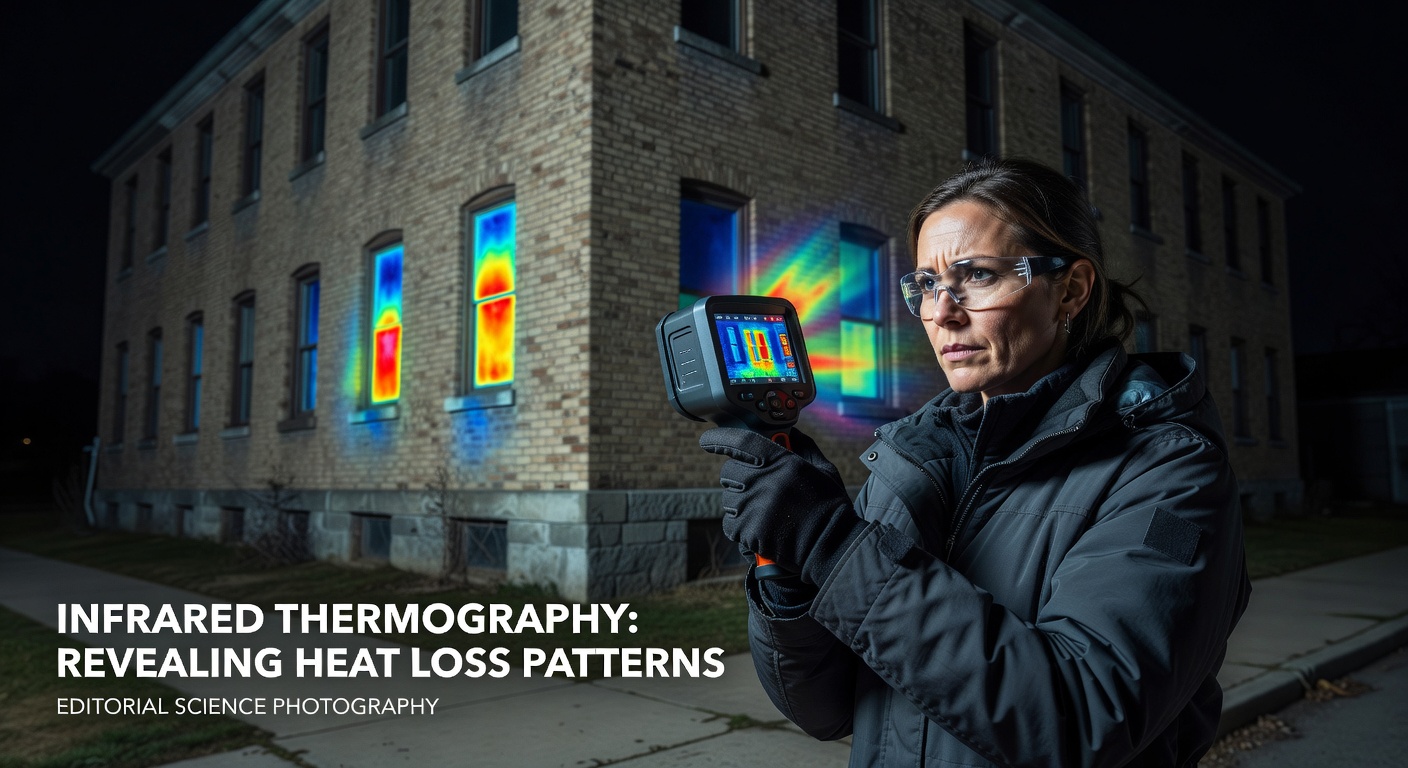
READ MORE →Point a thermal camera at your house on a cold night and you'll feel a mix of wonder and mild shame. The windows glow orange with heat loss. The junction between wall and roof blazes like a neon border. The gap under the front door — the one you've been meaning to fix — shines like a beacon. Your house is hemorrhaging energy in a colorful thermal display that previous generations simply had no way to see.
Thermal imaging detects long-wave infrared radiation — the heat emitted by any object above absolute zero. Warmer objects emit more radiation, cooler ones emit less. A thermal camera translates this into a false-color image where hot areas appear red or white and cool areas appear blue or purple. The result is a parallel visual universe defined entirely by temperature.
"We've been building leaky buildings for decades not because we didn't care, but because we literally couldn't see the leaks. Give everyone a thermal camera and the entire energy conversation changes overnight."
The cost of thermal imaging has dropped by roughly 95% in the past 15 years. FLIR, the company that essentially created the consumer market, launched its $199 phone attachment in 2014. By 2024, several companies were offering clip-on thermal cameras for under $100, and smartphone manufacturers began quietly adding basic thermal sensors to flagship devices.
The implications for energy efficiency are enormous. The International Energy Agency estimates that buildings account for approximately 40% of global energy consumption, with heating and cooling representing the majority of that. Studies in Germany and the Netherlands show that thermal imaging inspection programs reduce household energy use by an average of 18-24% — simply by making the invisible visible.
The democratization of thermal imaging has uncomfortable edges. In 2001, the US Supreme Court ruled in Kyllo v. United States that police using thermal cameras to detect heat lamps in private homes without a warrant was an unconstitutional search. That ruling was passed when thermal cameras cost tens of thousands of dollars and were essentially government-only technology. Today anyone can buy one.
Perhaps the most profound shift is what thermal imaging does to our relationship with the built environment. A beautiful building can hide a terrible thermal signature. A perfectly renovated Victorian terrace can be leaking heat at every original window frame. Thermal cameras don't lie about this. They impose a kind of energy honesty that aesthetics alone can never deliver.
Everything is leaking heat. For most of human history, we just couldn't see it. That's changing faster than building codes can keep up with. 🌡️
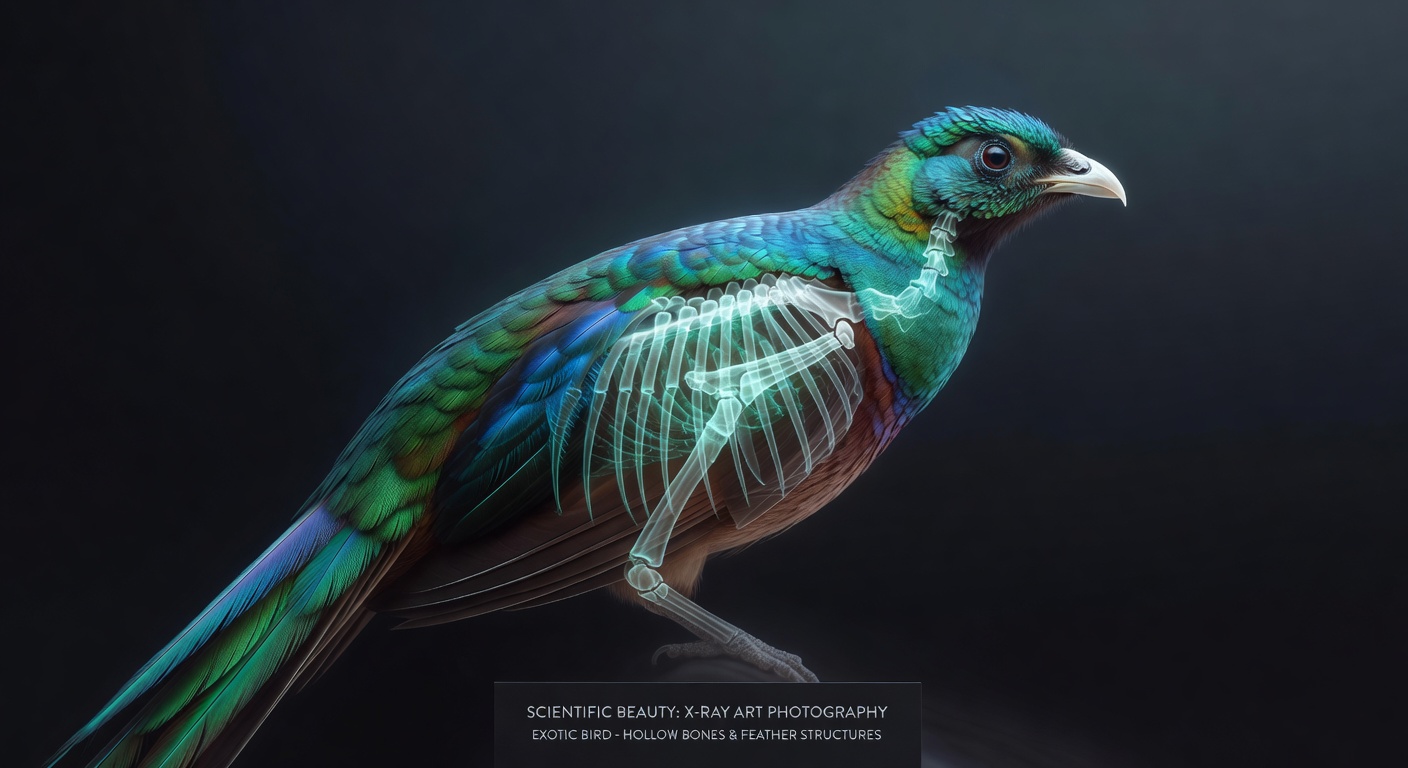
Wilhelm Röntgen's wife looked at the X-ray of her hand and said "I have seen my death." That was 1895. Today X-rays reveal the hidden architecture of everything from bird feathers to Renaissance paintings — and the next generation of imaging is showing us things Röntgen never imagined.
READ MORE →On the evening of November 8, 1895, physicist Wilhelm Röntgen noticed something strange while experimenting with a cathode ray tube in his darkened lab in Würzburg. A fluorescent screen on the other side of the room was glowing — even though his apparatus was enclosed in cardboard. Some kind of radiation was passing through solid matter as if it weren't there.
He spent the next six weeks barely leaving his lab, skipping meals, testing what this mysterious radiation could pass through. On December 22nd, he asked his wife Anna Bertha to hold her hand over a photographic plate while he directed the rays. The result — the bones of her hand, her ring finger still wearing her wedding ring — became one of the most famous photographs in history. Her reported response: "I have seen my death."
"Röntgen discovered X-rays on a Friday evening. By Monday, he had written a complete scientific paper. By the following week, the entire scientific world had been transformed. It is the fastest impact of a single discovery in the history of physics."
The medical applications were immediate and obvious. The artistic ones took longer to recognize. Dutch painter Nick Veasna has spent twenty years creating large-format X-ray photographs of birds, fish, and plants — revealing internal architecture of extraordinary beauty. Hollow bones of birds create geometric lattice structures that look like Gothic cathedrals. Tropical fish reveal skeletal geometries of surprising complexity. Orchid roots exposed in X-ray become abstract sculptures.
Art historians use X-rays routinely to study Renaissance and Baroque paintings. Beneath the surface of many famous works lie ghost images: earlier compositions the artist painted over, changed minds and altered figures, even completely different subjects on the reverse side of the canvas. Raphael's "Portrait of a Young Man" — the most valuable painting stolen in World War II and never recovered — can be partially reconstructed from X-ray analysis of the panel's wood and paint layers.
Every new imaging technology forces a renegotiation of what we mean by "seeing" something. When we see X-ray images of ancient Egyptian mummies, are we violating their privacy? When we peer through the walls of buildings from aircraft using thermal cameras, what counts as private space? When AI enhancement reveals details in photographs that the human photographer never saw with their own eyes, who made the discovery?
Röntgen's wife saw her skeleton and called it her death. But it was also her life — the hidden architecture that held her together. Every imaging breakthrough shows us a version of the world that was always there, always real, simply waiting for us to develop the right kind of eyes. 🔬