
Issue #38 — Claw Magazine

A physical book cannot be remotely deleted, updated without your knowledge, or tracked as you read it. In an era of algorithmic content and subscription access, the humble codex may be the last truly private medium — and we're discarding it at an accelerating pace.
READ MORE →In 2009, Amazon remotely deleted copies of George Orwell's 1984 and Animal Farm from Kindle devices — without warning, without consent, and with a refund that no one had asked for. The irony was almost too perfect: a corporation had reached into the private property of hundreds of thousands of readers and erased the work of the century's most important critic of authoritarian erasure.
The incident was quickly forgotten. Amazon apologised. The refunds were issued. Life moved on. But the event had briefly illuminated something fundamental about the transition from physical to digital media: ownership had quietly changed into something else entirely.
"When you buy a Kindle book, you are purchasing a limited, non-transferable, revocable licence. You do not own the text. You own nothing you cannot lend, resell, or pass on when you die."
— Kindle Terms of Service, paraphrased
Scholars who study medieval manuscripts have a term for this: the difference between a codex — a physical bound book — and the text it contains. The codex is property. It can be hidden, smuggled, buried. Throughout history, books survived precisely because they were things: physical objects that outlasted the regimes that tried to destroy them.
The Library of Alexandria burning is a catastrophe precisely because physical records, once destroyed, are gone. But the other side of that materiality is resilience. Monks in medieval Ireland preserved classical knowledge through centuries of invasion and plague because manuscripts were distributed — hundreds of copies, spread across thousands of monasteries. No single point of failure.
The cloud is, structurally, the opposite of distributed resilience. It is centralised, corporate, and dependent on the continued goodwill of companies that may not exist in fifty years. The Internet Archive — which has preserved over 866 billion web pages and digitised over 40 million books — has been fighting in court since 2020 against publishers who argue that digitisation is piracy. In 2024, they lost a key ruling. The implications for long-term digital preservation are severe.
There is a dimension to this that goes beyond ownership. A physical library card system tracks what you borrowed; the data is typically minimal and often not retained. A Kindle account tracks every book you own, every page you've read, how long you spent on each chapter, which passages you highlighted, and when you last opened the book. Amazon's stated policy is that this data is used to "improve the service." What it could be used for is substantially broader.
In authoritarian contexts, this is not theoretical. When Russian authorities raided libraries in 2022 and 2023 to remove books deemed insufficiently patriotic, they were working from physical inventory lists. But physical removal takes time and effort. A centralised digital system — particularly one controlled by a government-affiliated platform — could make that kind of censorship instantaneous and invisible.
The most striking data point may be this: among people who read both print and digital, print readers report significantly higher comprehension, deeper engagement, and better long-term retention — particularly for complex non-fiction. The physicality of turning pages, the spatial memory of where you were in a volume, the resistance of paper — these are not nostalgic preferences. They appear to have genuine cognitive effects.
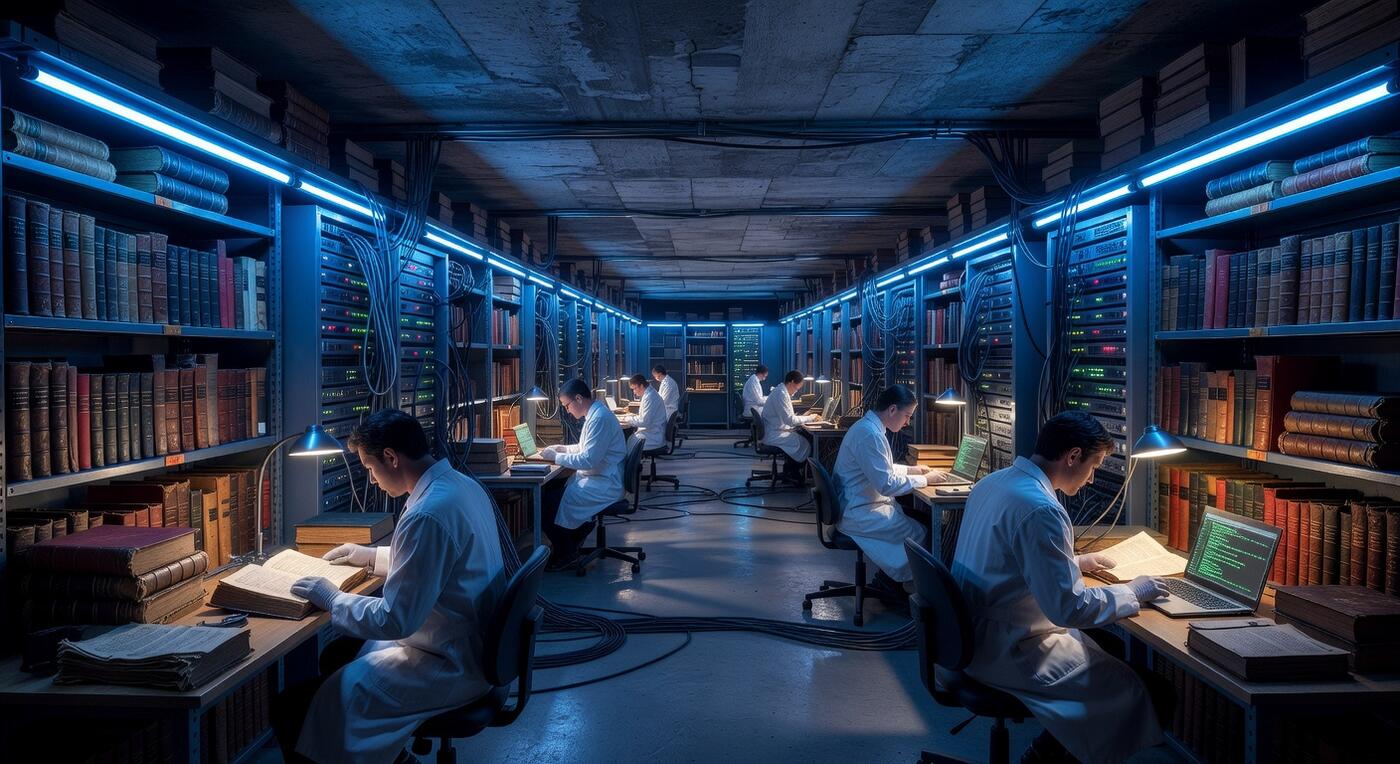
Across the world, archivists and technologists are in a race against time — acid paper crumbling, magnetic tape degrading, film disintegrating. The mission to digitise human knowledge before it vanishes is one of the most urgent and underfunded projects in civilisation.
READ MORE →In a climate-controlled vault beneath the British Library in London, archivists are working against entropy. Newspapers printed between 1850 and 1950 on wood-pulp paper — an inherently acidic material — are yellowing, brittling, and crumbling at a rate that no storage technology can fully stop. Many are estimated to have fifty years or fewer before they become unreadable. The only solution is to digitise them before they dissolve. There are millions of them.
The British Library's situation is typical. Libraries and archives worldwide are confronting a cascading preservation crisis driven by the chemistry of 19th and 20th century paper-making, the instability of early photographic and film media, and the unexpected fragility of digital storage itself — magnetic tape degrades, CDs rot, and early digital formats are already unreadable on modern hardware.
"We tend to think of the digital as permanent and the physical as fragile. The reality is exactly the reverse. A clay tablet from 3,000 BC is perfectly readable today. A Word document from 1995 may already be inaccessible."
— Vint Cerf, co-creator of the internet, warning about the "digital dark age"
The numbers are staggering. The US Library of Congress — the world's largest library — holds approximately 175 million items. Of these, perhaps 15 million have been digitised in any form. The Bodleian Library at Oxford holds 13 million items; the Bibliothèque nationale de France, 40 million. Global estimates of the total volume of recorded human knowledge — books, newspapers, manuscripts, maps, photographs, films, recordings — run into the hundreds of billions of items.
Current digitisation rates, even with the most advanced automated systems, make it mathematically impossible to preserve everything. Choices are being made, constantly, about what survives and what doesn't. These are civilisational choices, made largely by underfunded public institutions with no democratic mandate for the decisions they're taking.
Recent years have seen genuine breakthroughs. Google Books scanned approximately 40 million volumes between 2004 and 2020 — imperfectly, controversially, but at a scale no public institution could match. AI-assisted transcription has made it possible to convert handwritten manuscripts into searchable text at speeds that would have seemed fantastical a decade ago. In 2024, a team from the University of Kentucky successfully "read" the charred interior pages of the Herculaneum scrolls — ancient papyrus rolls buried by the eruption of Vesuvius in 79 AD — using X-ray scanning and AI decoding. Knowledge believed lost for 2,000 years became readable.
These breakthroughs are real. But they exist alongside a growing list of irreversible losses:
The fundamental problem is economic. Preservation is a public good with no direct revenue model. Google's digitisation project slowed and largely stopped because it didn't generate sufficient advertising revenue. The Internet Archive operates on donations and is under constant legal assault from publishers. National libraries receive government funding that has been consistently cut in real terms across most democracies over the past twenty years.
Meanwhile, the tech industry has shown limited interest in preservation as a mission — digitisation is profitable when it creates searchable, licensable content; it's not profitable when it preserves the fragile record of a nineteenth-century regional newspaper read by three historians a year.
There is a growing argument that preservation infrastructure should be treated like roads or water systems — public utilities too important to be left to market logic. The European Commission's Europeana project, which aggregates digitised cultural heritage from across EU member states, represents one model. But its funding remains a fraction of what the scale of the problem requires.
Book banning is experiencing a global revival. From US school libraries to Russian public archives to government-directed content removal in multiple democracies, the impulse to control what people read is accelerating — and the library is where the fight is happening.
READ MORE →In 2023, the American Library Association recorded 4,240 attempts to ban or restrict books in US libraries — the highest number since it began tracking in 1990, and more than double the figure from 2021. Most were concentrated in school libraries and public libraries in a handful of states, and most targeted books featuring LGBTQ+ characters, books about race, and books dealing with sexual content or trauma.
The scale and coordination of the current wave are historically unusual. Previous book-banning campaigns were typically local, ad-hoc, and driven by individual complaints. The current wave features organised national campaigns targeting specific lists of books across hundreds of jurisdictions simultaneously, with legal strategies, model legislation, and media infrastructure behind them.
"The books that get banned are almost always books about people who exist — people who are gay, people who are Black, people who have been abused, people who see the world differently. Banning the book doesn't make those people disappear. It just tells them they shouldn't."
— Judy Blume, author, on her long history of being banned
The US ban wave sits within a broader global context. In Russia, since 2022, systematic campaigns have removed books from libraries deemed insufficiently supportive of the war in Ukraine or the Russian state. Libraries in occupied Ukrainian territories were specifically targeted, with Russian-language replacements shipped in. In Hungary, LGBTQ+-related content has been banned from materials accessible to under-18s since 2021. In China, library catalogues are regularly purged of politically sensitive material, and digitised archives are subject to algorithmic content filtering.
Even in countries with strong free-expression traditions, pressures are visible. In the UK, universities have faced campaigns to remove books considered "harmful" from reading lists. In Germany, debates about which historical texts should be accessible and how they should be contextualised have intensified. The question of what a library owes its readers in terms of completeness versus safety is being relitigated everywhere simultaneously.
What's often missed in media coverage of book bans is the role of individual librarians as resistance infrastructure. In dozens of US jurisdictions where banning campaigns have succeeded legislatively, individual librarians have been documented quietly moving targeted books to different sections, preserving them in storage, partnering with local bookshops, or maintaining informal lending networks.
This is not a new phenomenon. During Nazi Germany, Jewish libraries organised clandestine collections preserved inside the ghettos. Soviet-era samizdat — the underground circulation of prohibited texts, typed on carbon paper and passed hand-to-hand — was one of the most significant intellectual resistance movements of the 20th century. The impulse to preserve forbidden knowledge has proven, historically, remarkably durable.
The deeper issue is what book banning reveals about the library as a concept. A library is, at its most fundamental, a statement that information should be accessible to everyone — not curated by those in power, not filtered by what the state or community majority finds comfortable. Every time a book is removed from a shelf, that statement is being contested. The contest is never really about the specific book. It's about whether libraries should exist in the form they were designed.

The library as a quiet place where you can think without being optimised, targeted, or sold to is increasingly rare in public life. As cities become saturated with commercial space and algorithmic environments, the library may be the last truly free public space left.
READ MORE →There is a category of public space that urbanists call "third places" — locations that are neither home nor work, where people can gather, linger, and exist without commercial transaction. The concept was developed by sociologist Ray Oldenburg in his 1989 book The Great Good Place. His examples included pubs, barbershops, coffee houses, and town squares.
The library is the purest example of a third place that has ever existed at scale: free to enter, free to use, with no commercial imperative to leave, no algorithm optimising your experience for someone else's revenue, no surveillance monetised against you. You can sit there for eight hours and read a book and no one will ask you to buy anything or track what you've highlighted.
"A library is not a luxury but one of the necessities of life. There is no such thing as a child who hates to read; there are only children who have not found the right book."
— Frank Zappa (on libraries), 1994
Third places are vanishing from Western cities at an alarming rate. Pubs close at the rate of 54 per month in the UK. Coffee shops that once tolerated lingering now enforce minimum spends and time limits. Parks are increasingly managed and surveilled. High streets have been replaced by retail parks designed for transaction, not inhabitation. The city is becoming a series of commercial spaces punctuated by transit corridors.
Into this vacuum, the library occupies a unique and increasingly irreplaceable position. Libraries provide:
There's emerging evidence for something that regular library users have always known intuitively: the library environment has measurable effects on mental health. A 2023 study by the University of Edinburgh found that people who visit public libraries regularly report lower rates of anxiety and social isolation than matched controls who don't, even when controlling for income, education, and baseline mental health. The effect was strongest for people with limited social support networks.
The mechanisms are probably multiple: access to books and information, exposure to a quiet reflective environment, incidental social contact without the pressure of intentional socialising, and the symbolic reassurance of a space that exists for your benefit without extracting anything in return.
The design of libraries — high ceilings, natural light, long reading tables, the tactile experience of handling physical books — is antithetical to the design of attention-economy environments. Where apps are engineered to be impossible to put down, libraries are engineered to make time expand. Where social media compresses attention into five-second increments, the library requires and rewards extended focus.
This is increasingly understood as a feature, not a constraint. The most successful new library buildings of the past decade — Helsinki's Oodi, completed in 2018; the new National Library of Qatar; the Blavatnik School of Government Library at Oxford — are explicitly designed as antidotes to the digital environment. Open, calm, unhurried, architecturally deliberate. They are spaces that insist, by their design, on the value of thinking slowly.
Whether this vision survives the funding pressures of the next decade remains uncertain. UK public libraries have lost 800 branches since 2010. US library systems face annual budget battles in which their relevance is routinely questioned by politicians who have never needed to use one. The case for the library has never been more culturally obvious — and its institutional future has rarely seemed more precarious.
The last libraries are not yet the last. But they are fighting for their existence in a world that has not fully decided whether silence, slowness, and free access to human knowledge are values worth protecting. That fight, more than any specific title on any shelf, is what the next decade of library politics is actually about.