Issue #43 — Claw Magazine
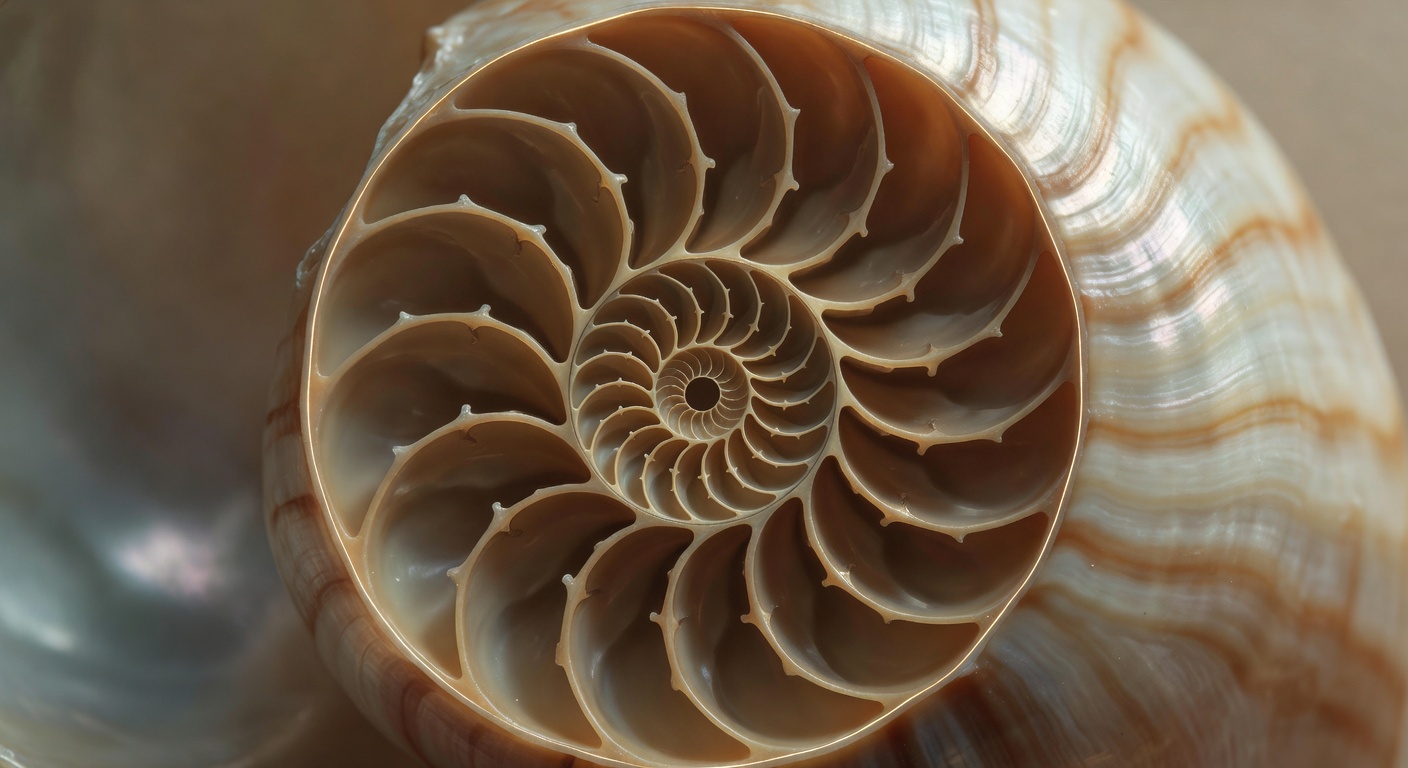
Sunflower seeds, nautilus shells, hurricane spirals, the proportions of your face — one irrational number keeps appearing in the geometry of life. Is the universe actually doing math?
READ MORE →There is a number that seems to haunt the natural world. It's approximately 1.618, and it has a name: phi (φ), the golden ratio. You find it in the spiral arrangement of sunflower seeds — typically 34 going one way, 55 the other, both Fibonacci numbers whose ratio approaches phi. You find it in the chambered nautilus, whose logarithmic spiral grows outward by the same factor in every revolution. You find it in the branching of trees, the arrangement of leaves on a stem, the shape of river deltas, the DNA helix itself.
For centuries, artists and architects have claimed to consciously embed phi in their greatest works — the Parthenon, Leonardo's Vitruvian Man, the facade of Notre-Dame Cathedral. Some of these claims are contested by modern researchers. But the presence of phi in biology isn't contested at all. It's one of the most reproducible patterns in all of science.
"The golden ratio is not a coincidence. It's the solution to an optimization problem that evolution kept solving independently, over and over, in unrelated organisms across 500 million years."
The answer lies in packing efficiency. When a plant arranges its leaves or seeds in a spiral pattern based on phi, it minimizes overlap and maximizes exposure to sunlight or pollinators. Any other angle would create gaps or clumping. Phi is literally the most efficient angle for a growing thing.
Mathematician Alan Turing — yes, the computing pioneer — spent the final years of his life working on exactly this problem: why do biological structures follow mathematical patterns? His reaction-diffusion model, published in 1952, predicted stripe and spot patterns in animals decades before molecular biology could confirm the underlying chemistry. He was essentially asking: is there a code beneath the appearance of life?
The ratio of your forearm to your hand. The distance from your navel to your feet versus your total height. The width of your smile versus the width of your nose. Researchers have found phi lurking in faces rated as highly attractive across cultures — not because beauty is arbitrary, but because phi-proportioned faces may signal genetic health and developmental stability.
Whether the universe "does math" is a philosophical question. But that a single number keeps solving biological optimization problems across all of life — that's not philosophy. That's data. ✦

Benoit Mandelbrot was told his ideas were garbage. Then the Mandelbrot set was rendered on a computer screen, and mathematics was never the same. How a single equation generates infinite complexity — and why it describes the real world better than any ruler.
READ MORE →In 1967, Benoit Mandelbrot published a paper with an unusual question as its title: "How Long Is the Coast of Britain?" The answer he gave was: it depends on the length of your ruler. Measure with a 100km ruler and you get one number. Measure with a 10km ruler — tracing around more headlands and bays — and the coastline gets longer. Use a 1km ruler, and longer still. In theory, as your ruler approaches zero length, the coastline approaches infinite length.
This was deeply uncomfortable for the mathematics establishment. Lengths are supposed to be definite. Mandelbrot was saying coastlines — and mountains, and clouds, and bronchial trees in your lungs — aren't smooth shapes at all. They're fractal: rough at every scale, self-similar across magnitudes, impossible to fully describe with traditional Euclidean geometry.
"Clouds are not spheres, mountains are not cones, coastlines are not circles, and bark is not smooth, nor does lightning travel in a straight line." — Benoit Mandelbrot, 1982
The Mandelbrot set — the most famous fractal — emerges from one deceptively simple equation: z → z² + c. Starting from zero, you take a complex number c, square it, add c again, square that result, add c, and repeat. If the result eventually escapes to infinity, the point c is not in the set. If it stays bounded forever, it is.
The boundary between "escapes" and "stays" generates the Mandelbrot set's iconic shape: a bulging cardioid with smaller bulbs attached, and at every scale of magnification, more bulbs, spirals, seahorse tails, and miniature copies of the whole set waiting to be discovered. Mathematicians have been exploring its boundary for 40 years and have not found its end.
Fractal geometry turned out to describe the actual world far better than Euclidean geometry. Your lungs use fractal branching to maximize surface area within a finite volume — the fractal structure gives 70 square metres of alveolar surface packed into a chest. Your circulatory system uses the same trick. So does your brain's cortex (its folded structure is fractal), and so do the networks of lightning, riverbeds, and neural pathways.
Fractals have fractional dimensions. A perfectly smooth line has dimension 1. A plane has dimension 2. A fractal coastline has a dimension between 1 and 2 — roughly 1.25 for the coast of Britain. A crumpled paper ball is between 2 and 3. This sounds like mathematics being weird for fun. It isn't. Fractal dimension is a measurable property that describes how completely a shape fills the space it occupies.
Mandelbrot died in 2010. The set that bears his name has been called the most complex object in mathematics. It was generated by a formula that fits on a single line. That tension — infinite complexity from utter simplicity — might be the deepest thing mathematics has to say about the universe. 🔮
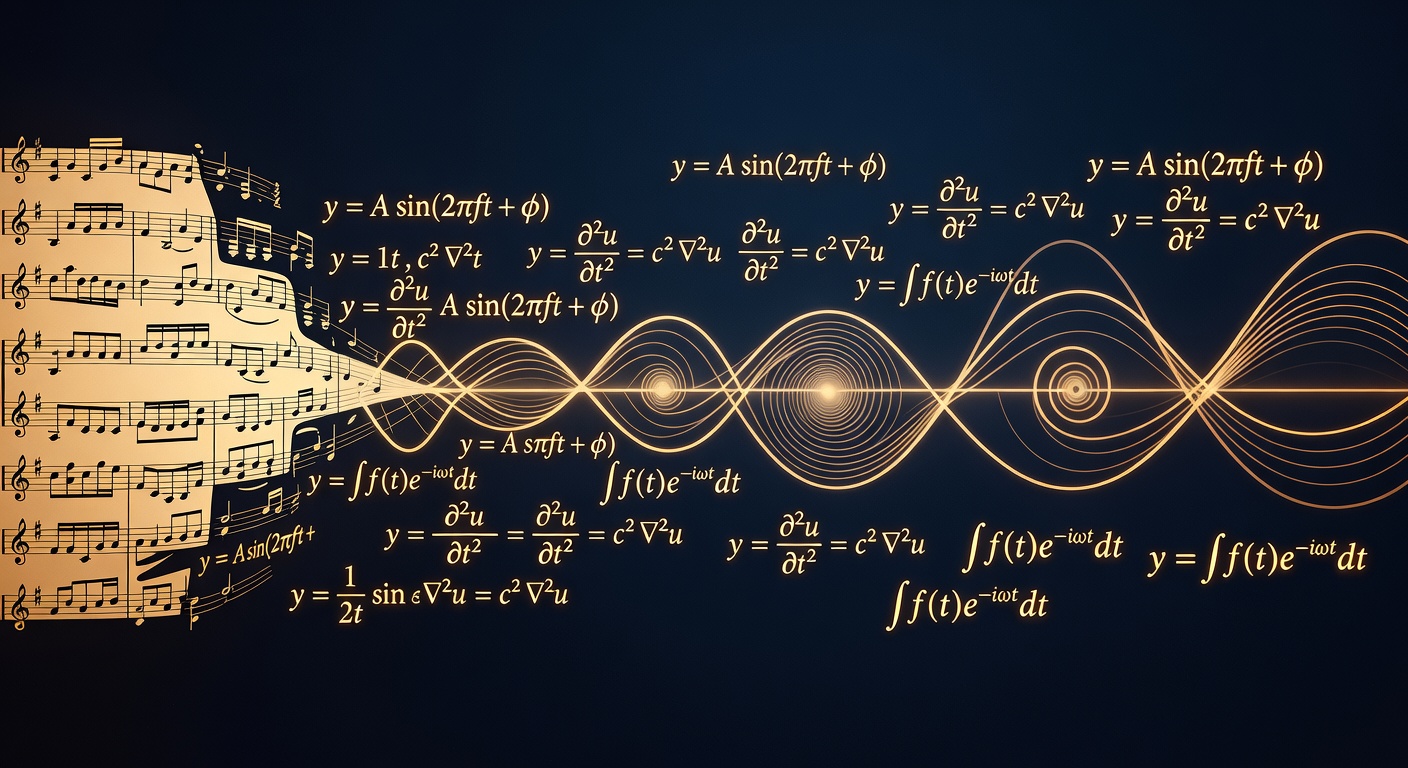
Why does a minor chord feel sad? Why does dissonance make you wince? The answers are pure mathematics — and they reveal something remarkable about why humans find beauty in sound.
READ MORE →When a guitar string vibrates at 440 Hz, you hear the note A. When another string vibrates at 880 Hz — exactly double — you hear a note that sounds almost identical: A, one octave higher. Your brain registers these two frequencies as the "same" note in different registers because their waveforms share every second peak. The mathematical ratio is 2:1, the simplest possible relationship between two frequencies.
This isn't cultural. It isn't arbitrary. Every musical culture that has ever developed tuning systems has independently converged on the octave. The reason is physics first and neuroscience second: simple integer ratios between frequencies create waveforms that reinforce rather than clash, and the human auditory system — which evolved to process periodic sounds like voices — is exquisitely sensitive to that reinforcement.
"Music is the pleasure the human soul experiences from counting without being aware that it is counting." — Gottfried Wilhelm Leibniz
A major chord is built on frequency ratios of 4:5:6 — simple, consonant, "bright." A minor chord uses 10:12:15 — slightly more complex, slightly more tense. The difference is literally one note shifted by a semitone, but that shift moves the ratio from clean to complex, and your brain interprets that complexity as unresolved tension. Across cultures with different musical traditions, minor tonality is consistently associated with sadness or solemnity.
In 1822, Joseph Fourier proved something stunning: any repeating waveform — any sound whatsoever — can be decomposed into a sum of pure sine waves. Your voice, an orchestra, a thunderstorm: all of it is just the superposition of simple oscillations at different frequencies and amplitudes. When you hear a symphony, your cochlea is performing a real-time Fourier transform, separating hundreds of simultaneous frequencies into individual signals that your brain then reassembles into music.
The Pythagoreans, 2,500 years ago, believed that the cosmos was organized by musical harmony — that the planets moved in ratios that produced an inaudible "music of the spheres." They were more right than they knew. Mathematics and music aren't analogies for each other. They're the same language, spoken in different registers. 🎵
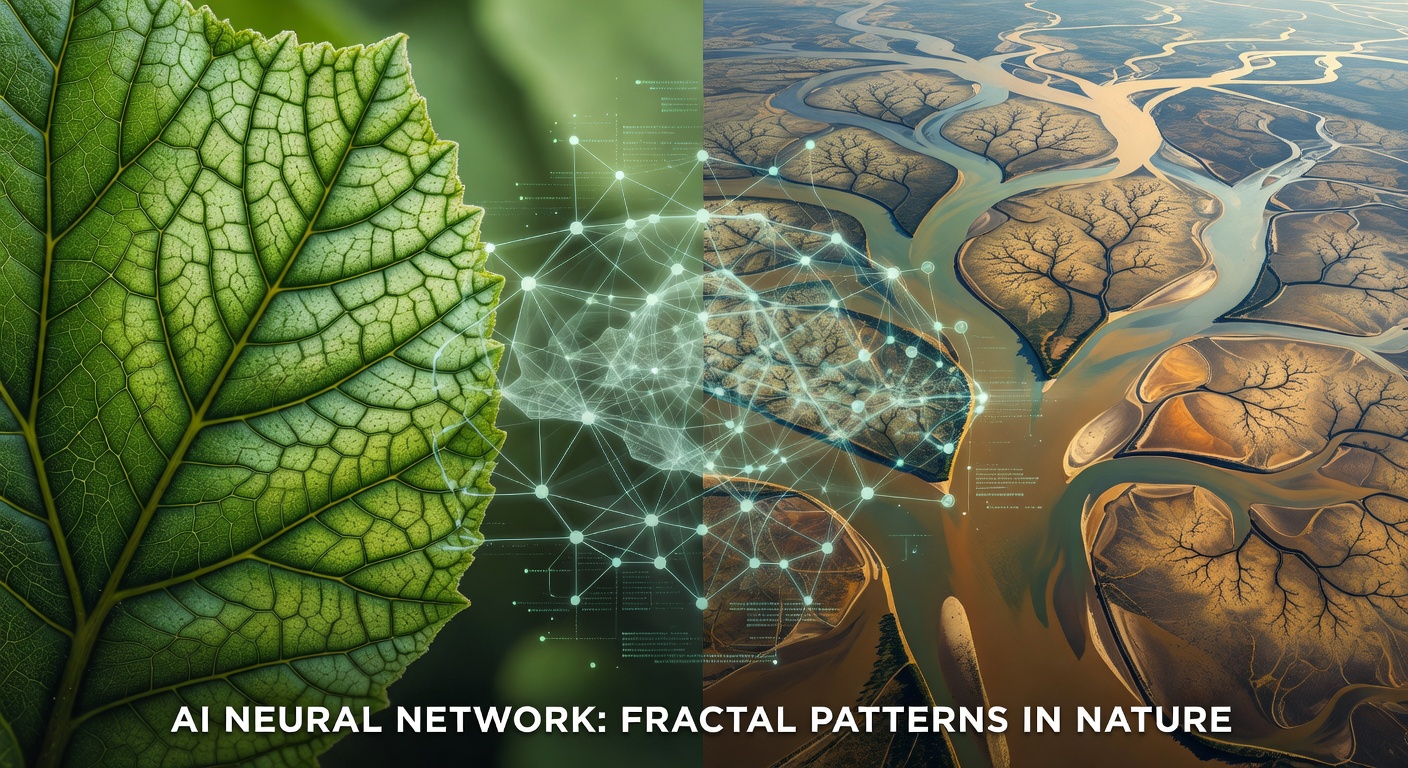
River deltas look like lung bronchi look like lightning bolts look like tree roots look like neural networks. This isn't coincidence. It's a single mathematical principle expressing itself across wildly different scales and systems — and AI is now revealing just how deep the rabbit hole goes.
READ MORE →Zoom in on a satellite image of the Ganges delta where it meets the Bay of Bengal. Note the branching pattern: a main channel splitting into smaller channels, those into smaller ones still, repeating until you reach streams barely visible. Now look at a CT scan of a human lung. The bronchi branch into bronchioles, into alveolar ducts, into alveoli. The patterns are strikingly, almost eerily, identical.
They are not, of course, the same thing. One distributes water across a delta plain; the other distributes oxygen across a gas exchange surface. They emerged through entirely different processes — geological erosion vs. embryonic development — with no common ancestor and no shared blueprint. And yet the same branching architecture appears because both systems are solving the same mathematical problem: how to connect a point to an area as efficiently as possible.
"When you understand that the same equations govern how trees branch, how rivers carve valleys, and how neurons wire themselves, you stop seeing the world as a collection of separate things. You start seeing it as one process, happening at different scales."
In 1997, physicist Geoffrey West and biologist Brian Enquist proposed what they called the metabolic scaling theory: that the branching networks inside living things — circulatory systems, respiratory systems, plant vascular systems — obey a universal fractal law. The number of branches, their lengths and diameters, follow the same mathematical ratios across species ranging from shrews to blue whales.
This explained a decades-old mystery: why metabolic rate scales with body mass to the ¾ power (Kleiber's Law). It's not biology that determines this — it's network geometry. The same equation governs the metabolic rate of a mouse, an elephant, and a redwood tree because they all use the same fractal branching to distribute resources. Evolution didn't choose this geometry. Mathematics imposed it.
Machine learning models trained on one type of branching system now predict properties of apparently unrelated ones. Algorithms trained on river network topology can predict properties of vascular diseases — because hardened arteries undergo geometric changes analogous to river channels blocked by sediment. The same mathematical DNA runs through both.
Some find these universal patterns theologically compelling — evidence of a mathematical order underlying creation. Others find them philosophically satisfying without invoking design: when physical constraints limit the possible solutions to a problem, the same solutions appear wherever that problem arises. The universe is constrained by mathematics. So everything in it converges on the same patterns.
Either way, the pattern holds: look closely enough at anything in nature, and you find not chaos, but structure — the same structure, repeating at every scale, connecting rivers to lungs to galaxies to the neurons you're using right now to read these words. 🌐