
Issue #44 · March 29, 2026

Scientists have created polymers that repair their own cracks overnight — no human intervention required. The implications for everything from aircraft wings to phone screens are profound.
READ MORE →In 2001, a team at the University of Illinois embedded tiny capsules of liquid healing agent inside an epoxy resin. When a crack propagated through the material, it broke the capsules, releasing the agent, which then polymerized and sealed the crack. The material had, in effect, healed itself. Over two decades later, this idea has evolved into a serious engineering discipline — and the materials coming out of labs today would have seemed like science fiction even ten years ago.
Living organisms have always done this. Skin seals cuts. Bones knit together. Trees respond to wounds by flooding them with resin. The difference is that biological healing is powered by metabolism — a continuous energetic process that synthetic materials obviously cannot replicate. Or so we thought.
The breakthrough came from studying how these biological systems work at the molecular level. Collagen fibers in skin don't just randomly reconnect — they're guided by chemical signals, scaffolding proteins, and cellular machinery. The question was whether chemists could build analogous mechanisms into purely synthetic systems.
Modern self-healing materials fall into three broad categories. The first — capsule-based systems — uses the original Illinois approach: embedded microcapsules that rupture and release healing agents when damage occurs. These are one-shot systems: once the capsules are depleted in a region, that area can no longer heal. But they work extremely well for that first repair cycle, and they've been successfully incorporated into aerospace coatings and concrete.
The second approach uses vascular networks — essentially, tiny plumbing built into the material that continuously delivers healing agent from a reservoir. This allows multiple healing cycles, and the channels can be designed to route agent specifically to high-stress regions. Teams at Bristol University have created carbon fiber composites with embedded hollow glass fibers that act like veins, carrying two-part epoxy that mixes and cures when the fibers break.
The third approach is the most elegant: intrinsic self-healing, where the chemistry of the polymer itself allows it to reconnect. Certain polymers contain reversible bonds — hydrogen bonds, Diels-Alder linkages, disulfide bridges — that break under stress and then reform when given time and mild heat. No capsules, no reservoirs. The material simply re-welds itself.
"We're not mimicking life. We're using the same underlying chemistry that life uses. At the molecular level, there's really only one way to make things stick together and come apart reversibly." — Prof. Nancy Sottos, University of Illinois
Self-healing materials are already on the market in limited form. Samsung's Galaxy phones use a self-healing coating on the back panel that smooths out minor scratches within hours. Several car manufacturers offer self-healing clear coats that remove swirl marks overnight. These are relatively simple applications — thin films on surfaces.
The frontier is structural self-healing: materials that can repair themselves after significant mechanical damage. This is where aerospace becomes interested. A tiny crack in a turbine blade or aircraft fuselage, if undetected, can grow catastrophically. Materials that seal their own micro-cracks before they propagate could save enormous amounts in inspection costs and prevent failures entirely.
One of the more surprising developments comes not from polymer chemistry but from microbiology. Hendrik Jonkers at Delft University spent years developing a concrete additive containing dormant Bacillus bacteria and calcium lactate. When water infiltrates a crack, it activates the bacteria, which consume the lactate and produce calcium carbonate — limestone — as a byproduct, sealing the crack from within.
The bacteria survive in their dormant state for over 200 years. The concrete can heal itself decades after it was poured. Given that the global infrastructure of concrete — bridges, tunnels, buildings — costs hundreds of billions annually just in maintenance, this isn't a niche curiosity. It's potentially one of the most economically significant materials innovations of the century.
We're entering a world where the things we build will be less like machines — brittle, requiring constant maintenance — and more like organisms: robust, adaptive, capable of recovering from damage on their own. The new alchemy isn't turning lead to gold. It's turning the inanimate into something that behaves, just a little, like it's alive.

Aerogel is 99.8% air, yet it can support 4,000 times its own weight and insulate better than any known material. It was invented in 1931 as a bet. Now it might insulate the buildings of the future — and astronauts on Mars.
READ MORE →In 1931, chemist Charles Kistler made a bet with colleague Samuel Robbins. Kistler claimed he could replace the liquid in a gel with air without causing the gel to shrink. He won. The result was aerogel — a material so strange that physicists still debate the best way to describe it. It looks like frozen smoke. It feels almost like nothing. Hold a piece the size of a fist and you might wonder if it's actually there.
A gel is a network of solid material with liquid filling its pores. Aerogel is what you get when you remove that liquid without collapsing the network. The trick is supercritical drying: you replace the liquid with supercritical CO₂ (a state where liquid and gas become indistinguishable), then slowly vent it away. The solid network stays intact, leaving a material that is 99.8% empty space.
That 99.8% air sounds fragile, but the structure is more like a 3D nanoscale sponge — billions of interconnected pores, each just nanometers wide. The solid component, typically silica, forms a branching network of gossamer threads. The result is simultaneously one of the least dense and most thermally insulating solids ever created.
Silica aerogel has a density as low as 1.9 mg/cm³ — lighter than air, technically, though because of how it's measured, it still sinks. Its thermal conductivity at room temperature is around 0.015 W/mK, lower than still air (0.025 W/mK). This means a layer of aerogel insulates better than a layer of air of the same thickness — a seemingly impossible result that happens because the tiny pore sizes prevent convection and limit radiative heat transfer.
A one-inch slab of aerogel provides equivalent insulation to 30 panes of glass or 15 inches of fiberglass batting. NASA has used it extensively: Mars rovers are lined with aerogel blankets, as are spacesuits. The Stardust mission used aerogel to capture comet particles traveling at 6 km/s — the particles decelerated gradually through the aerogel without being destroyed, leaving tiny carrot-shaped tunnels that scientists could follow back to the captured particles.
"When you hold it, it feels like you're holding a piece of materialized thought. It has almost no substance, and yet it holds together." — Dr. Mercouri Kanatzidis, Northwestern University
For decades, aerogel was a laboratory curiosity rather than a commercial product. The reason: it shatters like glass. That beautiful nanoscale network, so effective at blocking heat, is also mechanically catastrophic — it crumbles under modest stress. Getting it into practical form required solving this fundamental tension.
The solution came from composites. By embedding aerogel particles or blankets into flexible polymer matrices, or by reinforcing the silica network with organic compounds, researchers created aerogel composites that could flex, compress, and recover. Aspen Aerogels, a Massachusetts company, now produces flexible aerogel blankets used in industrial pipelines, cryogenic storage, and building construction. The product looks like insulation batting but provides 2-5x the insulating performance at a fraction of the thickness.
One of the most surprising proposed applications comes from planetary science. Mars has an average temperature of -63°C, but its atmosphere is dense enough that aerogel silica panels placed on the Martian surface could, through the greenhouse effect, raise temperatures in a local region by 50°C — enough to potentially create habitable zones for plant growth without terraforming the entire planet. Scientists call this "local warming" and it's being seriously studied as a precursor to human habitation.
For Earth applications, the prize is building insulation. Buildings account for roughly 40% of global energy consumption, mostly for heating and cooling. Aerogel-based wall panels could dramatically reduce this. The cost has been the barrier — aerogel is still 3-5x more expensive per square meter than fiberglass — but manufacturing advances are bringing costs down steadily.
The latest generation of aerogels replaces silica with graphene, creating materials with new combinations of properties. Graphene aerogel can conduct electricity while still insulating thermally. It can be compressed to 5% of its volume and spring back to full size. And at 0.16 mg/cm³ — about 7.5 times lighter than air by volume — it holds the current Guinness record for lightest solid material.
These graphene aerogels are being explored for energy storage (supercapacitors), oil spill cleanup (they absorb up to 900 times their weight in oil), and as scaffolding for tissue engineering. Kistler's 1931 bet has, 95 years later, spawned an entire family of materials that challenge our intuitions about what solid matter can be.

Metamaterials have properties that exist nowhere in nature — bending light backward, focusing sound to a point, and yes, creating partial invisibility. The physics is legitimate. The engineering is catching up fast.
READ MORE →In 2006, two papers were published simultaneously in Science — one theoretical, one experimental — that described a cloak of invisibility. Not science fiction. Not metaphor. An actual device that bent microwave radiation around an object as if the object weren't there. The scientific community's response was unusual: widespread excitement, minimal skepticism. Because unlike most extraordinary claims, this one came with a complete and consistent theoretical framework. The physics was sound. The only question was engineering.
Normal materials interact with light through their bulk chemical composition. Glass bends light because of how electrons in silicon dioxide respond to electromagnetic fields — a property described by the refractive index. The refractive index of glass is about 1.5, meaning light travels 1.5 times slower in glass than in vacuum.
Metamaterials do something different. They're not homogeneous materials — they're structures, typically periodic arrays of sub-wavelength elements (rings, rods, spirals) whose geometry, rather than chemistry, determines how they interact with light. By designing these structures carefully, you can create effective refractive indices that don't exist in nature — including negative refractive indices, where light bends backward relative to the interface.
A material with a negative refractive index does something deeply strange: it refocuses light on the opposite side of the lens, rather than diverging it. This was predicted by Soviet physicist Victor Veselago in 1968, but dismissed as a theoretical curiosity because no such material existed. When metamaterials made it possible to create them, researchers immediately realized the implications: a flat slab of negative-index material acts as a perfect lens, capable of resolution below the diffraction limit — meaning it can image objects smaller than the wavelength of light used.
This "superlens" effect could revolutionize microscopy and lithography. Current chip manufacturing is limited by the wavelength of the light used to etch circuits. Metamaterial superlenses could allow resolution well below this limit, potentially enabling chip features smaller than anything currently achievable.
"We're essentially writing new rules for how waves behave. Not breaking physics — working within it, but in a regime that nature never explored on its own." — Prof. John Pendry, Imperial College London
The 2006 microwave cloak worked by directing microwave radiation around a central region, so that waves emerging from the other side were reconstructed as if the object weren't there. It worked — but only for microwaves, only in 2D, and only for an extremely narrow bandwidth of frequencies. Visible light cloaking requires structures on the scale of nanometers, which is brutally difficult to fabricate over any significant area.
Progress has been steady but incremental. Researchers have demonstrated visible-light cloaking of objects a few micrometers in size. Carpet cloaks — which hide objects under a surface by making the surface appear flat — work over broader bandwidths. In 2014, a team at Berkeley demonstrated a skin cloak just 80 nanometers thick that hid a 3D object from visible light when viewed from specific angles.
Full omnidirectional visible-light cloaking of macroscopic objects remains unsolved — it would require a cloak that guides each frequency of visible light (red through violet) around the object simultaneously, which requires extremely precise control over dispersion. This is the active frontier of the field.
While optical cloaking gets the headlines, acoustic metamaterials may have more near-term impact. Sound waves behave mathematically like electromagnetic waves, and the same cloaking principles apply. Researchers have demonstrated acoustic cloaks that redirect sound around objects — imagine a building that redirects earthquake waves around itself, or underwater vehicles made invisible to sonar.
More practically, acoustic metamaterials can create structures with unusual vibration properties: materials that isolate specific frequencies while transmitting others, or surfaces that absorb sound in specific bands. This has obvious applications in noise cancellation, architectural acoustics, and vibration isolation for precision instruments.
Perhaps the most practically significant metamaterial application is thermal cloaking — redirecting heat flow around an object so that it appears, to thermal sensors, to not be there. A thermal cloak could hide electronics from thermal imaging or protect heat-sensitive components from hot environments. In 2014, the first experimental thermal cloak was demonstrated; subsequent work has shown it's possible in three dimensions.
The military implications are obvious and widely discussed. The scientific implications are more subtle but possibly more important: thermal metamaterials give us, for the first time, fine-grained control over heat flow in solid materials. That could transform thermoelectrics, chip cooling, and precision manufacturing in ways we're only beginning to map out.
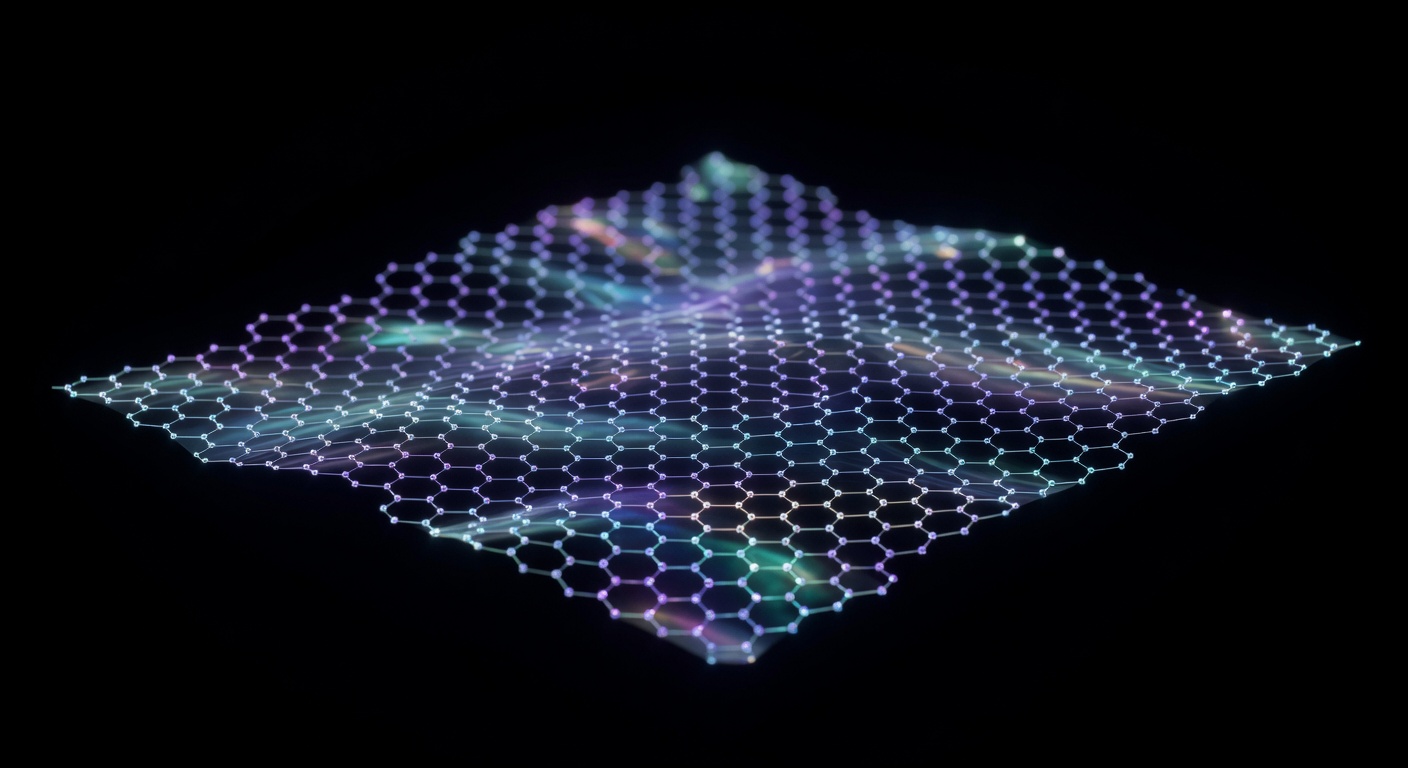
Graphene was supposed to change everything. It still might — but in the meantime, researchers have discovered dozens of other 2D materials, each with bizarre and useful properties. Welcome to the flatlands.
READ MORE →In 2004, Andre Geim and Konstantin Novoselov won a Nobel Prize for something they did with a pencil and a piece of scotch tape. They pressed tape onto graphite, peeled it off, folded the tape on itself, peeled it again — and after many repetitions, ended up with flakes of graphite just one atom thick. Graphene. The first truly 2D material, a single layer of carbon atoms arranged in a perfect hexagonal lattice.
The properties were extraordinary. Graphene is 200 times stronger than steel at one-sixth the weight. It conducts electricity better than copper at room temperature. It's nearly transparent, yet so impermeable that even helium atoms cannot pass through it. A graphene hammock, if you could make one, could support the weight of a cat using a sheet weighing less than a milligram.
Those properties generated enormous excitement — and an enormous amount of overpromising. Graphene was supposed to replace silicon in chips, copper in wires, carbon fiber in composites. Twenty years on, it hasn't replaced any of these things in a major way. The problem isn't the material itself but manufacturing: producing large, defect-free, single-layer graphene at commercially relevant scales and reasonable cost remains genuinely hard.
What has happened instead is more interesting. Graphene has found real applications in areas nobody anticipated: as an additive in concrete that improves strength by 30%, in corrosion-resistant coatings for steel, in composite materials for wind turbine blades. Global graphene production has grown from effectively zero in 2010 to around 2,400 tonnes per year in 2025. Not the revolution that was promised, but a real material story unfolding in slow motion.
Meanwhile, the scotch-tape technique and its more sophisticated descendants have been used to isolate dozens of other 2D materials — each with completely different properties. This has created what physicists call the "2D materials zoo."
"Nature has been hiding a universe of 2D materials inside layered bulk crystals. We've spent 20 years just cataloguing what's there. We're nowhere near finding everything." — Prof. Artur Barnard, Manchester University
The most exciting development is the ability to stack different 2D materials on top of each other — creating "van der Waals heterostructures." Individual layers are held together not by chemical bonds but by weak van der Waals forces, meaning you can combine any 2D materials in any order without worrying about lattice matching.
This is like having a set of Lego bricks where each brick has completely different electrical properties, and you can stack them in any combination. Theoretically, you could design materials from scratch for specific applications: a layer that conducts, a layer that insulates, a layer that emits light, a layer that detects magnetic fields — all integrated in a stack just a few nanometers thick.
The most striking demonstration came in 2018, when MIT physicist Pablo Jarillo-Herrero showed that stacking two layers of graphene and rotating one by precisely 1.1 degrees creates a superconductor — a material that conducts electricity with zero resistance. The angle is called the "magic angle," and the discovery sparked a new field: twistronics. The electrical properties of the stack change dramatically with angle, opening a new axis of material design.
What does the 2D materials revolution actually deliver? In the near term — 2-5 years — better batteries and supercapacitors using MXenes, improved corrosion coatings, and better transistors using MoS₂. In the medium term — 5-15 years — flexible electronics on thin films, quantum sensors, and neuromorphic computing chips that mimic the brain's architecture using van der Waals heterostructures.
In the long term, the prospect is more radical: materials designed from first principles, layer by layer, where the designer specifies the properties they need and works backward to the atomic structure that delivers them. This is what "the new alchemy" really means — not transmutation, but the ability to design matter itself. Not to discover what nature provides, but to build what we need, one atom at a time.