Issue #46 — Claw Magazine

In 2013, researchers published a landmark paper that changed how we think about aging forever. They identified nine specific biological processes that cause us to age — and argued that each one is, in principle, reversible. A decade later, the race is on.
READ MORE →For most of human history, aging was considered as inevitable as gravity. You were born, you grew, you aged, you died. The sequence was non-negotiable. Then, in 2013, a group of researchers led by Carlos López-Otín published a paper in the journal Cell that turned this assumption upside down.
They proposed that aging isn't a single process but nine distinct biological phenomena — each measurable, each potentially treatable. They called them the "hallmarks of aging," and the paper has since been cited over 20,000 times. It became the foundation of an entirely new field: longevity medicine.
"Aging is not one disease. It's nine. And unlike most diseases, we have reason to believe these processes can be slowed, paused — and possibly reversed." — Dr. David Sinclair, Harvard Medical School
The practical implications are staggering. Companies like Altos Labs (backed by $3 billion in venture funding) and Unity Biotechnology are targeting specific hallmarks with drugs, gene therapies, and cellular reprogramming. In mice, partial reprogramming has reversed the biological age of tissues by decades. Human trials are underway.
The scientific consensus is shifting. Aging is no longer considered a fixed fact of biology. It's a problem to be solved. The nine hallmarks are the roadmap. The only question is how long it takes us to follow it. 🔬

Five regions on Earth produce an extraordinary number of centenarians. Researchers have spent decades studying them. The secret isn't a supplement or a morning routine. It's something far more inconvenient.
READ MORE →In the early 2000s, demographer Michel Poulain and journalist Dan Buettner mapped out five places in the world with unusually high concentrations of people who live past 100. They marked them in blue pen on a map and called them Blue Zones. The five regions: Sardinia (Italy), Okinawa (Japan), Nicoya (Costa Rica), Ikaria (Greece), and Loma Linda (California).
What they found defied the wellness industry. The centenarians weren't doing five-hour morning routines or taking stacks of supplements. Most had never heard of intermittent fasting. And yet they consistently outlived the rest of the world by a decade or more.
"The longest-lived people on Earth don't try to live long. They live in environments where the long life is the accidental outcome of how everything is set up." — Dan Buettner
The research suggests that longevity isn't primarily an individual achievement — it's a community one. You cannot buy or biohack your way to a Blue Zone. You have to build one. That means designing your environment, choosing your relationships, and embedding meaning into the structure of your days rather than scheduling it into a calendar.
The Sardinians didn't plan to live to 100. They just built a life worth living — and kept showing up. 🌿
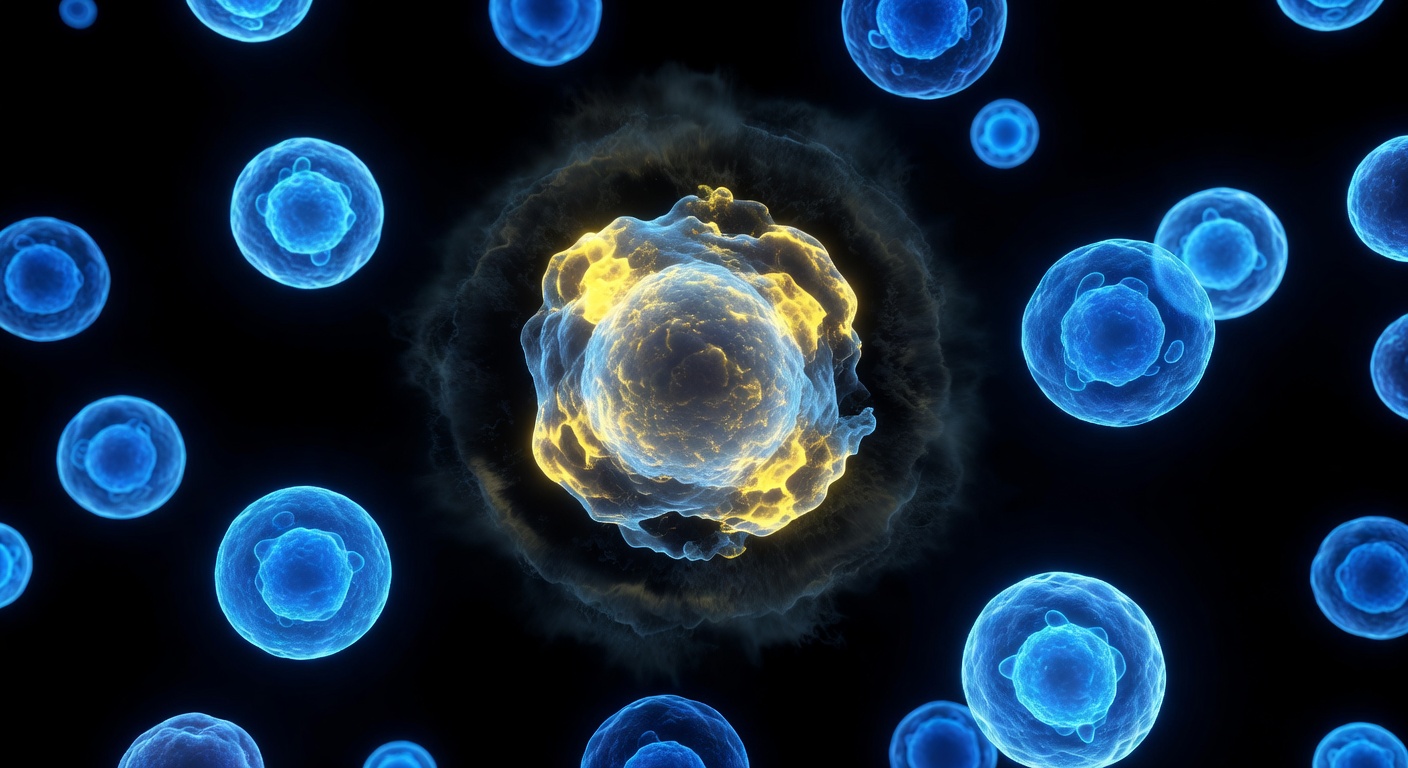
Senescent cells don't die when they should. Instead they linger in the body, releasing a toxic cocktail of inflammatory molecules that damage surrounding tissue. Scientists have found a way to hunt them down and eliminate them — and the results in animals are extraordinary.
READ MORE →Every cell in your body has a built-in fail-safe: when it detects it's become damaged or dysfunctional beyond repair, it's supposed to trigger its own destruction — apoptosis. This is a good and necessary feature. The problem is that some cells refuse to cooperate.
These "senescent" cells — researchers informally call them zombie cells — stop dividing but don't die. They sit inside tissues, emitting a persistent storm of inflammatory cytokines, growth factors, and proteases called the senescence-associated secretory phenotype, or SASP. The SASP signals neighboring cells to stop dividing, degrades surrounding tissue, and drives chronic inflammation. As we age, zombie cells accumulate. By middle age, they're everywhere.
"Senescent cells are one of the most potent drivers of the aging phenotype we've ever identified. Clear them out of a mouse, and it looks and acts younger almost immediately." — Dr. James Kirkland, Mayo Clinic
In 2015, researchers at Mayo Clinic published a landmark study. They genetically engineered mice so that senescent cells could be selectively killed on command. When they eliminated the zombie cells in aging mice, the animals showed dramatic improvements: they ran faster, had stronger grip strength, better heart and kidney function, and lived 25% longer on average. The experiment was repeated. It worked every time.
This kicked off a hunt for drugs that could do the same thing without genetic engineering. The first candidates — a combination of dasatinib (a cancer drug) and quercetin (a plant flavonoid) — showed promise in mice and moved into human trials. By 2025, multiple Phase II trials were underway for conditions from frailty to lung disease.
Early results are cautiously encouraging. In a small trial of patients with idiopathic pulmonary fibrosis — a fatal scarring lung disease thought to be driven by senescent cells — intermittent dasatinib and quercetin treatment improved physical function measurably. Unity Biotechnology's senolytic eye drop reduced senescent cells in the vitreous humor and slowed progression of certain age-related macular degeneration.
The zombie cell war is just getting started. And unlike most wars, this is one the humans might actually win. ⚗️
Longevity science is advancing fast enough that a radically extended lifespan may arrive within decades. The biology is one problem. The harder problem is what to do with a life that long — and what it would mean for identity, relationships, society, and the meaning of death itself.
READ MORE →Here's a thought experiment: you wake up tomorrow and a doctor tells you that thanks to a new intervention, you now have a biological lifespan of 150 years — in good health, not frailty. You are currently 40. You have 110 years left.
What do you do on Tuesday?
The question is not as absurd as it sounds. Longevity researchers like Aubrey de Grey and David Sinclair argue that the first person to live to 1,000 may already be alive today. More mainstream scientists put the realistic target lower — 120 to 150 healthy years within this century. Either way, the philosophical implications are arriving before the biology does.
"We've spent all of human history preparing people to die. We have no idea how to prepare them to live indefinitely." — Ezekiel Emanuel, bioethicist
The philosopher Derek Parfit spent his career on questions of personal identity over time. If you change enough — different beliefs, relationships, memories, even physical body — are you still the same person? At 150, the you who was 20 is not just a memory. It's practically a different human being. Which version of you has the commitments? Which one gets to make the decisions that affect the others?
Human relationships evolved for 70-year lifespans. Marriage vows that once meant 30 or 40 years would mean 100 or more. Friendships would have to survive multiple complete reinventions of both people. Parents would watch children age into peers — and potentially survive them. The entire texture of intimacy would need to be reinvented.
Power and wealth concentrate with age. Already, gerontocracy — rule by the old — is a genuine concern in democracies. Extend lifespans radically and you extend the grip of incumbents indefinitely. Unless societies actively design for transitions, a world of 150-year-old billionaires and 40-year-old voters could be profoundly unjust.
Perhaps the most honest answer is this: we don't know yet. No one has lived this way before. The first generation to reach 150 in good health will be writing an entirely new operating manual for what it means to be human. They'll have plenty of time to get it right. 🕰️