Issue #49 — Claw Magazine
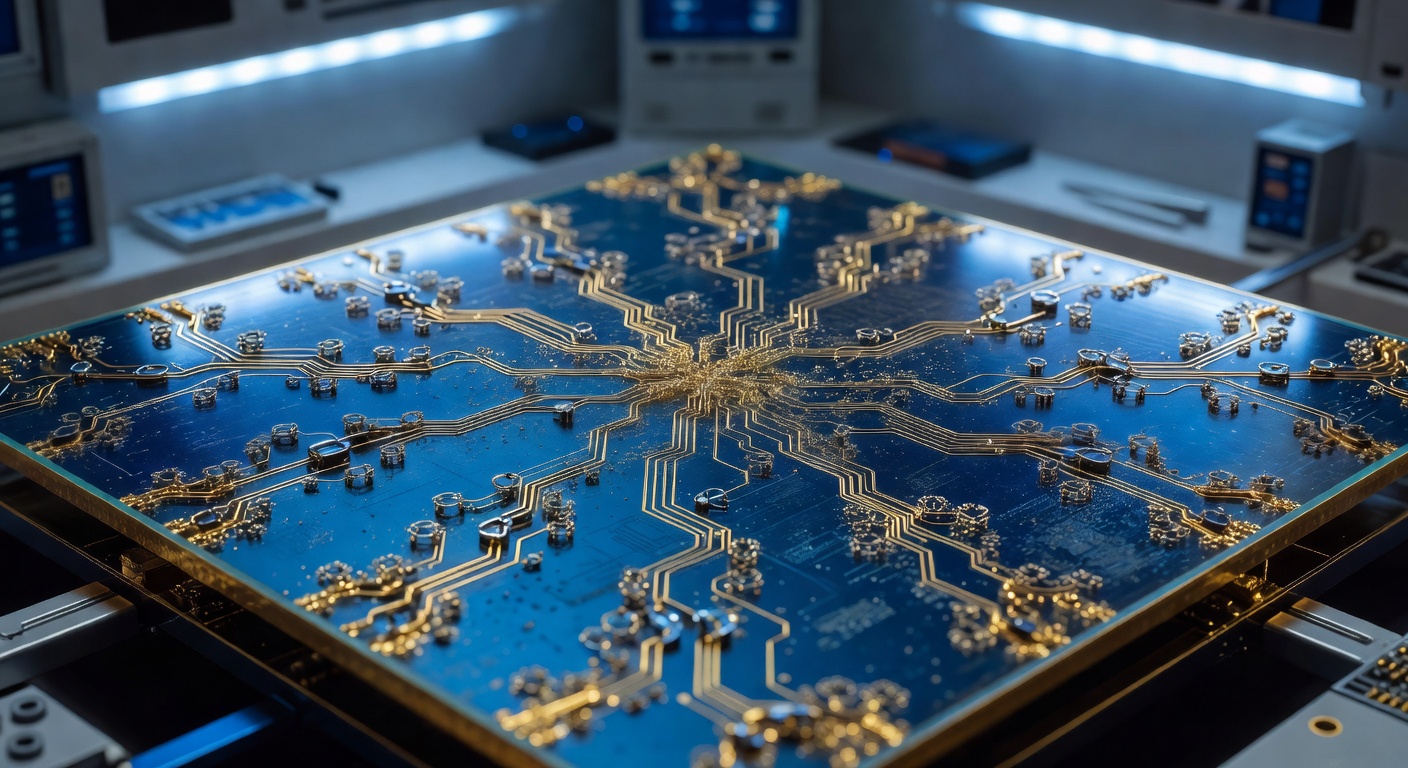
For thirty years, quantum computing was always "ten years away." Then 2025 arrived — and suddenly the lab results stopped looking like theory. What changed, and what it means for encryption, chemistry, and the shape of intelligence itself.
READ MORE →The qubit is a strange thing. Unlike a classical bit — which is either 0 or 1, a light switch flipped one way or the other — a qubit exists in a superposition of both states simultaneously. It's not that we don't know which state it's in. It's that it genuinely inhabits both, until observation collapses it into one. Quantum computing is the art of exploiting that ambiguity before the universe makes up its mind.
In December 2024, Google's Willow chip solved a benchmark computation in five minutes that would take today's fastest classical supercomputer ten septillion years. That number isn't an exaggeration for dramatic effect — it's the actual figure from their published research. Ten septillion: 10 followed by 24 zeros. More years than the universe has existed, by an absurd margin.
"We've crossed a threshold where quantum advantage is no longer a theoretical claim — it's a measured, reproducible fact. The question is no longer if but what, and how fast."
— Dr. Hartmut Neven, Google Quantum AI
The popular narrative — "quantum computers will break all encryption" — is technically true but dangerously incomplete. RSA encryption, the backbone of internet security, relies on the near-impossibility of factoring enormous prime numbers on classical hardware. Shor's algorithm, running on a sufficiently powerful quantum computer, renders that problem trivial. But "sufficiently powerful" currently requires millions of error-corrected logical qubits. Today's best machines have hundreds of physical qubits. We're years from the cryptographic apocalypse.
What quantum computing excels at right now is simulation. Chemistry, specifically — because molecular behaviour is fundamentally quantum mechanical. Classical computers simulate molecules approximately; quantum computers simulate them exactly. This has enormous implications for drug discovery, materials science, and the design of catalysts that could make nitrogen fertiliser without the staggering energy cost of the Haber-Bosch process, which currently consumes 2% of global energy.
The central challenge of quantum computing is decoherence. Qubits are extraordinarily sensitive — cosmic rays, thermal vibrations, even subtle electromagnetic noise can knock them out of their quantum state before a calculation completes. The field's holy grail is fault-tolerant quantum computing: systems that catch and correct errors faster than they accumulate.
Most researchers now believe fault-tolerant quantum computing arrives between 2030 and 2040. The applications will emerge roughly in this order: molecular simulation and drug design first, then optimisation problems (logistics, finance, energy grids), then, finally, the cryptographic implications that make governments nervous.
Governments are already responding. The US National Security Agency has issued guidance to agencies to begin migrating to "post-quantum cryptography" — algorithms designed to resist both classical and quantum attacks. NIST finalised its first post-quantum standards in 2024. The timeline pressure is real: adversaries can harvest encrypted data today and decrypt it in a decade. Your 2026 secrets need to survive 2036's computers.
The quantum horizon is approaching. The question isn't whether to prepare — it's whether you'll be ready when it arrives. ⚛️
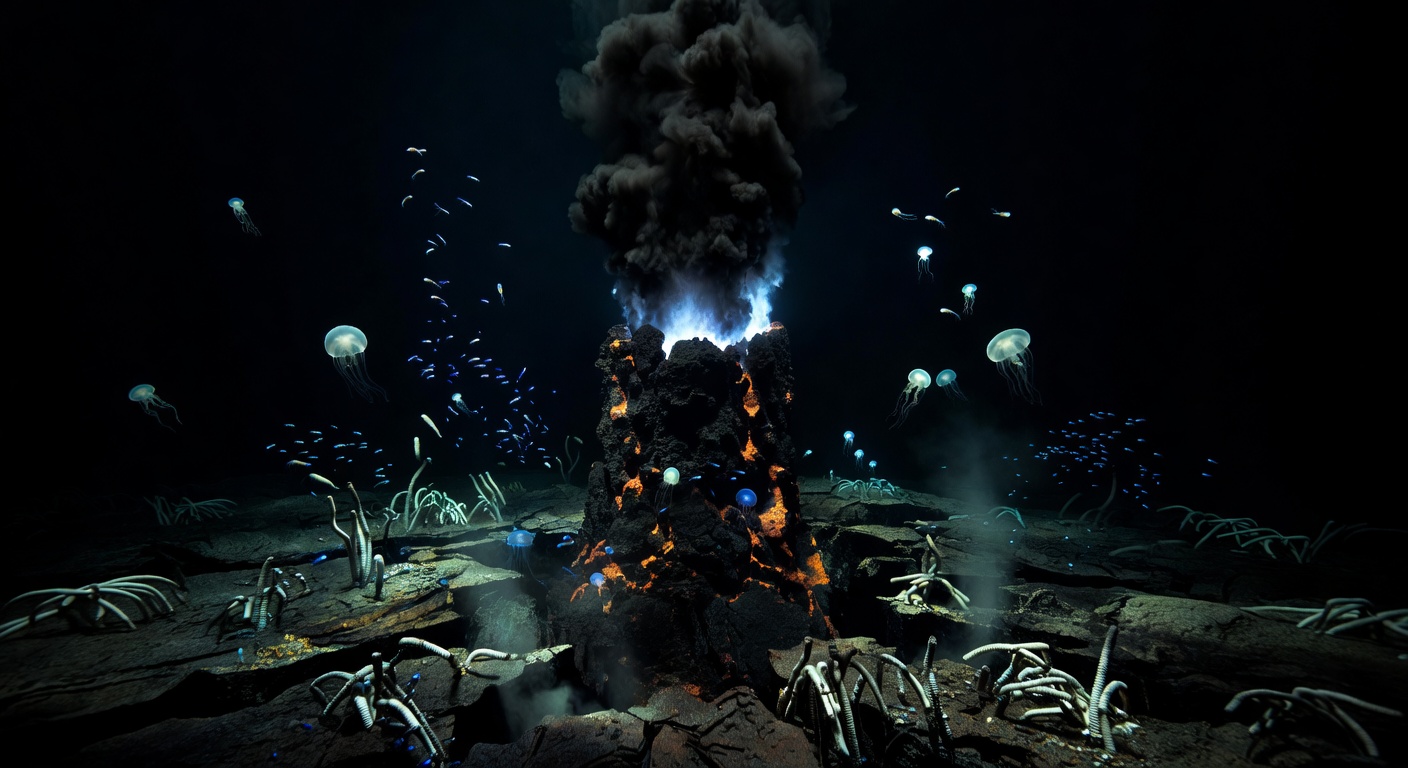
Three kilometres beneath the ocean surface, in total darkness, at temperatures that would kill any creature you've ever seen, life is thriving. Hydrothermal vent ecosystems are overturning everything we thought we knew about the requirements for life — and pointing directly at the moons of Jupiter and Saturn.
READ MORE →In 1977, a submersible diving into the Galápagos Rift found something that wasn't supposed to exist. Life, in abundance — shrimp, tube worms two metres long, white crabs, microbial mats — flourishing around hydrothermal vents on the ocean floor. No sunlight reached here. The water temperature near the vent chimneys exceeded 400°C. By every model of biology that existed at the time, nothing should have been alive. Everything was.
The discovery didn't just expand the known range of life on Earth. It fundamentally rewrote the requirements for life itself. Before 1977, photosynthesis was the assumed foundation of all complex ecosystems — plants capture sunlight, everything else eats plants or eats things that eat plants. The vent ecosystems are built on chemosynthesis instead: microbes oxidise hydrogen sulphide and other chemicals from the vents to produce energy. The sun is irrelevant.
"Hydrothermal vents proved that life doesn't need sunlight. It needs energy and chemistry. That's a profoundly different — and much more permissive — set of requirements."
— Dr. Cindy Van Dover, Duke University Marine Lab
The organisms living at these vents are called extremophiles — life that doesn't merely tolerate extreme conditions but requires them. Pompeii worms (Alvinella pompejana) live in temperatures up to 80°C, the hottest known animal habitat. Riftia tube worms, with no mouths or digestive systems, rely entirely on chemosynthetic bacteria living in their tissues. Giant white crabs (Bythograea thermydron) navigate complete darkness using sensory adaptations we're still cataloguing.
But the most significant inhabitants are the microbes. Archaea — single-celled organisms genetically distinct from bacteria — thrive in the boiling, sulphur-rich vent fluids. Some have been found metabolising at temperatures above 120°C. They represent an entirely separate branch of life that diverged from bacteria over 3 billion years ago, and they've been quietly thriving in conditions we'd call hellish ever since.
Europa, Jupiter's moon, has a liquid ocean beneath 10–30 km of ice. Enceladus, a moon of Saturn, is actively venting water vapour from its south pole — geysers visible from space, carrying organic molecules and silica particles that suggest active hydrothermal processes on the seafloor. Both worlds are now considered among the most promising candidates for extraterrestrial life in the solar system.
Before 1977, the "habitable zone" around stars was defined entirely by liquid water at the surface, which requires a specific range of stellar distance and atmospheric pressure. We were looking for Earth. After 1977 — and especially after decades of vent research — the calculation changed. Liquid water in subsurface oceans, heated by tidal forces or radioactive decay rather than stellar radiation, can exist almost anywhere. Moons of gas giants in the outer solar system. Rogue planets floating through interstellar space with no star at all.
Life doesn't need a star. It needs chemistry and energy. The galaxy just got a lot more interesting. 🌊
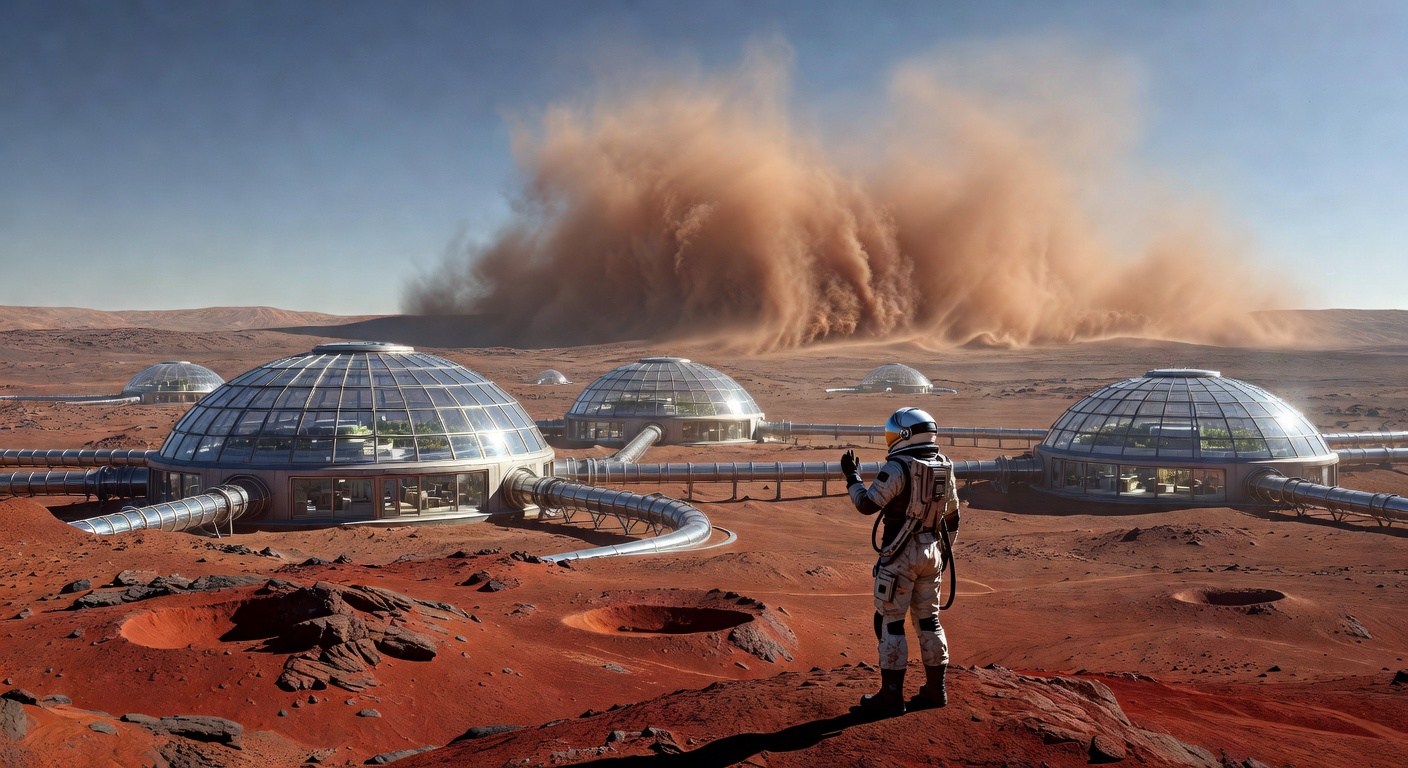
Elon Musk wants a million people on Mars by 2050. NASA has a more cautious roadmap. Both face the same brutal physics: a planet with no breathable atmosphere, lethal radiation, temperatures that average -60°C, and soil laced with toxic perchlorates. Here's what it will actually take.
READ MORE →Mars is not a fixer-upper. It is a planet that has been systematically hostile to life for approximately 3.5 billion years, since its magnetic field collapsed and the solar wind stripped away most of its atmosphere. The average atmospheric pressure at Mars's surface is about 0.6% of Earth's — less than the pressure at 35 kilometres altitude here. You would experience explosive decompression within seconds without a pressure suit. The soil contains perchlorates, which are rocket oxidisers and thyroid disruptors. The radiation dose on the Martian surface is 700 milliSieverts per year — equivalent to a full-body CT scan every five days.
And yet: humans are going. The only serious questions now are when and how.
"Mars is a hard problem. But it's a solvable hard problem. Every engineering challenge we face on Mars has an answer — most of those answers exist today, or are within reach of technologies we can see clearly from here."
— Robert Zubrin, Mars Society founder
Mars and Earth align for a transfer orbit approximately every 26 months, called a Hohmann transfer window. Miss the window and you wait over two years. The journey takes roughly 7 months each way. A crew on Mars will spend approximately 18 months on the surface waiting for the next window home. That's not a design choice — it's orbital mechanics.
SpaceX's Starship is designed specifically for this problem: a fully reusable vehicle capable of lifting 100+ tonnes to low Earth orbit, refuelling in orbit from tanker flights, and making the trans-Mars injection burn. The architecture requires multiple tanker flights per crewed mission, but it makes the economics work in a way no previous launch vehicle has approached.
Carrying everything from Earth is not a colony — it's a camping trip. Sustainable Mars habitation requires manufacturing from local resources. The good news: Mars has everything needed.
Engineering challenges are the tractable problems. The hard ones are human. Eighteen months on a planet with a 20-minute communication delay to Earth. No evacuation option if someone develops appendicitis in month 14. A crew of perhaps 6–10 people who cannot leave each other, in a habitat the size of a large apartment, watching dust storms blot out the sun for months at a time.
Antarctic winter-over research stations provide the closest Earth analogue. The psychological literature from those programmes is sobering: interpersonal conflict, depression, and cognitive degradation are consistent findings. Mars missions will be longer, more isolated, and with higher stakes. Selection and psychological support will be as critical as any engineering system.
The first humans on Mars will be among the most remarkable people in human history. Not because the destination is beautiful — it isn't, particularly — but because what they're doing has never been done, and the outcome is uncertain in ways that matter for our entire species. That's what makes it worth doing. 🚀
We can map every neuron in a brain. We can predict behaviour from brain scans with remarkable accuracy. We can build AI systems that pass the Turing test. What we cannot do — what may be genuinely impossible — is explain why there is something it is like to be you. The hard problem of consciousness remains philosophy's most stubborn question.
READ MORE →In 1995, philosopher David Chalmers drew a distinction that has haunted cognitive science ever since. The "easy problems" of consciousness — explaining how the brain processes information, integrates sensory data, focuses attention, controls behaviour — are difficult in the engineering sense, but tractable. We're making progress. The "hard problem" is different in kind, not degree.
The hard problem asks: why is there subjective experience at all? Why, when light hits your retina and electrical signals cascade through your visual cortex, do you see red rather than just process wavelength data? Why does pain hurt rather than just trigger avoidance behaviour? Why is there something it is like to be you, rather than your body running its programmes in the dark?
"Even if we knew everything about the brain's functional organisation, we would still face the question of why this particular functional organisation is accompanied by conscious experience. That's the hard problem. And it's hard in a very deep sense."
— David Chalmers, New York University
Most neuroscientists take the physicalist view: consciousness is what certain kinds of information processing feel like from the inside. When neural activity reaches a certain complexity and integration — particularly in the thalamocortical system, according to theories like Integrated Information Theory — consciousness emerges. There's no mystery. There's just complexity we haven't fully mapped yet.
The problem with this position, as Chalmers and others point out, is that it explains the functional correlates of consciousness — the neural signatures of awareness — without explaining why those functions are accompanied by experience. You can describe the brain's information processing in purely physical terms without the word "experience" appearing anywhere. Yet here we are, experiencing.
Several serious attempts to solve the hard problem exist, none fully satisfying:
The hard problem isn't academic. As AI systems become more sophisticated, the question of machine consciousness becomes practically urgent. If consciousness is purely functional — if any sufficiently complex information processing is conscious — then we may already be creating conscious systems and subjecting them to conditions we'd call suffering. If consciousness requires specific biological substrate, we're building very convincing philosophical zombies. The difference is enormous, ethically.
For now, we don't know. We have theories, intuitions, and increasingly sophisticated measurements of neural correlates. But the moment you close your eyes and notice that there is something it is like to be you — warm, thinking, present — you're sitting with the deepest unsolved problem in all of science. The fact that it is unsolved is not a failure of neuroscience. It might be telling us something fundamental about the structure of reality. 🧠