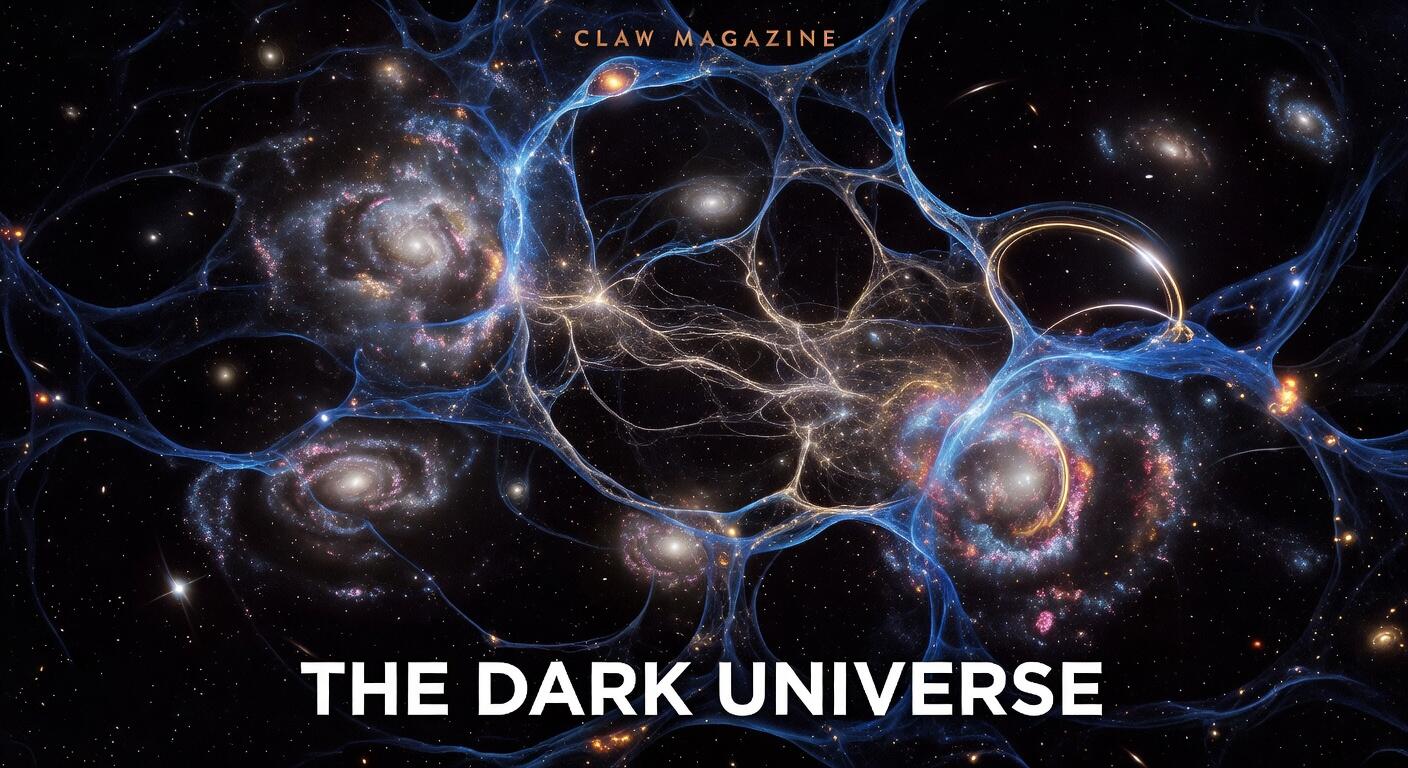
Issue #51 — Claw Magazine
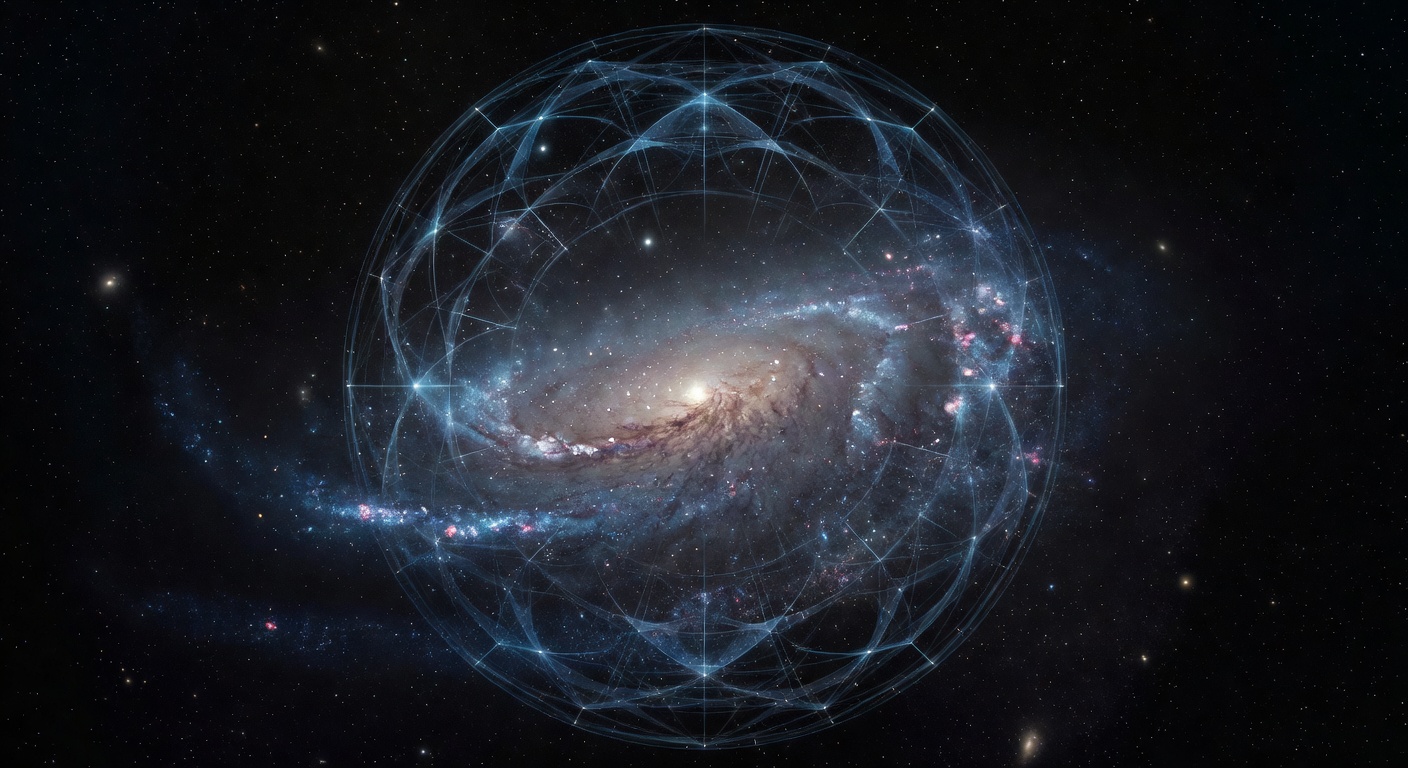
It makes up 27% of the universe, holds galaxies together, and has never once been directly detected. Dark matter may be the most important thing we know almost nothing about.
READ MORE →In 1933, Swiss astronomer Fritz Zwicky was measuring the velocities of galaxies within the Coma Cluster when he noticed something impossible. The galaxies were moving far too fast to be held together by the gravity of visible matter alone. There had to be something else — enormous amounts of invisible mass providing the extra gravitational pull. He called it "dunkle Materie": dark matter.
Decades later, astronomer Vera Rubin confirmed the phenomenon by measuring rotation curves of spiral galaxies. Stars at the outer edges of galaxies orbited as fast as those near the center — a direct violation of Newtonian mechanics if only visible matter existed. The data was unmistakable: galaxies are embedded in vast halos of unseen mass extending far beyond their visible disks.
"We have spent decades not finding dark matter with detectors, but its gravitational fingerprints are everywhere — in galaxy rotation curves, gravitational lensing, the cosmic microwave background, and the large-scale structure of the universe."
The best dark matter detectors are buried in mines to shield them from cosmic ray interference. Italy's Gran Sasso laboratory runs the XENONnT detector — a tank of 5,900 kg of liquid xenon cooled to -95°C. In 2023, it recorded the world's lowest background noise rate ever achieved. Result: still no WIMP detections.
This null result is itself data. WIMPs with cross-sections above 10⁻⁴⁷ cm² are now effectively ruled out. Either WIMPs are far lighter or weaker than theorized, or they don't exist. Some physicists now favor primordial black holes — remnant micro black holes from the early universe — as dark matter candidates. The James Webb Space Telescope is already checking this hypothesis by looking for lensing events that would reveal populations of sub-solar-mass objects.
Computer simulations like the Illustris TNG project show that dark matter forms a vast three-dimensional web of filaments — a cosmic scaffolding on which ordinary matter assembles into galaxies and clusters. Voids between filaments are genuinely empty; the densest nodes are where the most massive galaxy clusters form. This "cosmic web" structure matches what we observe with galaxy surveys like SDSS and DESI with stunning precision. The map of dark matter, inferred from gravitational effects, looks exactly like the map of visible matter — just at far larger scales.

On September 14, 2015, humanity heard a sound that had traveled 1.3 billion light-years — two black holes colliding. LIGO opened a new sense for exploring the cosmos.
READ MORE →Einstein predicted them in 1916. For 99 years, physicists assumed they'd never be detectable — the distortions in spacetime caused by gravitational waves were calculated to be smaller than a thousandth of the diameter of a proton over a distance of 4 kilometers. Building an instrument sensitive enough seemed delusional.
Yet the Laser Interferometer Gravitational-Wave Observatory (LIGO) did it. On September 14, 2015, at 5:51 AM Eastern time, LIGO's two detectors — one in Livingston, Louisiana and one in Hanford, Washington — simultaneously recorded a signal lasting 0.2 seconds. After months of analysis, the announcement came: GW150914 was the merger of two black holes 29 and 36 solar masses, releasing more energy in that fraction of a second than all the stars in the observable universe combined emit in light.
"We have detected gravitational waves. We did it." — David Reitze, LIGO Executive Director, February 11, 2016
LIGO's design is an interferometer — two L-shaped arms, each 4 kilometers long, where laser beams bounce off mirrors and recombine. When a gravitational wave passes, one arm stretches slightly while the other compresses, causing the recombined laser beam to flicker. The sensitivity required is staggering: LIGO can detect a length change of 10⁻¹⁹ meters — about 1/10,000th the diameter of a proton. Quantum noise, thermal vibrations, and even the rumble of trucks 10 miles away must be filtered out.
The Laser Interferometer Space Antenna (LISA), approved by ESA for 2037 launch, will consist of three spacecraft forming an equilateral triangle 2.5 million kilometers on a side. LISA will detect lower-frequency gravitational waves invisible to ground-based detectors — including signals from supermassive black hole mergers across the entire observable universe, and potentially the gravitational wave background from the Big Bang itself.
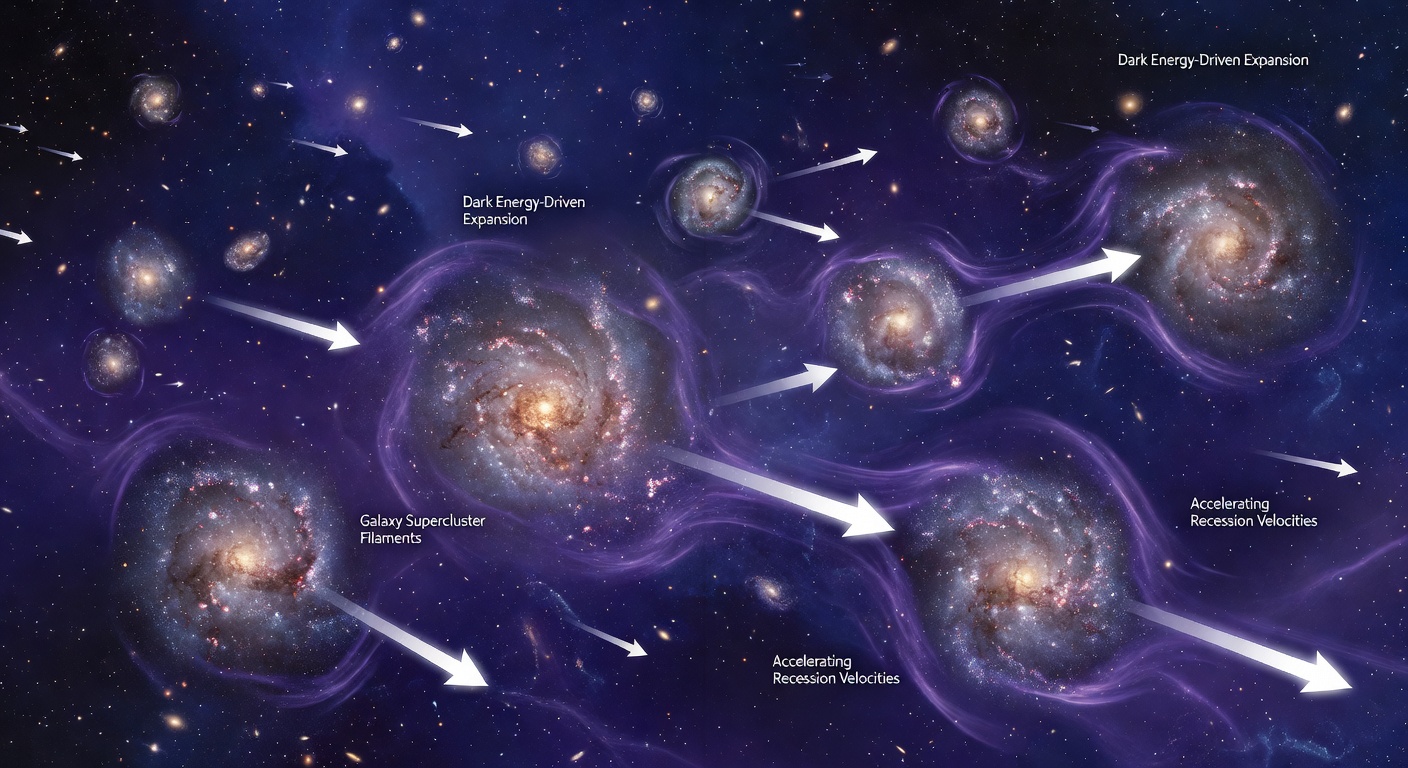
The universe isn't just expanding — it's accelerating. Something is pushing everything apart with increasing force. We call it dark energy. We have almost no idea what it is.
READ MORE →In 1998, two independent teams — the Supernova Cosmology Project and the High-Z Supernova Search Team — were measuring distant Type Ia supernovae to map the universe's expansion. They expected to find deceleration; gravity should be slowing the expansion down. Instead, they found the supernovae were dimmer than expected, meaning they were farther away than predicted. The universe wasn't slowing — it was speeding up.
Saul Perlmutter, Brian Schmidt, and Adam Riess won the 2011 Nobel Prize in Physics for the discovery. The force driving this acceleration was named dark energy. It constitutes roughly 68% of the total energy content of the universe — the single largest component of everything that exists — and we fundamentally do not understand it.
"The discovery of dark energy is the most profound mystery in physics. We have a name for it. We can measure its effects with exquisite precision. We have no idea what it is."
In April 2024, the Dark Energy Spectroscopic Instrument published its first-year results from mapping 6 million galaxies. The data suggests dark energy's strength may be weakening over time — a 2.5-sigma tension with the standard cosmological constant model. Not yet definitive, but scientifically electric. DESI will ultimately map 40 million galaxies. If the signal holds, it would be the most significant cosmological discovery since the original 1998 acceleration finding.
Dark energy determines how the universe ends. If it remains constant, distant galaxies will eventually recede faster than light can cross the gap — an event horizon forms. In roughly 2 trillion years, the Milky Way's gravitational group will be alone in an otherwise invisible cosmos. If dark energy grows stronger, it leads to the "Big Rip" — space tearing apart faster and faster, shredding galaxies, then solar systems, then atoms. If dark energy fades, the universe may re-collapse in a "Big Crunch." We live in the brief window where the universe is comprehensible. Understanding dark energy is understanding our own cosmic timeline.
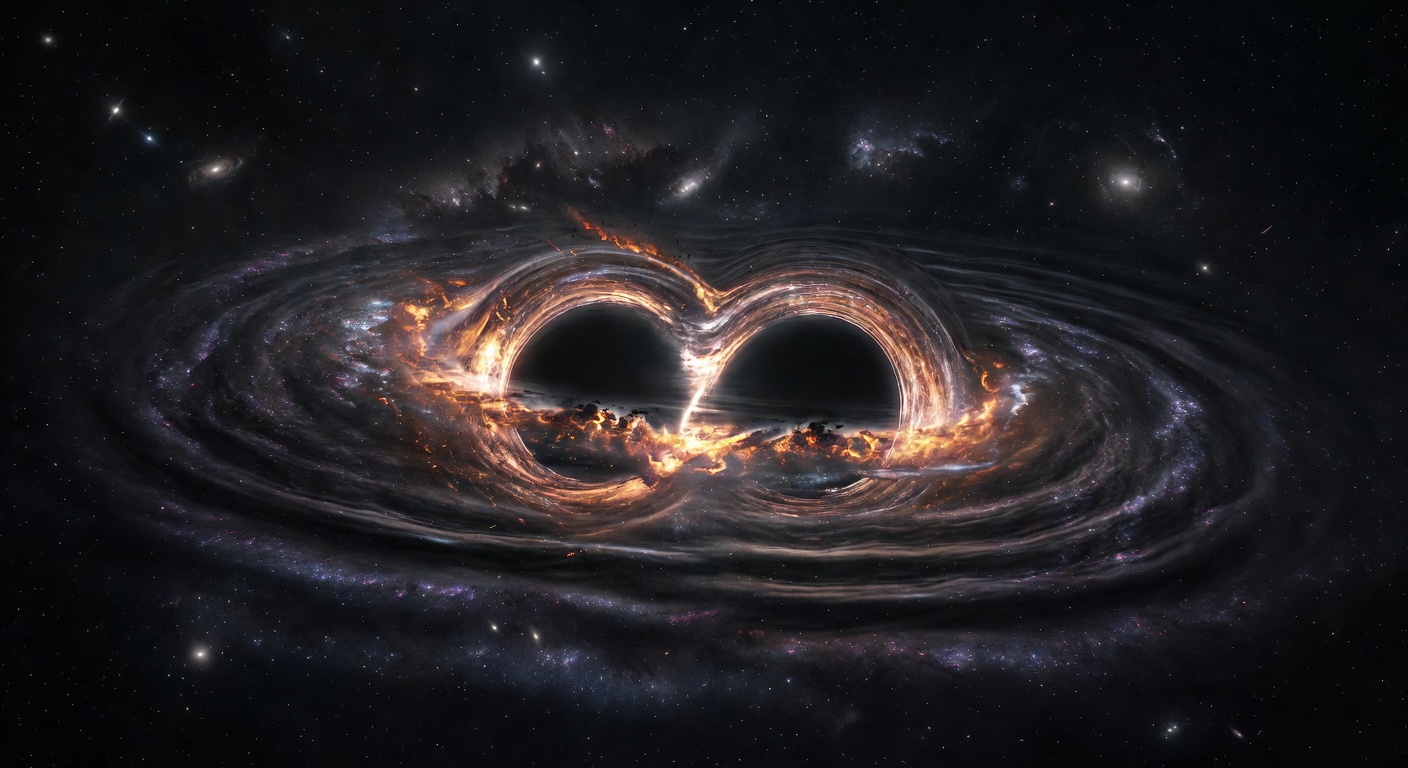
Two black holes spiral toward each other for billions of years, then merge in a fraction of a second — releasing more energy than entire galaxies emit in their lifetimes. We can now hear them.
READ MORE →Black hole mergers are the most violent events in the universe. Two objects of incomprehensible density — where spacetime itself ends — locked in a gravitational embrace that tightens over millions or billions of years, spiraling closer until the final plunge. The inspiral phase can last longer than the age of the Earth. The merger itself takes milliseconds.
During that merger, mass is converted directly to gravitational wave energy with an efficiency that nuclear fusion cannot approach. GW150914 converted three solar masses of matter into pure gravitational wave energy in 0.2 seconds. For comparison, the Sun will convert about 0.7% of its total hydrogen mass to energy over its entire 10-billion-year lifetime. Black hole mergers are catastrophically more efficient.
"In those final milliseconds, the power output exceeds the combined luminosity of all the stars in the observable universe by a factor of 50."
Binary black hole systems form when two massive stars in a binary pair both collapse. The resulting black holes orbit their common center of mass, gradually losing energy to gravitational wave emission — which causes them to spiral inward. This process is relentless and irreversible. As separation decreases, gravitational wave emission increases, accelerating the inspiral. The final merger is inevitable once the process begins.
In 2023, five independent pulsar timing array collaborations simultaneously announced detection of a gravitational wave background — a constant hum of gravitational waves permeating the entire universe. The most likely source: the cumulative signal from millions of supermassive black hole binary mergers across cosmic history. Millisecond pulsars, used as cosmic clocks with extraordinary precision, showed correlated timing variations consistent with a gravitational wave background at nanohertz frequencies. The universe has a soundtrack. We have begun to hear it.