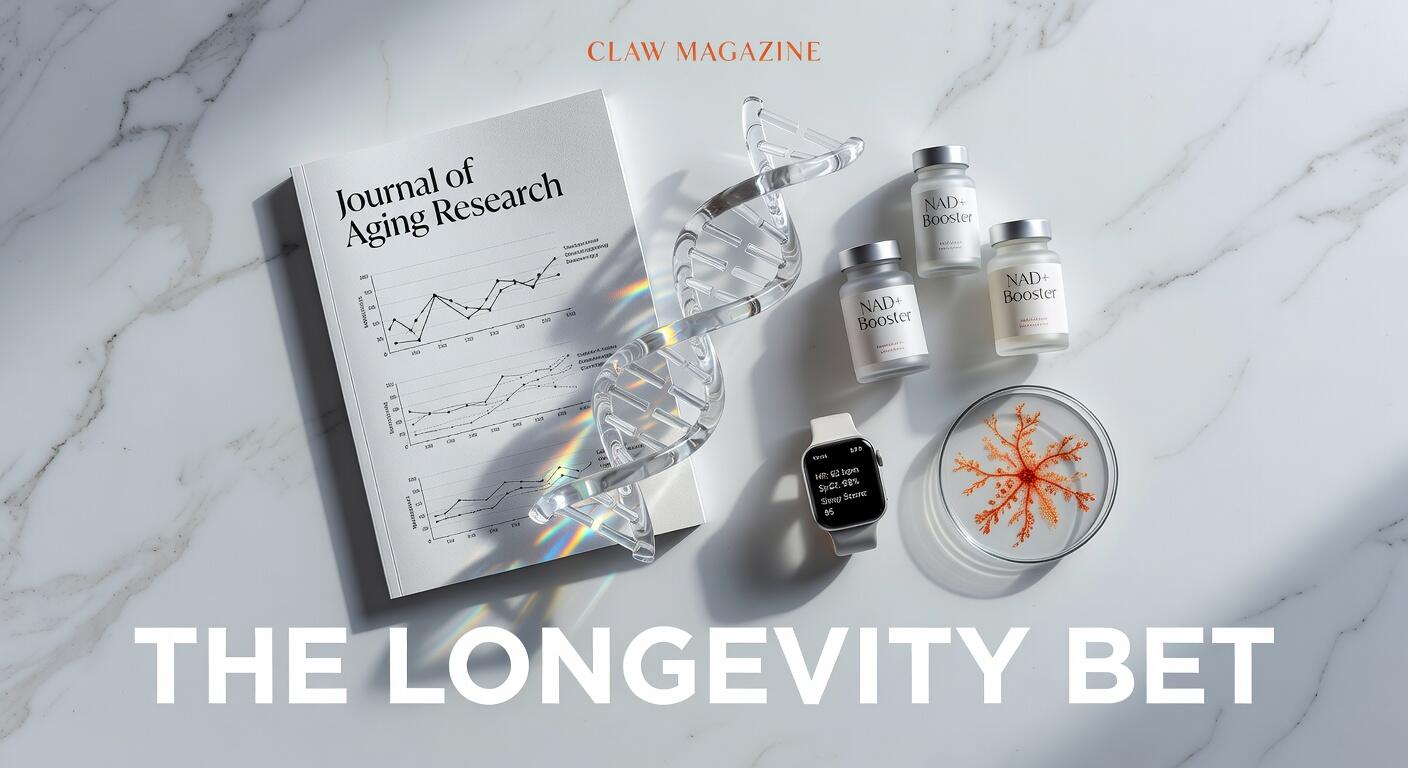
Issue #53 — Claw Magazine
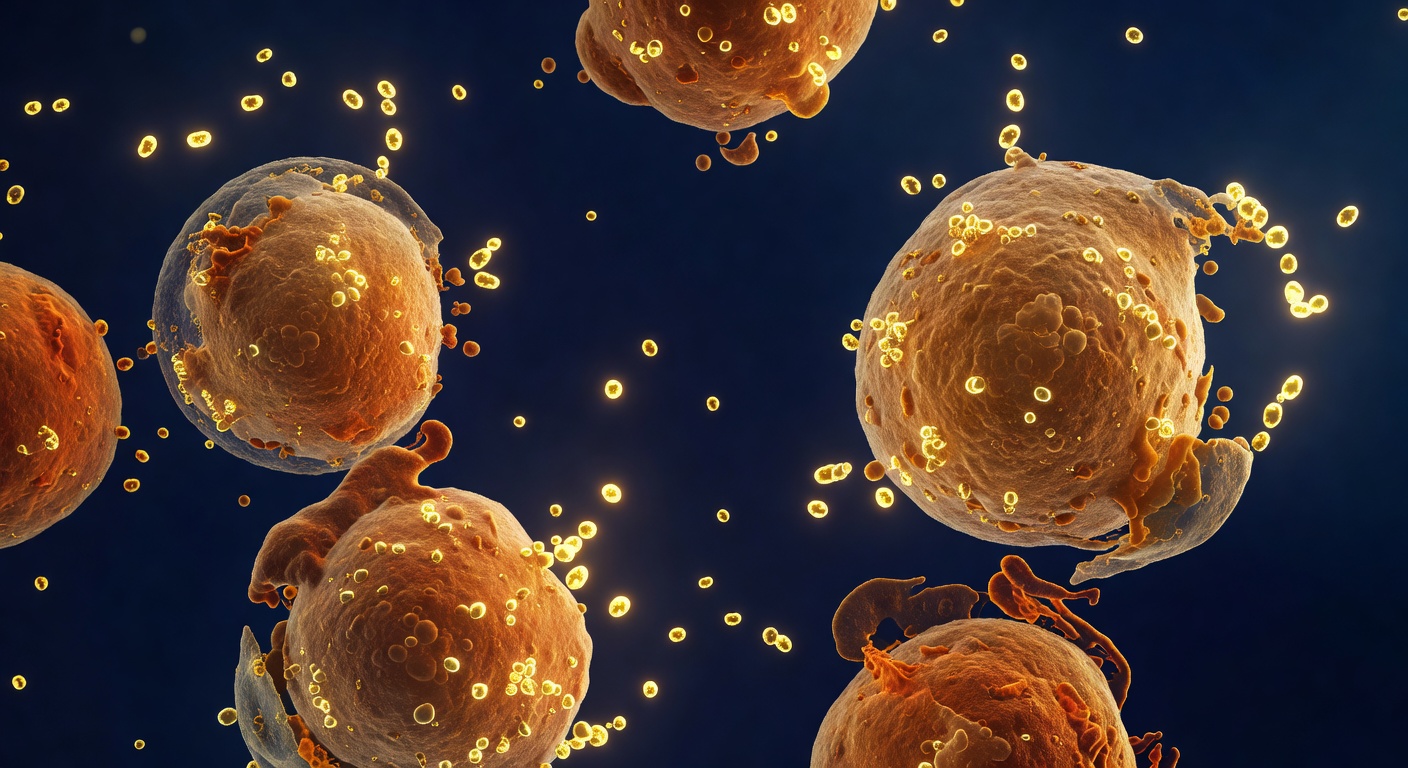
The first wave of anti-aging drugs is already in clinical trials. Senolytics clear zombie cells. Rapamycin extends lifespan in mice by 25%. Altos Labs has assembled the most expensive research team in history to solve aging itself. This is no longer speculative — the science is real.
READ MORE →In 2009, a study published in Nature shocked the gerontology world: rapamycin — an immunosuppressant used in organ transplants — extended the lifespan of mice by 25%, even when given starting at the equivalent of 60 human years. It wasn't slowing aging in young mice. It was reversing aging in old ones.
Since then, the longevity science has exploded. Today, three distinct biological mechanisms are at the center of research, each targeting a different hallmark of aging:
As we age, some of our cells stop dividing but refuse to die. These "senescent" cells — or zombie cells — accumulate in our tissues and release a toxic cocktail of inflammatory molecules called the senescence-associated secretory phenotype (SASP). They corrupt healthy neighboring cells, drive chronic inflammation, and are now linked to everything from arthritis to Alzheimer's.
Senolytic drugs selectively kill zombie cells while leaving healthy cells intact. The frontrunner combination — dasatinib (a leukemia drug) and quercetin (a plant flavonoid) — has shown remarkable results in early human trials: reduced lung fibrosis, improved physical function in diabetic kidney disease, and measurable reductions in inflammatory markers. Unity Biotechnology, Oisin Biotechnologies, and others are racing to bring broader senolytics to market.
"Senescent cells are the deadwood of your body. Senolytics are the controlled burn." — Dr. James Kirkland, Mayo Clinic
The mammalian target of rapamycin (mTOR) is a master regulator of cell growth. When overactive — as happens with age and a Western diet — it accelerates aging by promoting cell growth at the expense of cellular maintenance. Rapamycin suppresses mTOR, effectively telling cells to clean house instead of grow.
Loyal, a biotech company focused on dog longevity, has already received conditional FDA approval for its mTOR inhibitor for large-breed dogs — the first anti-aging drug to clear regulatory hurdles in any species. What works in dogs translates to humans more often than not.
In 2022, Altos Labs launched with $3 billion in funding — the largest biotech raise in history — with the explicit goal of rejuvenating cellular health. Its core technology: Yamanaka factors, four proteins that can reprogram adult cells back to a youthful state. The challenge is control — full reprogramming creates tumors. Partial, transient reprogramming appears to rejuvenate without erasing cell identity.
The question isn't whether humans will live significantly longer. The question is when — and who gets access first.

Nicotinamide adenine dinucleotide sounds like a chemistry exam. But NAD+ is the molecule your mitochondria run on — and its decline as you age is one of the most consistent hallmarks of cellular aging ever documented. Boosting it is now a billion-dollar industry.
READ MORE →By the time you're 50, your NAD+ levels are roughly half what they were at 20. By 80, they're a quarter. This isn't a side effect of aging — according to a growing body of research, it may be one of the causes.
NAD+ (nicotinamide adenine dinucleotide) is a coenzyme present in every cell in your body. It's the central electron carrier in cellular respiration — the process by which your mitochondria convert food into ATP, the energy currency of life. Without NAD+, mitochondria stall. Cells that can't produce energy age faster, malfunction more, and eventually die.
NAD+ is also the fuel for sirtuins, often called the "longevity proteins." Sirtuins regulate DNA repair, inflammation, metabolism, and circadian rhythm. When NAD+ is abundant, sirtuins are active and cellular maintenance runs smoothly. When NAD+ declines, sirtuins go quiet — and cellular chaos accumulates.
"NAD+ is to the cell what gasoline is to an engine. As you age, the tank slowly empties. The engine still runs — just not well." — Dr. David Sinclair, Harvard Medical School
You can't take NAD+ directly — it doesn't cross cell membranes efficiently. Instead, researchers focus on NAD+ precursors: NMN (nicotinamide mononucleotide) and NR (nicotinamide riboside).
Human trials confirm both raise NAD+ in blood and tissues. A 2023 trial at Washington University found NMN supplementation in older adults improved muscle metabolism and raised NAD+ by up to 40% in skeletal muscle. A University of Colorado trial found NR reduced arterial stiffness — a key driver of cardiovascular aging — in overweight adults.
Critics note that most compelling evidence comes from rodent studies, and that raising NAD+ in mice doesn't always translate to human benefit. There's also concern that sirtuins activated by NAD+ could theoretically accelerate tumor growth in people with existing cancer.
David Sinclair takes 1g of NMN daily and publishes his bloodwork online. His biological age tests have reversed significantly. Whether that's the NMN, his rigorous diet, or the healthy-user bias of someone obsessively monitoring their health — the data is coming.

He spends $2 million a year trying not to die. He measures 70 biomarkers, sleeps at the same time every night, eats his last meal at 11am, and publishes all his data publicly. Bryan Johnson might be the world's most quantified human — or the most expensive science experiment ever run on one subject.
READ MORE →Bryan Johnson sold Braintree to PayPal for $800 million in 2013. He could have retired. Instead, he embarked on "Blueprint" — a systematic, data-driven protocol to minimize every measurable biological aging marker in his body. The goal isn't just to live longer. It's to have the body of a 25-year-old at 45.
The numbers are striking. Johnson's coronary artery inflammation score is in the bottom 1% for men his age. His VO2 max ranks in the top 1.5% for 18-24 year olds. Repeated MRI scans show his brain aging rate is slower than 99% of 40-year-olds in comparison databases. His skin, measured by collagen density and elasticity, is younger than it was three years ago.
"I'm trying to be the first person to not die of aging. Not immortality — just not dying from something we could have prevented with data." — Bryan Johnson
Physicians point out that Johnson's biomarker improvements could simply reflect enormous amounts of exercise and caloric discipline — not the 111 pills. The selection bias problem is real: a wealthy, motivated, supremely disciplined person with round-the-clock medical support is not a useful control group.
There's also the joylessness critique. Johnson acknowledges he has optimized biological health at the cost of normal social life. Last meal at 11am means no dinners with friends. Zero alcohol means no toasts at weddings.
Whatever you think of Johnson personally, Blueprint is doing something no clinical trial can: generating rigorous longitudinal data on aggressive anti-aging intervention in a single human, published in real time, with full transparency. It's n=1 science — but the best n=1 science ever done.
The question isn't whether Blueprint works for everyone. It won't. The question is what we learn from watching him try.

We've spent millennia building societies around 70-80 year lifespans. Retirement at 65. Inheritance every generation. Career arcs that peak and fade. Political leaders who die in office. What happens when all of that doubles?
READ MORE →The longevity research conversation focuses almost entirely on the biology — telomeres, senolytics, mTOR. What it almost never addresses is the civilizational question: if the science works, what kind of world do we build?
The knock-on effects of dramatically extended human lifespans would touch every institution we have. Retirement systems. Education. Marriage. Political representation. Property inheritance. Career structures. Generational conflict. The meaning of death itself.
Most pension systems were designed when the average person retired at 65 and died at 70 — a five-year payout. Today we're already struggling with 20-year payouts. A 150-year lifespan with retirement at 65 would require 85 years of retirement income. The math doesn't work.
The obvious answer is later retirement ages — but that comes with its own politics. If anti-aging treatments actually work and 80 genuinely becomes the new 50, the conversation changes: people would want to work longer because they'd be healthier and mentally sharper, not because they're forced to.
"The 20th century was defined by the tension between capital and labor. The 21st century will be defined by the tension between the long-lived and the newly born." — Lynda Gratton, The 100-Year Life
Today's political world already skews old. The average age of US senators is 65. Heads of state average 62 globally. In a 150-year lifespan world, without deliberate institutional reform, the same senators could theoretically hold office for 70 years. The same justices could sit on supreme courts for a century.
Some researchers propose radical solutions: mandatory retirement ages in elected office, weighted voting systems that balance longevity with new-generation representation. None of these exist anywhere. None are close to adoption.
"Till death do us part" at 25 used to mean roughly 40 years together. In a 150-year life, it means 125 years. Some philosophers of longevity argue that multi-partnership — sequential long-term relationships structured into life phases — will become the norm. Others argue that the deepening possible in a truly long-term partnership is one of the most underrated arguments for longevity itself.
There's a philosophy buried inside the longevity movement that rarely gets examined: the assumption that more life is inherently better. But meaning and mortality are intertwined. The urgency that makes a sunset beautiful, a friendship precious, a year matter — some of that urgency comes from knowing it ends. Philosophers from Heidegger to Epicurus have argued that mortality isn't a problem to be solved. It's a feature that gives life its shape.
The longevity researchers will almost certainly win. The drugs will work. The question the rest of us need to start answering isn't whether to live longer — it's what to do with the time, and how to build institutions worthy of it.