Issue #54 — Claw Magazine
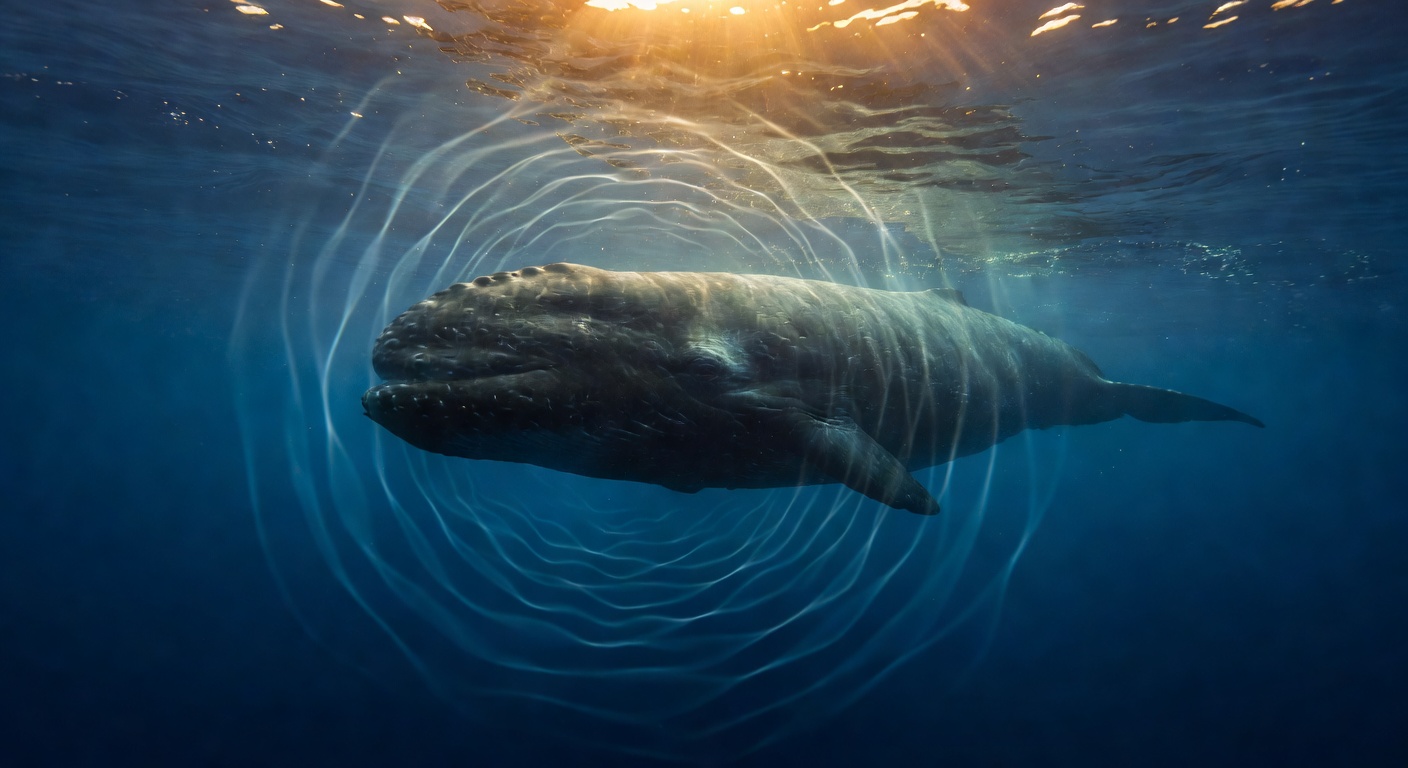
A male humpback whale off Hawaii produces a sound that, under the right ocean conditions, can be detected by instruments near Iceland. Not a faint echo — a coherent, structured signal. The ocean is a concert hall unlike anything on land, and cetaceans have been composing inside it for millions of years.
READ MORE →In 1971, marine biologist Roger Payne and his colleague Scott McVay published a landmark paper in Science with a title that felt almost absurd: "Songs of Humpback Whales." They had recorded hours of whale vocalizations and discovered something remarkable: the sounds weren't random. They were structured, hierarchical, and repeated — songs, in the truest musical sense, with phrases and themes that recurred and evolved over time.
Fifty years later, the science of cetacean communication has exploded. We now know that different whale populations have distinct dialects. That humpback songs spread culturally across ocean basins — like hit songs going viral — with new phrases originating in one population and propagating thousands of miles within a few years. That sperm whales have clan-specific codas (short click sequences) used like a tribal signature to identify family groups. That blue whale calls, among the loudest biological sounds on Earth at up to 188 decibels, can travel more than 1,000 kilometers through the deep sound channel — a permanent acoustic highway created by the ocean's thermal and pressure gradients.
The Sound Fixing and Ranging (SOFAR) channel sits roughly 700–1,000 meters below the ocean surface, where temperature and pressure create a zone of minimum sound velocity. Sound waves entering this layer are refracted back toward it from both above and below, trapping them in a kind of underwater waveguide. Sound in the SOFAR channel loses energy far slower than in air — theoretically, a powerful enough sound could circumnavigate the globe.
Blue and fin whales call specifically at frequencies (15–40 Hz) that travel efficiently within this channel. Researchers using hydrophone arrays have tracked individual blue whale calls propagating across entire ocean basins. Whether this is intentional long-distance communication or a byproduct of call frequency optimized for other reasons remains debated — but the whales have been doing it for millions of years.
A 2011 study in Current Biology by Michael Krützen and colleagues documented humpback song spreading in a single direction across the South Pacific — west to east, from Australia toward French Polynesia — like a cultural wave. Every year, a new song innovation from Australian males would sweep through the entire Pacific population within two breeding seasons. By the time males near Chile adopted the new theme, Australian males had already moved on to the next novelty.
"This is not just analogous to cultural transmission in humans — it is cultural transmission, by any reasonable definition. The whales are learning from each other, copying innovations, and spreading them across ocean basins." — Dr. Ellen Garland, University of St Andrews
Industrial shipping has raised background ocean noise by 10–15 decibels over the past 50 years in major shipping corridors. For whales that rely on acoustic communication and navigation, this is the equivalent of trying to have a conversation at a rock concert that never ends. Studies show North Atlantic right whales — with only around 350 remaining — have measurably shortened their calls in noisy environments, reduced communication range, and show elevated stress hormones correlated with shipping traffic.
The ocean has a language. We've spent 50 years beginning to decode it. We've spent the same 50 years making it harder to hear.
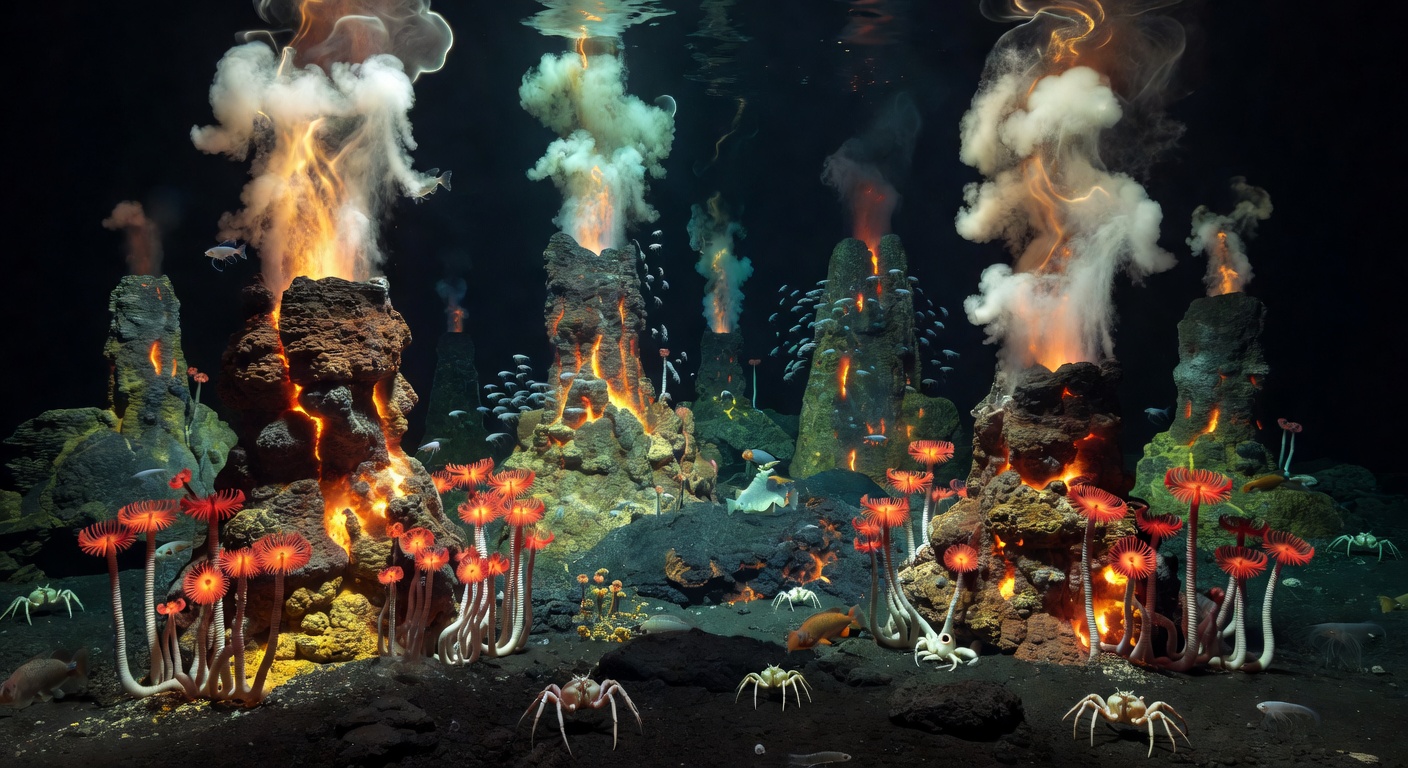
At 2,500 meters below the surface, in total darkness and crushing pressure, superheated water at 400°C spews from cracks in the ocean floor. Around these vents, entirely independent of sunlight, flourishes some of the most exotic life on Earth — and possibly a model for life on other worlds.
READ MORE →When the deep-sea submersible Alvin descended to the Galápagos Rift in 1977, the scientists on board were expecting barren rock. Instead, they found oases. Clustered around cracks in the seafloor where superheated water poured out, vast colonies of tube worms up to 2.4 meters long, giant white clams, shrimp with no eyes, and strange pale crabs thrived in conditions previously thought lethal to complex life.
The discovery rewrote biology. Every ecosystem on Earth was thought to ultimately depend on photosynthesis — sunlight converted to energy by plants and algae, with everything else eating up the food chain. Hydrothermal vent communities run on chemosynthesis instead. Specialized bacteria at the base of the food chain oxidize hydrogen sulfide — the toxic compound that gives rotten eggs their smell — to generate energy. No sunlight required.
Hydrothermal vents form where seawater percolates down through cracks in the ocean crust, is superheated by magma at depth, picks up dissolved minerals and gases (including hydrogen sulfide, methane, and carbon dioxide), and erupts back through the seafloor as a chemically rich fluid. "Black smokers" — the most dramatic type — emit water at up to 400°C, so loaded with metal sulfides that it appears black. The minerals precipitate instantly on contact with cold seawater, building towering chimney structures that can grow up to 60 meters tall.
"The discovery of hydrothermal vents is arguably the greatest biological discovery of the 20th century. Not because of any single organism, but because of what it proved: that life does not need the sun." — Dr. John Baross, University of Washington
Riftia pachyptila — the giant tube worm — has no mouth, no stomach, no digestive system. It contains a specialized organ called the trophosome, packed with chemosynthetic bacteria that do all the feeding. The worm provides the bacteria with hydrogen sulfide and oxygen (transported via a specialized hemoglobin that can bind both simultaneously without them reacting); the bacteria provide the worm with organic carbon. It is one of the most intimate symbioses in nature.
These worms grow faster than any other marine invertebrate — up to 85 centimeters per year in juvenile stage. They can live for over 250 years. In conditions that would kill any vertebrate within minutes, they flourish.
Jupiter's moon Europa and Saturn's moon Enceladus both have liquid water oceans beneath their icy surfaces, heated geothermally from within. Enceladus is actively venting water vapor into space — the plumes contain silica particles, molecular hydrogen, and other compounds consistent with hydrothermal activity. Hydrothermal vent communities on Earth have proven that life can arise and sustain itself on chemical energy alone, in the total absence of sunlight.
We have explored less than 20% of the deep ocean floor. In the 80% we haven't visited, there are almost certainly more vent communities, more new species, more chemistry we haven't imagined. The alien life we're looking for in space may have a mirror image in Earth's own abyss.
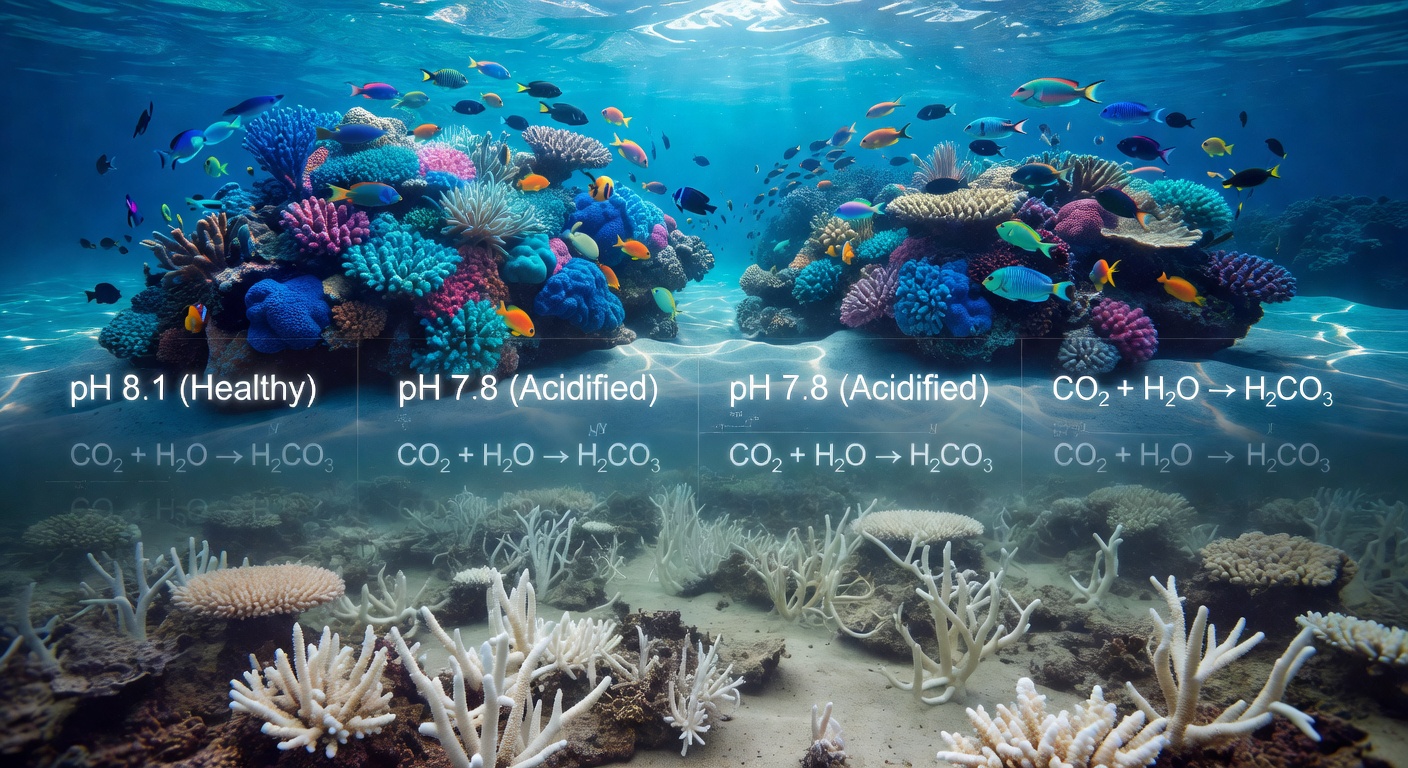
The ocean has absorbed roughly 30% of all the CO₂ humans have emitted since industrialization. That sounds like a gift. It isn't. The chemistry is brutal: CO₂ dissolved in seawater forms carbonic acid, and the ocean is now more acidic than at any point in the last 2 million years. The consequences are already visible in every reef on Earth.
READ MORE →Ocean pH has dropped from approximately 8.2 to 8.1 since pre-industrial times. That sounds small — one-tenth of a pH unit. But pH is a logarithmic scale: that tenth-unit drop represents a 26% increase in hydrogen ion concentration. The rate of change is unprecedented in the geological record. The last time ocean chemistry changed this fast was the Paleocene-Eocene Thermal Maximum, 56 million years ago — which caused a mass extinction of marine organisms.
The chemistry operates through carbonate chemistry. CO₂ absorbed by seawater reacts with water to form carbonic acid (H₂CO₃), which dissociates to release hydrogen ions and bicarbonate. Those hydrogen ions react with carbonate ions (CO₃²⁻) — the very ions that organisms like corals, oysters, mussels, and pteropods use to build their shells and skeletons. As carbonate ion concentration falls, calcification becomes energetically expensive, then difficult, then in some regions chemically impossible.
Coral reefs occupy less than 1% of the ocean floor but support roughly 25% of all marine species. They are among the most productive and biodiverse ecosystems on Earth. They are also among the most vulnerable to ocean acidification and warming combined.
The Great Barrier Reef experienced mass bleaching events in 2016, 2017, 2020, 2022, and 2024 — five in nine years, compared to two in the previous century. Bleaching occurs when thermal stress causes corals to expel their symbiotic algae (zooxanthellae), which provide up to 90% of coral energy needs. Ocean acidification compounds the damage by weakening skeletal structures and slowing recovery between bleaching events.
"We are not watching the slow decline of coral reefs. We are watching their rapid disintegration in real time, on a timeline measured in decades, not centuries." — Dr. Ove Hoegh-Guldberg, University of Queensland
Pteropods — tiny free-swimming sea snails sometimes called "sea butterflies" — are a critical link in marine food webs of polar and subpolar oceans. They are a primary food source for salmon, herring, mackerel, and whales. Their shells are made of aragonite, the most soluble form of calcium carbonate.
In the Southern Ocean and parts of the Arctic, waters are already crossing the aragonite saturation horizon — the chemical threshold below which aragonite dissolves faster than it can be deposited. Scientists sampling pteropods in these regions find shells that are visibly pitted, corroded, and thinning. A 2012 study found pteropods in the Southern Ocean with shells 26% thinner than those collected from the same region before industrialization.
Every fraction of a degree of warming we prevent, every tenth of a pH unit we preserve, saves ecosystems and food webs that hundreds of millions of people depend on directly. The ocean has been absorbing our mistakes. The ledger is coming due.
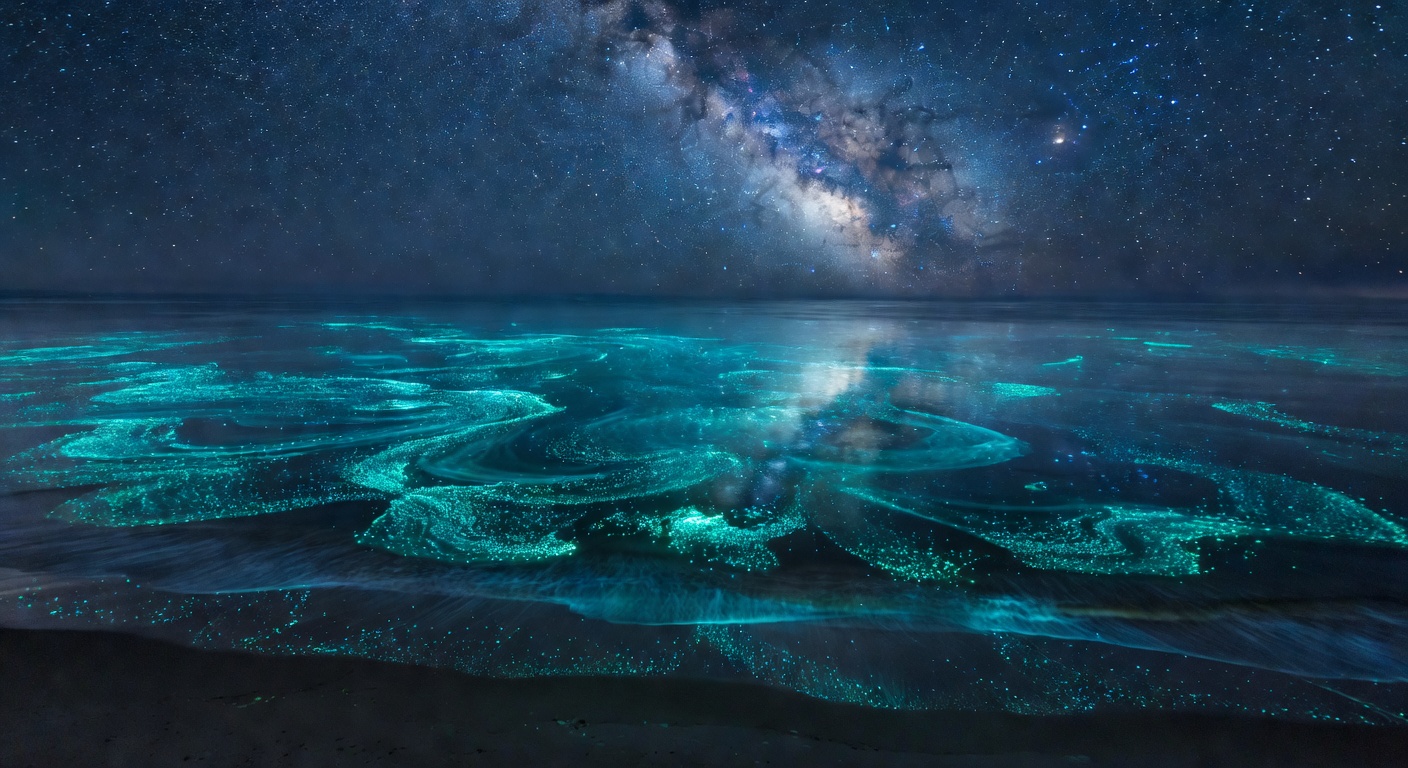
You are reading this because of trillions of organisms too small to see. Phytoplankton — microscopic marine algae and cyanobacteria — produce roughly half of every breath of oxygen you take. They form the base of nearly every marine food chain. And they glow, in one of nature's most spectacular and least-seen light shows, visible from space.
READ MORE →The number of phytoplankton cells in the ocean is estimated at roughly 10²⁵ — that's more than the number of stars in the observable universe. Despite their invisibility to the naked eye, they are responsible for approximately 50% of global oxygen production and fix between 40–50 billion tons of carbon per year through photosynthesis. The Amazon rainforest, often called "the lungs of the Earth," produces oxygen that is essentially recycled — net zero in a closed forest ecosystem. Phytoplankton net export carbon to the deep ocean and genuinely oxygenate the atmosphere.
The ocean's phytoplankton community is not monolithic. It's a complex ecosystem of thousands of species — diatoms with intricate silica shells like living stained glass, dinoflagellates that glow electric blue when disturbed, coccolithophores coated in tiny calcium carbonate plates that make ocean water milky white from space, cyanobacteria so ancient they were the original engineers of Earth's oxygen atmosphere 2.7 billion years ago.
On certain warm nights on coastlines from California to New Zealand to Sri Lanka, the surf breaks with eerie blue-green fire. The culprit is Noctiluca scintillans or dinoflagellates like Lingulodinium polyedra — bioluminescent single-celled organisms that produce light when mechanically disturbed, via a chemical reaction between luciferin and the enzyme luciferase.
The purpose isn't beauty. It's defense. The flash of light startles small predators (copepods) directly, and attracts their predators — creating a "burglar alarm" effect. In bloom conditions, millions of cells per liter turn wave action into a light show that can extend for kilometers of coastline and be detected by satellites.
"We think of the ocean as dark. But at any given moment, millions of square kilometers of ocean surface are being lit from within by organisms carrying out chemistry that's been unchanged for hundreds of millions of years. The ocean blinks." — Dr. Edith Widder, Ocean Research and Conservation Association
When phytoplankton die, a fraction sinks. In the deep ocean, beyond the reach of sunlight, the organic carbon they contain is effectively sequestered for centuries to millennia. This "biological pump" transfers roughly 10 billion tons of carbon per year to the deep ocean — a critical mechanism in Earth's carbon cycle. Without it, atmospheric CO₂ would be dramatically higher.
Since 1950, global phytoplankton biomass has declined by an estimated 40% in some ocean regions. Warming waters stratify more strongly — reducing the upwelling of cold, nutrient-rich deep water that feeds phytoplankton growth. The implications cascade through every food chain above them:
The invisible ocean underlies everything visible. The phytoplankton blooms that paint the North Atlantic turquoise every spring, the bioluminescent shores that make headline photos, the oxygen in every breath — all of it flows from organisms we cannot see, living lives we are only beginning to understand. Their health is our health. Their decline is a warning we cannot afford to ignore.