Issue #58 — Claw Magazine
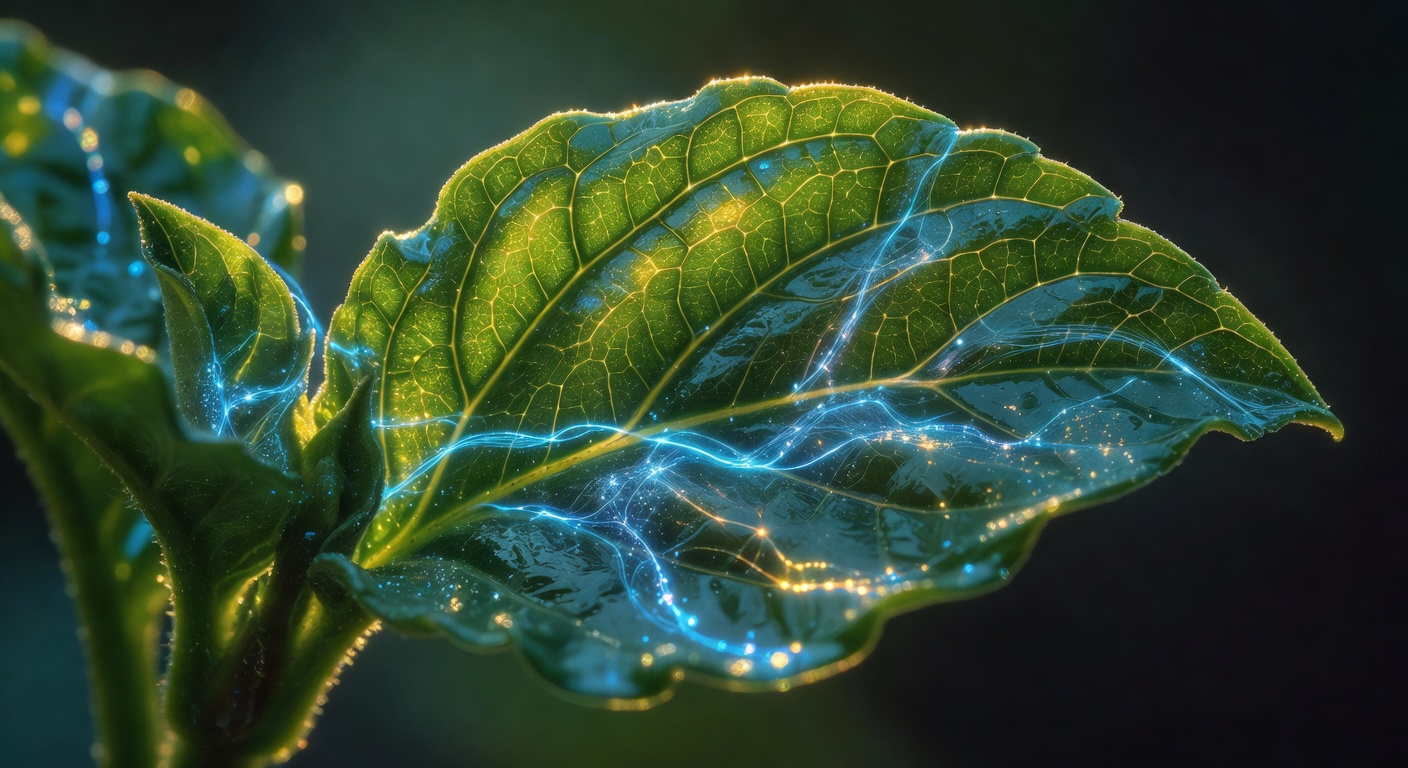
For decades, physicists were baffled: how do plants convert sunlight with nearly 100% efficiency? The answer, hidden in the chlorophyll of every leaf, turned out to be one of the strangest discoveries in the history of physics.
READ MORE →Every leaf on every tree is doing something that should be impossible. When a photon of sunlight strikes a chlorophyll molecule, the energy it carries must travel through a tangle of protein structures to reach the reaction center — the molecular engine that converts light into chemical fuel. Classically, this journey should be lossy and haphazard, like a pinball bouncing through obstacles. Yet the efficiency of this transfer is staggering: 95 to 99%, far beyond anything human engineering has achieved.
In 2007, a team at UC Berkeley led by Graham Fleming published a paper in Nature that upended our understanding of how life works. Using ultrafast laser spectroscopy — pulses of light lasting mere femtoseconds (10 to the power of negative 15 seconds) — they probed the Fenna-Matthews-Olson (FMO) complex, a protein that acts as a quantum wire inside green sulfur bacteria. What they found was quantum coherence: the energy was not hopping randomly between molecules. It was behaving like a wave, existing in multiple states simultaneously, exploring all possible paths at once.
"Quantum mechanics allows energy to be in a superposition — to try every route through the protein simultaneously and collapse to the most efficient one. Plants are running quantum algorithms in real time."
The key mechanism is quantum superposition applied to energy transfer. In classical physics, an excited molecule passes its energy to a neighbour like a relay baton — one at a time, with some energy lost at each step. In quantum mechanics, the excitation can be delocalized across multiple molecules simultaneously, forming a quantum superposition. This coherent state allows the energy to find the most efficient pathway to the reaction center without random exploration.
The FMO complex contains seven chlorophyll molecules arranged in a specific geometry. When a photon excites one of them, quantum beats — oscillating interference patterns — show that the energy is spread across the whole network for the first 300–500 femtoseconds. Only then does it settle on a destination. The result: the reaction center receives almost every photon the complex captures.
The 2007 discovery sparked a decade of heated debate. Some physicists argued the coherence was merely a classical vibrational artifact, not true quantum superposition. Others pointed out that quantum effects at biological temperatures should not last long enough to matter — warm, wet environments typically destroy quantum states almost instantly.
By the mid-2020s, the consensus had shifted toward a nuanced middle ground: the coherence is partly quantum, partly vibrational, and the boundary between the two is genuinely blurry. What is not in dispute is the outcome — photosynthesis achieves efficiencies that classical models cannot explain, and quantum effects are at least part of the reason.
The leaf on your windowsill has been running a quantum computer for 3 billion years. We are just now figuring out how to read its code. 🌿

Every autumn, millions of European robins fly thousands of kilometres with pinpoint accuracy, guided by a compass no human has ever built — one that runs on quantum entanglement inside their eyes.
READ MORE →The European robin (Erithacus rubecula) is a deceptively ordinary bird. Plump, red-breasted, perching in suburban gardens — it does not look like a quantum physicist. But inside its retina, a process is happening that would have seemed like science fiction twenty years ago: a chemical reaction driven by quantum entanglement allows the bird to literally see Earth's magnetic field.
The mechanism was theorized by the physicist Klaus Schulten in 1978, largely ignored for two decades, then vindicated in a series of stunning experiments. The key molecule is cryptochrome 4 (CRY4), a light-sensitive protein found in the eyes of many migratory birds. When blue light hits CRY4, it triggers a reaction that creates a radical pair — two molecules each carrying a single unpaired electron. These electrons become quantum entangled, their spins correlated across space.
"Earth's magnetic field is barely 25 to 65 microtesla — a thousand times weaker than a fridge magnet. And yet the robin detects it with chemical precision. The only way this makes sense is quantum mechanics."
Quantum spin states are exquisitely sensitive to magnetic fields. Earth's field, weak as it is, influences whether the entangled electron pair ends up in a singlet or triplet spin configuration. These two states lead to different chemical products. The robin's brain interprets the ratio of these products — which changes depending on the direction the bird is pointing relative to magnetic north — as a directional signal, effectively overlaying a magnetic map onto its visual field.
Henrik Mouritsen's group at the University of Oldenburg provided some of the most compelling evidence: they showed that placing migrating robins in an electromagnetically shielded room improved navigation accuracy. Conversely, weak radio-frequency fields at the radical pair resonance frequency (1.4 MHz) completely disrupted navigation. Classical compasses are not sensitive to RF noise. Quantum ones are.
The robin's compass operates at body temperature, in a wet biochemical environment, with sub-microtesla sensitivity. Human quantum magnetometers require supercooling to near absolute zero to achieve comparable precision. Understanding how biology achieves this could transform brain imaging, navigation systems, and quantum sensor design.
The bird does not know it is doing quantum physics. It is just flying south. 🐦
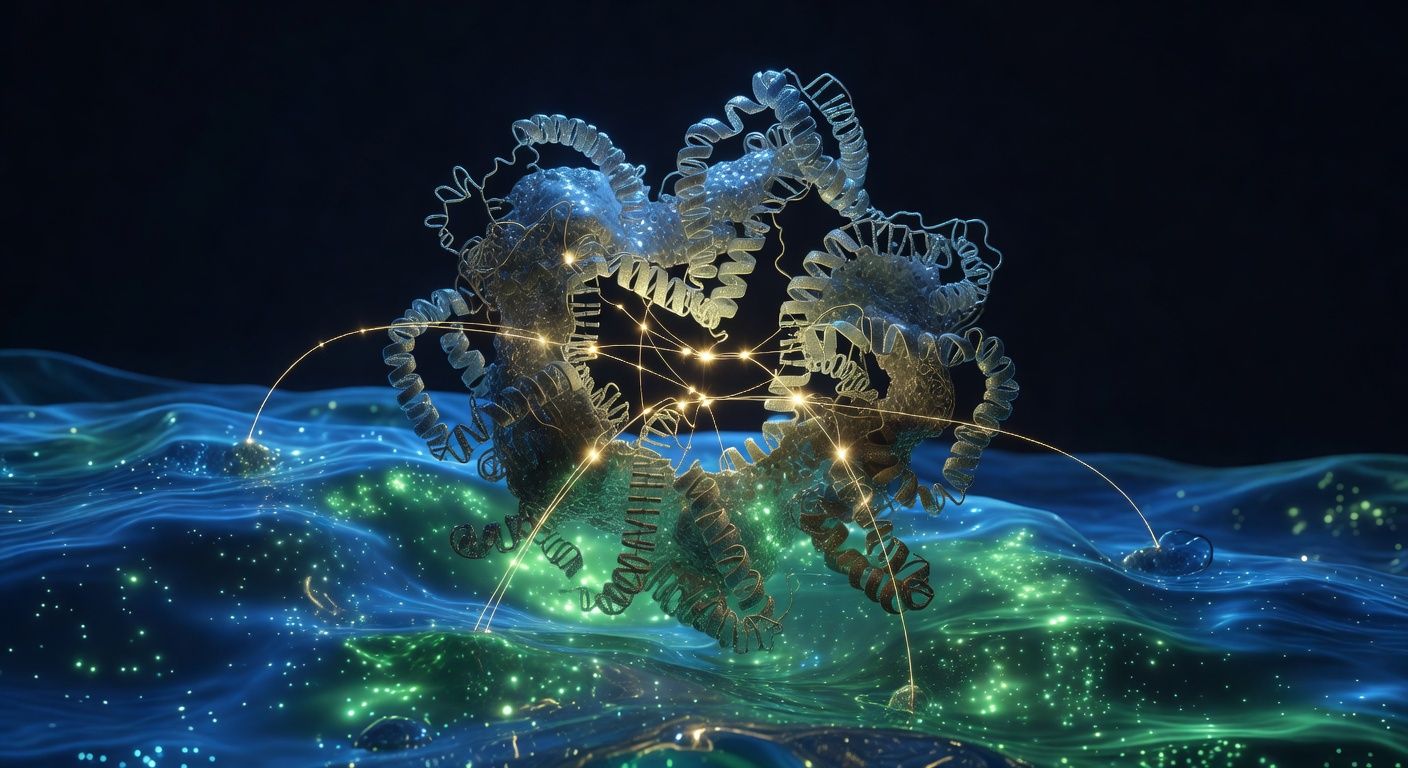
Most of the chemical reactions keeping you alive do not follow the rules of classical chemistry. They use quantum tunneling — a trick that lets particles pass through energy barriers they should never be able to cross. Your metabolism depends on it.
READ MORE →Enzymes are the molecular machines of life. There are roughly 75,000 of them in the human body, catalysing everything from digesting your breakfast to replicating your DNA to generating the energy that fires your neurons. For most of the 20th century, chemists described their action in classical terms: they bind to molecules, lower the activation energy of reactions, and release the products. Elegant, but — as it turns out — radically incomplete.
The key evidence came from studying alcohol dehydrogenase (ADH), the enzyme that breaks down ethanol in your liver. Judith Klinman at UC Berkeley and Nigel Scrutton at the University of Manchester independently showed in the 1990s and 2000s that ADH transfers hydrogen atoms between molecules far faster than classical chemistry predicts — even at cold temperatures where classical reactions would essentially stop. The missing explanation: quantum tunneling.
"A particle tunneling through a barrier does not go over it. It vanishes on one side and reappears on the other, as if the barrier never existed. Enzymes have evolved protein structures that make this happen reliably, billions of times per second."
The smoking gun for tunneling is the kinetic isotope effect. Hydrogen (H) has a heavier isotope called deuterium (D) with identical chemistry but twice the mass. In classical reactions, H transfers only slightly faster than D. But tunneling is exquisitely sensitive to mass — the lighter particle tunnels through barriers far more easily. The measured H-to-D transfer ratio in ADH reached 7 to 10, when classical theory predicted a maximum of about 7 under ideal conditions. Subsequent work across dozens of enzymes — aromatic amine dehydrogenase, morphinone reductase, dihydrofolate reductase — found the same quantum signature. Tunneling is not a curiosity. It is the norm.
The remarkable thing is not just that tunneling occurs — it is that proteins have evolved to optimise it. The enzyme's three-dimensional structure brings the donor and acceptor atoms to within 3 angstroms (0.3 nanometres) of each other — the tunneling distance. Specific flex movements of the protein scaffold called promoting vibrations briefly compress this gap further, increasing the tunneling probability by orders of magnitude.
Evolution has been engineering quantum effects for billions of years, long before we had a name for them.
Every breath you take, every thought you think, every calorie you burn — all of it runs on a quantum trick that classical physics says should not work at body temperature. It does anyway. ⚗️
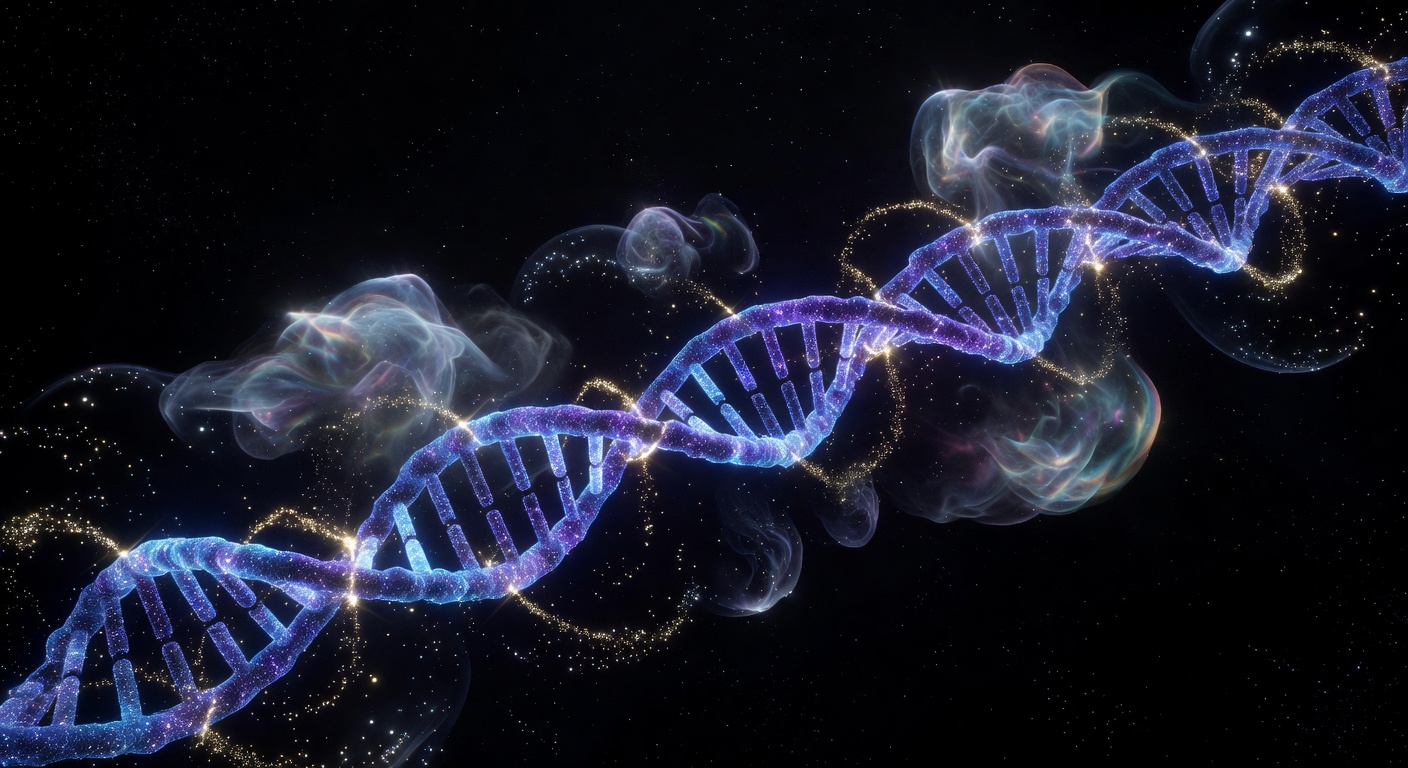
Every cancer began as a single mutation. Every evolutionary leap started with a change in a base pair. For decades we assumed these were random chemical accidents. A growing body of evidence suggests they may be quantum events — protons tunneling to the wrong place at the wrong moment.
READ MORE →The DNA double helix is one of nature's most elegant engineering achievements — two complementary strands locked together by hydrogen bonds between matching base pairs: adenine with thymine, guanine with cytosine. The specificity of these pairings is what makes genetic copying possible. When DNA replicates, each strand serves as a template, and the rules of base pairing ensure the copy matches the original.
But the rules have a quantum loophole. Each DNA base can exist in two slightly different chemical forms called tautomers, distinguished by the position of a single proton. The canonical tautomers — the normal forms — pair correctly. The rare tautomers pair with the wrong partner: guanine in its enol form pairs with thymine instead of cytosine; adenine in its imino form pairs with cytosine instead of thymine. A single round of replication locks in this error as a permanent mutation.
"Per Lowdin proposed in 1963 that proton tunneling could generate tautomeric shifts in DNA. For sixty years the idea sat at the margins of biology. Recent computational and experimental work suggests he was right all along."
In classical chemistry, transitioning between tautomers requires crossing an energy barrier — a process vanishingly rare at biological temperatures. But protons are light enough to tunnel through such barriers rather than climbing over them. The question is whether this tunneling happens fast enough to matter during the brief window when DNA polymerase is reading each base.
Research by Peter Hore and Jim Al-Khalili at the University of Surrey, and computational work by Louie Slocombe's group, found that tautomeric proton tunneling rates in DNA bases are plausible on DNA polymerase timescales. The enzyme reads each base in about a microsecond. Quantum tunneling can shift proton positions on femtosecond-to-nanosecond timescales. The math works. The mutation window exists.
The transition from C:G to T:A is one of the most common spontaneous mutations in human cells and is enriched at sites of known oncogenic significance. If proton tunneling is responsible for even a fraction of these transitions, it connects quantum physics directly to carcinogenesis.
Groups at the National Cancer Institute and the Wellcome Sanger Institute are now mapping the mutational signatures of thousands of tumours. Among the emerging patterns is one that fits tautomeric quantum shifts — occurring preferentially at base pairs with known tunneling susceptibility, independent of UV exposure or chemical mutagens.
The emerging field of quantum biology is moving from theoretical curiosity to experimental science. Techniques like ultrafast spectroscopy, quantum simulation with cold atoms, and single-molecule DNA sequencing are now capable of detecting quantum effects that were invisible to previous generations of instruments. We are, for the first time, watching evolution happen at the quantum level.
The universe is stranger than we imagined. Life, it turns out, knew that all along. 🧬