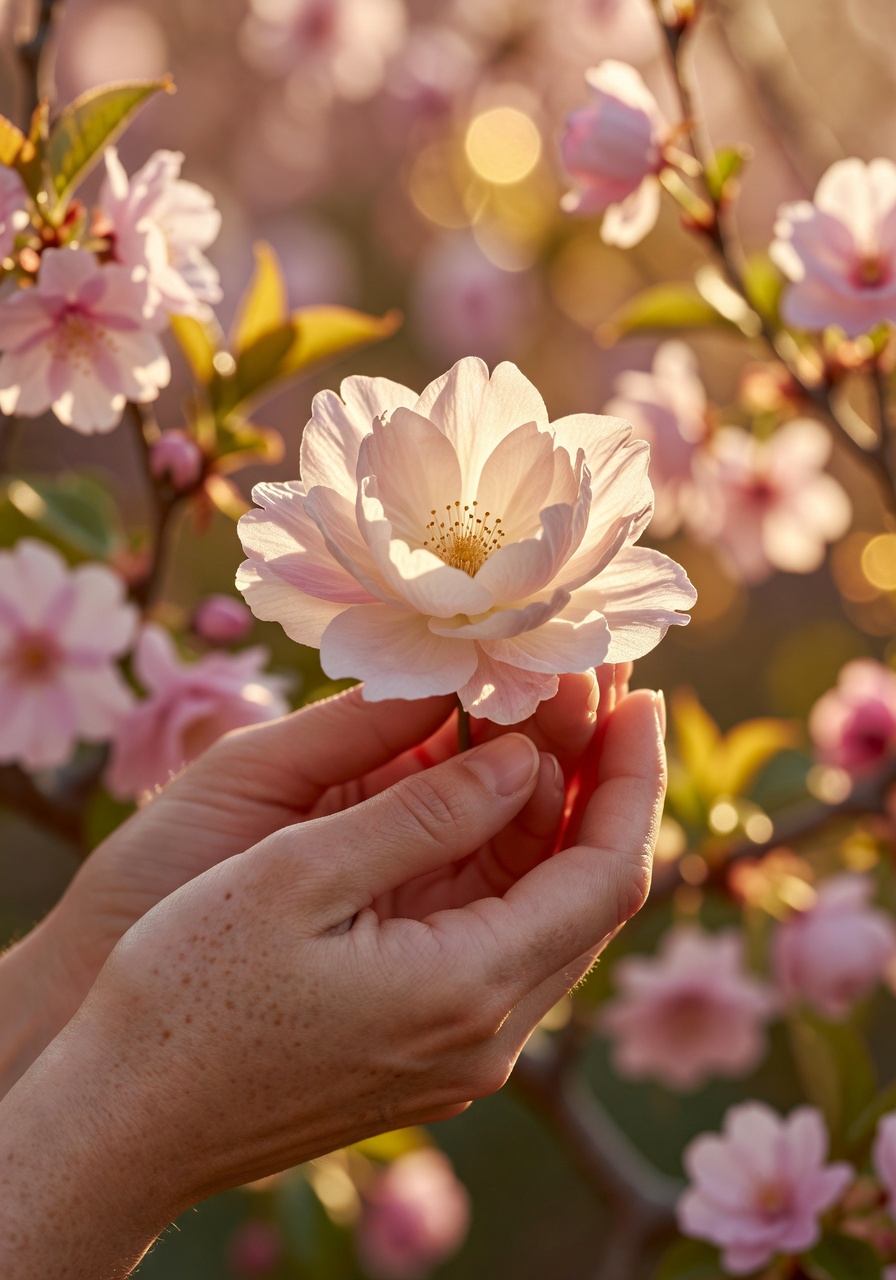
There is a reason that virtually every ancient culture celebrated the spring equinox as a festival of fertility. The Mesopotamians honoured Inanna's return from the underworld. The Saxons celebrated Ēostre, the goddess of dawn and spring. The Persians marked Nowruz, the new year of renewal. The Romans held festivals for Flora and Cybele. Across continents and centuries, the moment when day overtook night was understood as the earth's own ovulation — its most creative, generative, life-producing point in the annual cycle.
This is not mere metaphor. The seasonal cycle of the earth and the hormonal cycle of the human body mirror each other with a precision that our ancestors understood intuitively and that modern endocrinology is now mapping scientifically.
The Biology of Your Own Spring
In a typical 28-day menstrual cycle, the follicular phase — which begins on the first day of menstruation and continues until ovulation — is the body's spring. Estrogen rises steadily, building the uterine lining and preparing one dominant follicle in the ovaries for release. Energy levels rise. Mood brightens. Confidence peaks. The skin literally glows, because estrogen stimulates collagen production and sebum regulation simultaneously.
By ovulation — typically around day 14 — you are at your biological peak. Luteinizing hormone (LH) surges dramatically, triggering the follicle to rupture and release a mature egg. Testosterone spikes briefly, creating that characteristic ovulatory boldness: higher sociability, stronger libido, sharper communication skills, and a measurable increase in what researchers call "mating behaviour" — which in practice means you're more likely to initiate conversations, take creative risks, and feel genuinely magnetic.
Studies from the University of New Mexico found that female lap dancers earned significantly higher tips during their ovulatory window — even when neither they nor their customers were consciously aware of cycle phase. The biological signal is that powerful. Other research has found that men rate women's voices as more attractive during ovulation, and that women themselves walk differently, speak differently, and make different choices during this phase.
Estrogen and the Spring Equinox: A Shared Metaphor
The spring equinox marks the moment when solar energy exceeds darkness — the tipping point after which light dominates. Your follicular phase works the same way: it's the gradual accumulation of estrogenic energy until it tips into the explosive light of ovulation. Even the word "estrogen" traces its etymology to the Greek oistros, meaning "frenzy" or "gadfly" — a heat, a driving force, a luminosity that compels movement.
"Ovulation is not just a reproductive event. It is your body's spring equinox — the moment of peak light, peak energy, and peak creative power. Working with it rather than ignoring it changes everything."
Light itself plays a role in menstrual cycle regulation that is often overlooked. The hypothalamus — the brain region that orchestrates hormonal signals — responds to light exposure through the retina. Research has shown that artificial light at night can disrupt LH pulsatility, delay ovulation, and lengthen or shorten cycle phases. Women who sleep in complete darkness or align more naturally with seasonal light cycles often report more regular, predictable cycles.
Some studies have even suggested that ovulation timing clusters around the full moon in women living with less artificial light — a finding that has been both celebrated and contested in research communities, but points to a light-cycle connection that pre-industrial women would have taken as given.
Mapping Your Inner Seasons
The framework of cycle as seasons — popularized by researchers like Alexandra Pope and writers like Alissa Vitti — offers a remarkably practical tool for understanding your own energy patterns:
Menstruation (Winter): The bleeding phase calls for rest, reflection, and withdrawal. Energy is inward. Creativity is dreaming rather than doing. This is not weakness — it's necessary fallow time, like winter soil regenerating.
Follicular Phase (Spring): Rising estrogen brings rising energy. This is your window for starting new projects, having important conversations, exercising more intensely, socialising more freely. The brain is running on estrogen, which enhances verbal fluency, creativity, and executive function.
Ovulation (Summer): Your peak. The 3–5 day window around ovulation is your most socially and cognitively powered period. Schedule negotiations, presentations, first dates, and bold asks during this window. Use it intentionally.
Luteal Phase (Autumn): Progesterone rises after ovulation, creating a turn inward. The body is preparing for either pregnancy or menstruation. Energy shifts toward completion, detail work, and consolidation. PMS, if present, peaks in late luteal phase.
Tracking Your Fertile Window: Beyond the App
Most cycle-tracking apps use calendar calculation — essentially averaging your past cycles to predict ovulation. For women with regular 28-day cycles, this works reasonably well. For everyone else — which is most women — it can miss the actual fertile window by days.
Cervical mucus tracking is significantly more accurate. Around ovulation, vaginal discharge shifts to a clear, slippery, stretchy consistency often described as "egg white" — this is fertile-quality cervical fluid, which nourishes and transports sperm. Noticing this change tells you with high accuracy that ovulation is approaching or occurring.
Basal body temperature (BBT) tracking captures the temperature rise (typically 0.2–0.4°C) that occurs after ovulation due to progesterone. This confirms ovulation retrospectively rather than predicting it, but over several cycles it helps identify your personal pattern.
LH strips — available cheaply from pharmacies — detect the LH surge that precedes ovulation by 24–36 hours, giving you advance notice of your peak fertility window. Used alongside mucus tracking, they're a powerful combination.
Using Your Cycle's Spring Intentionally
Here's what changes when you stop treating your cycle as a reproductive inconvenience and start treating it as a performance-optimization tool. You stop fighting your energy. You schedule demanding work for follicular and ovulatory phases. You protect your luteal phase for quieter, more focused tasks. You stop apologising for needing rest during menstruation and actually take it — or at least take it more than you did before.
This isn't about being constrained by your cycle. It's about being informed by it. A surfer doesn't fight the wave — they read it. Your hormonal pattern is a tide you can learn to read. And once you can read it, you stop being surprised by your own inner weather. You start forecasting it. You start using it.
This spring equinox, wherever you are in your cycle, take a moment to notice: what season is your body in right now? Are you in follicular spring, building energy? Ovulatory summer, at your peak? Luteal autumn, turning inward? Menstrual winter, calling for rest? Each phase is valid. Each has its gifts. The light returns not in spite of the darkness, but because of it. 🌸