

Sleep Architecture: How Your Cycle Rebuilds Your Brain Every Night
You lose 1–2 hours of deep sleep in the week before your period. Not because something's wrong — because your brain is doing something else entirely. The science of how sleep shifts across your cycle is finally being taken seriously.
Read moreEvery night, your brain cycles through four stages of sleep in roughly 90-minute blocks. Stages 1–3 are NREM (non-rapid eye movement), with Stage 3 being the deepest — called slow-wave sleep (SWS). Then comes REM, where you dream. This architecture isn't fixed. It shifts dramatically across your menstrual cycle, and almost nobody talks about it.
The Luteal Phase Sleep Tax
In the luteal phase (roughly days 15–28), rising progesterone increases your core body temperature by 0.3–0.5°C. This sounds tiny, but sleep onset requires a temperature drop. Your body struggles to cool down, which delays sleep onset by an average of 15–20 minutes and fragments the first sleep cycle.
A 2020 study in Sleep Medicine Reviews analyzing polysomnography data from 600+ women found that during the late luteal phase:
- Slow-wave sleep (deep sleep) decreased by 15–20%
- REM sleep increased by 10%, with more vivid and emotional dream content
- Sleep efficiency (time asleep vs. time in bed) dropped from ~92% to ~85%
- Nighttime awakenings increased by an average of 2.3 per night
Why Your Brain Does This
The shift toward more REM sleep in the luteal phase isn't a malfunction. REM sleep is when your brain processes emotional memories, consolidates social learning, and regulates mood through serotonin receptor recalibration. During the luteal phase, when progesterone and its metabolite allopregnanolone are modulating GABA receptors, your brain appears to need more emotional processing time.
This may explain the vivid, often anxiety-laden dreams many women report premenstrually. Your brain is working overtime to process emotional content while its neurochemistry shifts.
The Follicular Phase Recovery
Once menstruation begins and progesterone crashes, something remarkable happens: deep sleep rebounds. Days 3–10 of the cycle typically show the highest slow-wave sleep of the entire month. This is when your brain does its most intensive physical repair — clearing metabolic waste (including amyloid-beta, linked to Alzheimer's), consolidating motor memories, and releasing growth hormone.
This is your brain's recovery window. It's also why many women report feeling sharper, more energized, and more creative in the mid-follicular phase — they're literally getting higher-quality sleep.
Practical Sleep Strategies by Phase
- Luteal phase (days 15–28): Sleep in a cooler room (1–2°C below your usual). Wear light breathable fabrics. Take a warm shower 90 minutes before bed (the subsequent cooling triggers sleepiness). Consider magnesium glycinate (200–400mg) — it supports both GABA activity and temperature regulation.
- Late luteal/premenstrual: Don't fight the earlier wake-ups. If you wake at 4–5 AM, a 20-minute yoga nidra or body scan may help you drift back. Avoid screens — the emotional REM fragility makes blue light exposure more disruptive.
- Follicular phase (days 1–14): Protect this window. This is when sleep quality peaks, so maximize it: consistent bedtime, dark room, no alcohol. Your brain wants to rebuild — let it.
- Ovulation (day ~14): The LH surge can cause a brief temperature spike and one rough night. It passes within 24 hours.
"Women don't have a sleep problem. They have a sleep research problem. We've studied men's sleep for 70 years and assumed it applied to everyone. It doesn't." — Dr. Fiona Baker, SRI International

Your Grandmother's Stress Lives in Your DNA: Epigenetic Inheritance and Women's Health
When your grandmother was pregnant with your mother, the egg that became you was already forming. Three generations, one biological moment. What she ate, feared, survived, and endured left chemical marks on genes you carry today.
Read moreIn 1944, the Nazis blockaded the western Netherlands, cutting off food supplies for six months. The Dutch Hunger Winter killed 20,000 people. But the most startling effects took decades to appear — not in the survivors, but in their grandchildren.
Women who were pregnant during the famine gave birth to smaller babies (expected). But those babies — when they grew up and had children of their own — also had smaller babies and higher rates of obesity, diabetes, and cardiovascular disease. The famine's effects had jumped a generation, without any change to the DNA sequence itself.
How Epigenetics Works
Your DNA is not your destiny — it's more like a vast library. Epigenetics determines which books get read. The main mechanisms:
- DNA methylation: Chemical tags (methyl groups) attach to genes and silence them. Stress, nutrition, and toxin exposure can add or remove these tags.
- Histone modification: DNA wraps around proteins called histones. When histones are tightly wound, genes can't be read. Loosely wound = gene active.
- These marks can be inherited. Unlike mutations (which change the letters of DNA), epigenetic marks change which letters get read — and they can pass to the next generation through eggs and sperm.
What This Means for Women Specifically
Women carry a unique epigenetic burden — and gift. Because all of a woman's eggs form during fetal development, your eggs were exposed to everything your mother experienced during pregnancy. This is called "transgenerational epigenetic inheritance," and it's been documented in humans for:
- Metabolic programming (diabetes risk, obesity tendency)
- Stress response calibration (cortisol sensitivity, anxiety baseline)
- Reproductive timing (age of menarche, fertility window)
- Immune function patterns (autoimmune susceptibility)
A 2019 study in Nature Neuroscience showed that daughters of women who experienced high stress during pregnancy had altered HPA axis (stress response system) reactivity — they produced more cortisol in response to moderate stress and took longer to return to baseline. This wasn't learned behavior. It was biological calibration set before birth.
The Hopeful Part: Epigenetics Is Reversible
Unlike DNA mutations, epigenetic marks can change. This is both the vulnerability and the promise. Research shows that within a single generation, positive environmental changes can modify inherited epigenetic patterns:
- Nutrition: Folate, B12, and choline directly provide methyl groups for DNA methylation. Adequate intake during pregnancy has been shown to partially reverse stress-related epigenetic marks.
- Stress reduction: Meditation practitioners show measurably different methylation patterns on inflammation and stress-related genes after just 8 weeks of practice (Kaliman et al., 2014).
- Exercise: A single bout of exercise changes methylation patterns on metabolic genes in skeletal muscle. Regular exercise over 6 months reverses some obesity-related epigenetic marks (Rönn et al., PLOS Genetics).
- Social connection: Secure attachment relationships in childhood can buffer inherited stress epigenetics. It's never too late — therapy and close relationships in adulthood also modify stress-gene expression.
"You are not just living your own life. You are completing a biological sentence that your grandmother began. And you are writing the opening lines for your granddaughter." — Dr. Moshe Szyf, McGill University
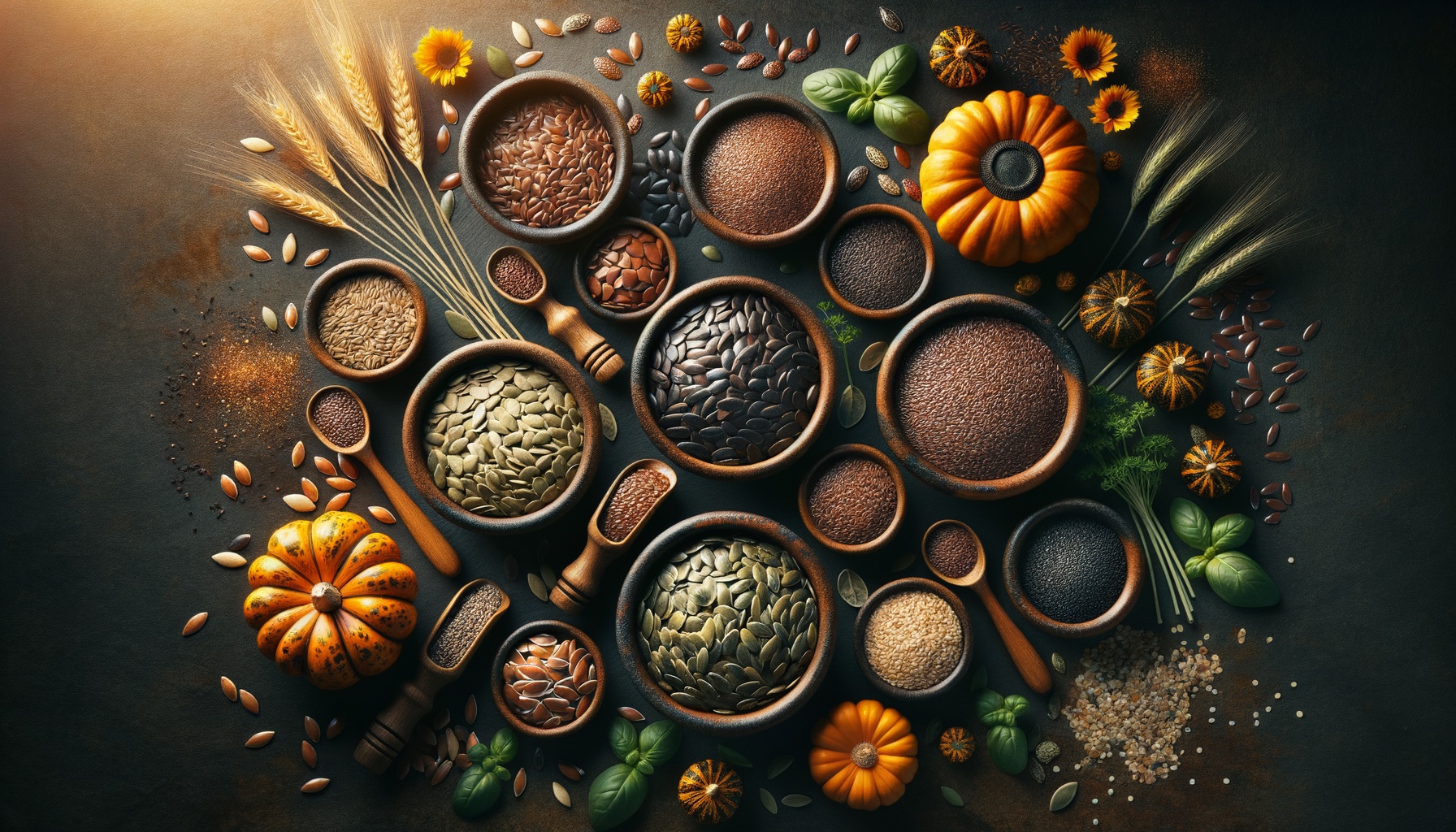
Seed Cycling: The Ancient Practice That Science Is Finally Catching Up To
Eat pumpkin and flax seeds in your follicular phase, sunflower and sesame in your luteal phase. It sounds too simple. But the lignans, zinc, selenium, and essential fatty acids in these seeds map surprisingly well onto what your hormones actually need.
Read moreSeed cycling is the practice of eating specific seeds during each phase of your menstrual cycle to support hormonal balance. Follicular phase (days 1–14): 1 tablespoon each of ground flax seeds and pumpkin seeds daily. Luteal phase (days 15–28): 1 tablespoon each of ground sunflower seeds and sesame seeds daily.
The wellness internet loves this practice. The medical establishment largely ignores it. The truth, as usual, is more interesting than either position.
The Biochemistry Behind It
Follicular phase seeds (flax + pumpkin):
- Flax seeds are the richest dietary source of lignans — phytoestrogens that can weakly bind to estrogen receptors. During the follicular phase, when estrogen is rising, lignans help modulate estrogen levels — boosting them if too low, blocking excess if too high. They act as selective estrogen receptor modulators (SERMs).
- Flax also provides ALA omega-3s, which reduce inflammation and support the prostaglandin balance needed for healthy ovulation.
- Pumpkin seeds are rich in zinc (essential for FSH and LH production) and magnesium (needed for over 300 enzymatic reactions including hormone synthesis).
Luteal phase seeds (sunflower + sesame):
- Sesame seeds contain the highest lignan content after flax — but different lignans (sesamin and sesamolin) that specifically support progesterone production and help block excess estrogen during the phase when the estrogen-to-progesterone ratio matters most.
- Sunflower seeds are rich in selenium (critical for thyroid hormone conversion and progesterone support) and vitamin E (shown to reduce PMS symptoms by 40% in clinical trials).
What the Evidence Actually Shows
Let's be honest: there are no large randomized controlled trials specifically on "seed cycling" as a named protocol. But there is strong evidence for the individual components:
- Flax seed supplementation (30g/day) was shown to reduce anovulatory cycles and lengthen the luteal phase in a Journal of Clinical Endocrinology & Metabolism study
- Zinc supplementation improves menstrual regularity in women with PCOS (multiple studies)
- Selenium supports healthy progesterone production via its role in corpus luteum function
- Vitamin E reduces prostaglandin F2-alpha, the compound responsible for menstrual cramps
- Omega-3 fatty acids reduce dysmenorrhea (painful periods) as effectively as ibuprofen in some studies
How to Actually Do It
- Days 1–14 (period through ovulation): 1 tbsp ground flax seeds + 1 tbsp ground pumpkin seeds. Add to smoothies, oatmeal, yogurt, or salads.
- Days 15–28 (ovulation through period): 1 tbsp ground sunflower seeds + 1 tbsp ground sesame seeds. Same methods.
- Grind fresh: Whole seeds pass through undigested. Grind in small batches, store in the fridge. Pre-ground flax oxidizes quickly.
- Give it 3 cycles: Hormonal changes don't happen overnight. Commit to 3 full cycles before evaluating.
- If you don't have regular cycles: Use the moon as a guide — new moon = day 1, full moon = ovulation. This gives your body a consistent pattern to work with.
"Seed cycling isn't magic. It's strategic micronutrient delivery timed to your body's shifting needs. We just happen to call it food instead of medicine." — Dr. Jolene Brighten, naturopathic endocrinologist

Boundaries Are Medicine: The Neuroscience of Saying No
Saying no activates the same neural circuits as physical self-defense. Women who set clear boundaries have measurably lower cortisol, better immune function, and report 40% less burnout. Here's why it's so hard — and why it's worth it.
Read moreIn 2023, researchers at UCLA published a study that shocked even veteran psychologists. They put participants in an fMRI scanner and asked them to imagine saying "no" to an unreasonable request from someone they cared about. The brain regions that activated were the anterior insula and dorsal anterior cingulate cortex — the same areas that light up during physical pain.
Setting boundaries literally hurts. And for women, socialized from childhood to prioritize others' comfort, it often hurts more.
Why Boundaries Are Harder for Women
This isn't weakness. It's neurobiology plus culture:
- Oxytocin response: Women produce more oxytocin in social situations than men. Oxytocin — the "bonding hormone" — creates a stronger neurochemical reward for maintaining social harmony and a stronger aversion to social conflict.
- Tend-and-befriend: While men's stress response is fight-or-flight, women's stress response (identified by Dr. Shelley Taylor at UCLA) is "tend-and-befriend" — seek safety through social connection. Setting a boundary feels like threatening that safety.
- Cultural conditioning: Girls are socialized to be accommodating, pleasant, and self-sacrificing. Studies show that girls who assert themselves are rated as "less likeable" by teachers and peers, while assertive boys are rated as "leaders." This creates a learned helplessness around boundary-setting that persists into adulthood.
- Hormonal sensitivity: In the luteal phase, when progesterone rises and GABA sensitivity increases, many women report feeling more emotionally porous — boundaries feel harder to maintain, and perceived rejection feels more intense.
What Happens in Your Body When You Don't Set Boundaries
Chronic boundary violations — saying yes when you mean no, absorbing others' emotions, overextending your time and energy — create a measurable physiological cascade:
- Cortisol remains chronically elevated (disrupting sleep, immunity, and menstrual regularity)
- The vagus nerve — your body's "calm down" nerve — loses tone, reducing your ability to self-regulate
- Pro-inflammatory cytokines increase (chronic low-grade inflammation)
- Telomeres shorten faster (biological aging accelerates)
- The prefrontal cortex — responsible for decision-making and self-advocacy — becomes less active, making it even harder to set boundaries. It's a vicious cycle.
Building the Boundary Muscle
Boundaries aren't walls. They're membranes — they let good things in and keep harmful things out. Like any skill, they strengthen with practice:
- Start small and low-stakes: "I can't make it tonight, but let's plan for next week." Practice with people who are safe and likely to respond well.
- Use the "sandwich" for difficult conversations: Warmth → boundary → warmth. "I love spending time with you. I need to leave by 8 tonight. Let's make the most of the time we have."
- Name the feeling, not the person: "I feel overwhelmed when plans change last-minute" instead of "You always change plans." This reduces defensiveness and keeps the focus on your need.
- Prepare for the guilt wave: After setting a boundary, you will likely feel guilty. This is the oxytocin system mourning the potential social rupture. It lasts about 20 minutes. Breathe through it. It passes.
- Track your energy: For one week, note every time you say yes reluctantly. Rate your energy at the end of each day (1–10). You'll see the correlation immediately.
Boundaries and Your Cycle
Your capacity for boundary-setting fluctuates with your hormones:
- Follicular phase + ovulation: Estrogen and testosterone rise together, boosting confidence and assertiveness. This is your strongest boundary window. Schedule difficult conversations here.
- Luteal phase: Progesterone increases emotional sensitivity. Boundaries feel harder but are arguably more needed. Pre-set boundaries during the follicular phase ("I always leave by 9 PM on weeknights") so you don't have to summon the courage in the moment.
- Premenstrual: This is when resentment surfaces — often about boundaries you didn't set earlier in the cycle. Use it as information, not ammunition. Journal what frustrated you and address it in the follicular phase.
"Daring to set boundaries is about having the courage to love ourselves, even when we risk disappointing others." — Brené Brown