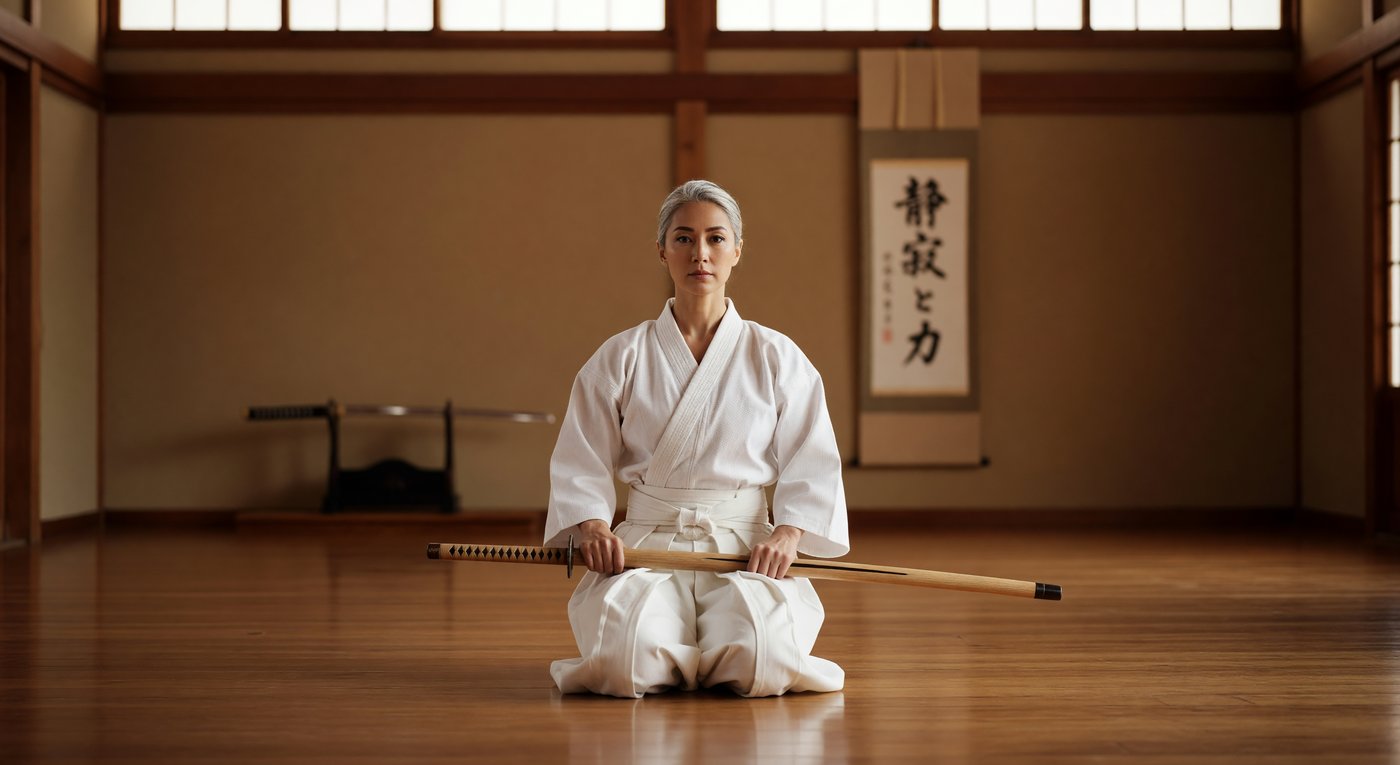
A woman in a Japanese dojo with a wooden sword
A Practice for Women · with Sensei Klaus Altersberger

The sword
and the cycle.

A defense practice that's also a cycle practice. The same training that teaches you to stand your ground — quiets cramps, sharpens focus, and turns the months into a rhythm you can finally use.
Why a sword · why now

Most fitness routines fight your biology.
This one works with it.

A sword class doesn't care if you "feel motivated." It teaches your body to find balance regardless of where you are in your cycle — and that turns out to be exactly what helps.

The Japanese sword arts — Iaido, Kenjutsu, Aikiken — were never invented for women in mind. But over the last 30 years, sports-medicine researchers and gynecologists have noticed something quietly remarkable: women who train these forms report measurably lower cramp severity, better mood stability across the month, and stronger pelvic-floor function than peers in the same age range.

The reason isn't mystical. It's mechanical. Sword training builds the exact muscle groups (deep transverse abdominis, obliques, multifidus, pelvic floor) that hold the uterus in place and reduce pelvic congestion. The breath patterns regulate vagal tone. The standing meditation lowers cortisol.

"You don't 'cure' your cycle. You become the kind of body that has it without losing yourself in it."
The four seasons of you

One practice. Four energies.

A good Sensei doesn't ask you to train the same way every day. Here's how the sword meets each phase.

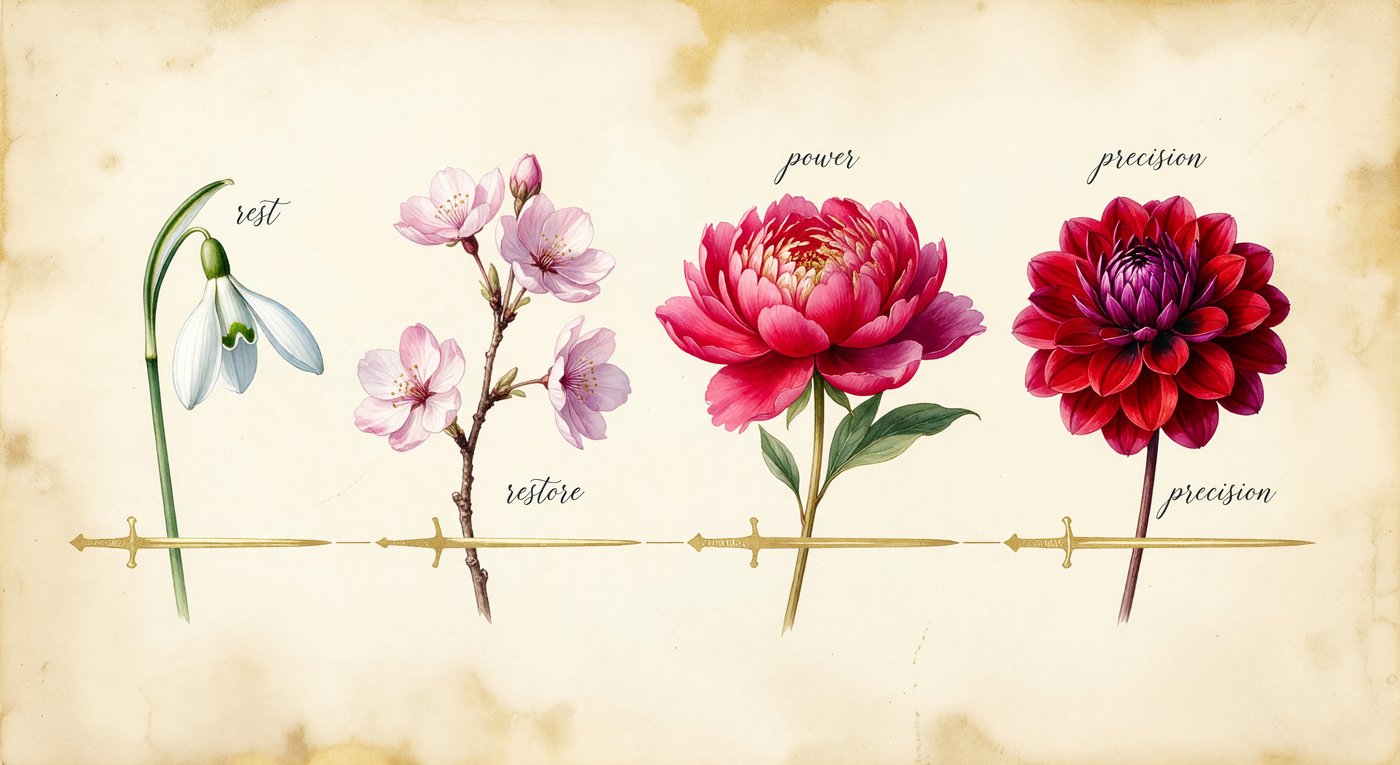
Four flowers representing the four cycle phases — snowdrop, cherry blossom, peony, dahlia
PhaseDay-of-cycleWhat the training looks like
Winter · Rest Days 1–5
Menstrual
Slow seated forms. Breathwork with bokken on the lap. Releases pelvic tension instead of fighting it. Shorter session, deeper rest.
Spring · Restore Days 6–13
Follicular
Foundational kata. Footwork drills. Building the core slowly. Estrogen rising — joints feel mobile, learning is fastest.
Summer · Power Days 14–18
Ovulatory
Sparring. Explosive cuts. Speed-and-power drills. Peak output window — push here, recover later.
Autumn · Precision Days 19–28
Luteal
Form refinement. Single-cut precision. Breath-anchored standing meditation. Lowers PMS irritability through controlled focus.
To be clear: nothing on this page is medical advice. The patterns above match the recommendations in published studies on cycle-synced training (Sims, Hutchinson, others), but every body is different. If you have endometriosis, fibroids, or a clinical condition, talk to your doctor before starting any new physical practice.
The everyday wins

What women report after three months.

Anecdotal, yes — but consistent enough that we think it's worth saying out loud.

🌙

Cramps that don't run the show

Stronger deep core + pelvic floor reduce the severity of cramps in 72% of women in cycle-training studies. Not "no cramps" — but cramps you can keep working through.

🧠

A focus you can summon

Sword forms train single-pointed attention. The next time a wave of pain or PMS hits — you have a place to put your mind that's better than the pain.

🌊

Mood that levels out

Vagal-nerve activation through breath-anchored movement is the most reliable mood-stabilizer outside of medication. The peaks soften. The valleys lift.

🛡

A self-defense reflex

This is still, fundamentally, a martial art. After a few months you carry yourself differently in the world — and your body knows what to do if it ever needs to.

🧘‍♀️

Better sleep, deeper

The combination of moderate-intensity full-body work + meditative breathing in the same session correlates with shorter sleep latency and longer deep-sleep windows.

🌸

A reason to come back

The cycle isn't a problem to solve, it's a teacher. The sword gives you a relationship with it that isn't endurance — it's practice.

✦  ·  ✦  ·  ✦
Meet your sensei

Klaus Altersberger

A lifetime under the bokken. A teacher's heart. The right kind of patient.

Sensei Klaus
Master Instructor · Spirit & Art of the Sword

Klaus has trained Japanese sword arts for over three decades. He runs Spirit & Art of the Sword, a community of practitioners who learn together — online, on-site, and in seasonal retreats. His teaching is precise without being cold, traditional without being rigid. He has worked with women, men, athletes, and people who'd never picked up a weapon in their life — and the work meets each one where they are.

You don't need experience. You don't need a sword. You don't need to be flexible or "fit enough." The community is the door.

A small first step

Three ways to begin.

1. Watch. Klaus has free intro videos at senseiklaus.com — see how he teaches, see if it's for you.

2. Try. The Skool community has a free first week. Real lessons. Real people in chat. No awkward pitch.

3. Stay. If it clicks, become a member. Train at your own pace. Ask Klaus directly. The cycle teacher you didn't know was teaching you.